
When you’re facing a potential cancer diagnosis, the last thing you want to worry about is money. But for many, the question of cost is unavoidable and can add a huge amount of stress. It's important to know from the outset that there's no single price tag for private cancer treatment in the UK. The final figure is built from many different elements, from your first meeting with a specialist to the last follow-up appointment.
Broadly speaking, you might see major surgical procedures costing anywhere from £5,000 to £17,000. However, a full course of treatment, including diagnostics and therapies, can easily run into the tens of thousands.
Understanding the Journey of Private Cancer Treatment Costs
Think of paying for private cancer care less like buying a product off a shelf and more like funding a journey. Each step you take along your personal 'treatment pathway' comes with its own specific cost. My aim here is to break down that journey for you, piece by piece, so you can replace any financial uncertainty with clear, straightforward information. I want you to feel confident and in control as you navigate your options.
The financial path is often broken down into three core stages: the initial consultation, the diagnostic tests, and the treatment itself. This chart gives you a good visual sense of how the costs are typically distributed.
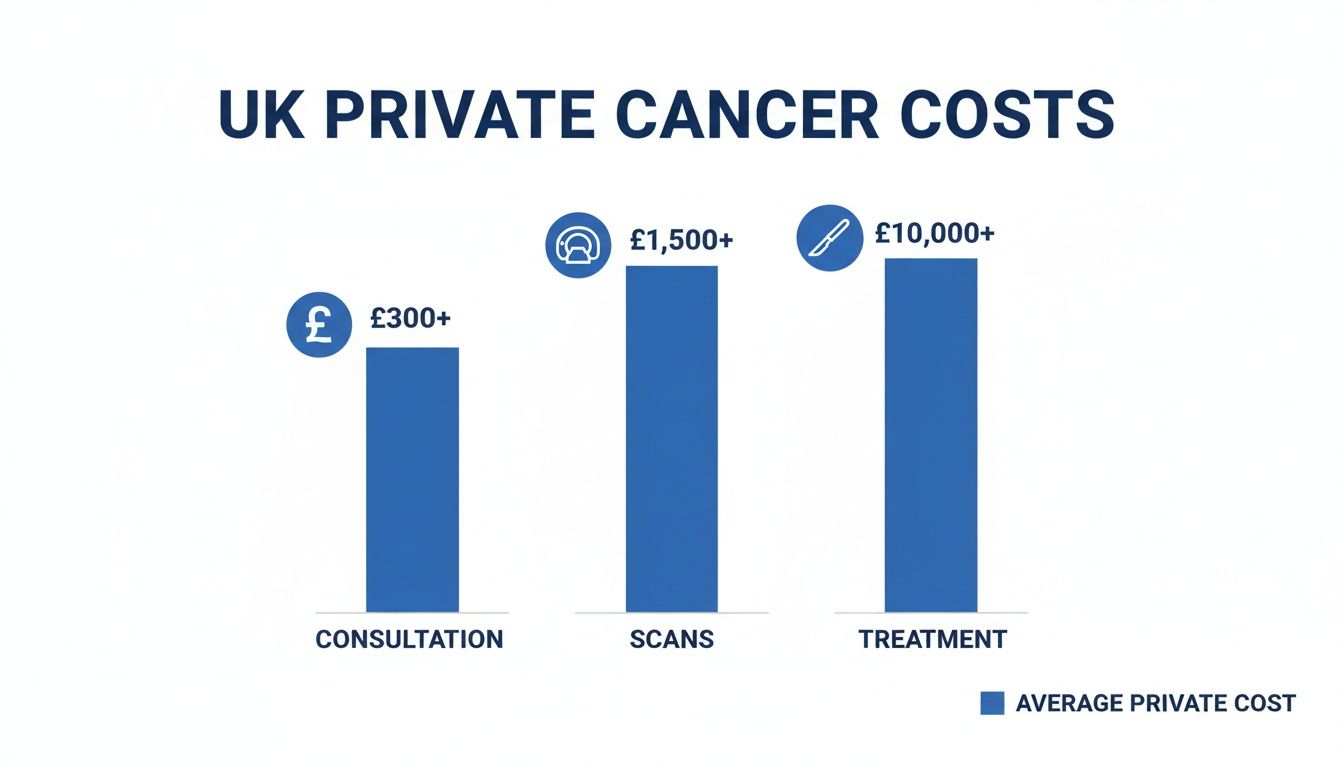
As you can see, while the consultation and scans are the first hurdles, the bulk of the expense comes from the treatment phase. This is the part that covers the surgery, your hospital stay, and any other therapies you might need afterwards.
The Building Blocks of Your Bill
So, what exactly are you paying for? Your final bill is a bit like an itemised receipt, with several key components that add up to the total. Getting to grips with these helps you understand where the money is going at every single stage.
- Consultant Fees: This is the charge for your specialist's time and expertise. It covers your initial meetings, any follow-up appointments, and the detailed planning of your treatment.
- Diagnostic Tests: Before any treatment can be planned, we need a precise diagnosis. This means things like CT or MRI scans, and often biopsies, all of which are billed as separate items.
- Hospital and Procedure Fees: This is almost always the largest part of the bill. It covers the surgery itself, the anaesthetist's fee, the use of the operating theatre, and the cost of your room during your inpatient stay.
- Follow-Up Care: Your care doesn't end when you leave the hospital. The cost of post-operative appointments and any ongoing monitoring is also factored into the overall expense.
To give you a clearer idea, here's a quick summary of what you might expect to pay at different stages if you're funding your own care.
At a Glance Typical Costs for Private Cancer Treatment Stages
| Treatment Stage | Typical Self-Pay Cost Range (UK) |
|---|---|
| Initial Consultation | £250 – £400 |
| Diagnostic Scans (e.g., CT, MRI) | £500 – £2,000 per scan |
| Biopsy Procedures | £1,500 – £4,000 |
| Thoracic Surgery | £8,000 – £17,000+ |
| Chemotherapy/Radiotherapy | £15,000 – £50,000+ per course |
| Follow-Up Consultation | £150 – £250 |
These figures are, of course, estimates and can vary quite a bit depending on your specific needs and the hospital you choose.
Getting your head around these costs is vital, particularly when you're looking at a specific operation. You can dive deeper into this by reading my detailed guide on understanding the real thoracic surgery cost in the UK.
For a wider view on how to budget for private healthcare and the different factors that influence costs, this article on Expat Medical Insurance Cost: A Clear Guide to Budgeting Abroad offers some really valuable insights. By breaking down each charge, you can face your treatment plan with a much clearer financial outlook.
A Patient's Journey Through Private Thoracic Cancer Care
To really get to grips with the cost of private cancer treatment in the UK, it helps to look past the spreadsheets and follow a real story. Numbers on a page can feel abstract and cold, but walking through a patient's journey brings the whole process—the decisions, the emotions, and the financial weight—into sharp focus. Let’s follow the path of ‘David’, a patient who recently navigated a thoracic cancer diagnosis and shared his story.

David's story started with a nagging cough and a worrying shortness of breath. His GP referred him for an X-ray, which came back with concerning results. Suddenly, he was facing a potentially long wait for further tests on the NHS, and the uncertainty was becoming unbearable for him and his family. This is the very point where many people, just like David, start to consider the private route.
The First Step: Consultation and Diagnosis
Wanting answers quickly, David decided to pay for an initial private consultation himself. He booked an appointment with a thoracic specialist and was seen within just three days. That first meeting cost him £300.
During the consultation, the specialist laid out the next steps: an urgent CT scan and a biopsy to get a definitive diagnosis. For David, the sheer speed of private diagnostics made all the difference. The CT scan was arranged for the very next day, at a cost of around £850, and the biopsy was booked for two days after that, costing approximately £2,500.
Within a single week, David had gone from a state of anxious uncertainty to having a confirmed diagnosis and a clear understanding of what he was facing. While this rapid timeline came with costs totalling over £3,600, the psychological relief was immense, and it meant his treatment could be planned right away.
This initial phase really highlights one of the core benefits of private care: speed. For David, paying for this diagnostic stage meant he could skip weeks of waiting, something he felt was invaluable for his peace of mind.
Facing the Treatment Quote
With a clear diagnosis, the conversation turned to treatment. David's consultant recommended minimally invasive keyhole surgery—a video-assisted thoracoscopic surgery (VATS) lobectomy.
A few days later, a detailed quote arrived. This is often the most sobering moment in the journey, as the figures can be quite confronting. The quote was broken down into several key parts:
- Surgeon's Fee: Covering the specialist's time and expertise in performing the operation.
- Anaesthetist's Fee: A separate charge for the anaesthesiologist who would manage his care during surgery.
- Hospital 'Package' Fee: An all-inclusive price covering the operating theatre, nursing care, a standard three-night stay, medications, and meals.
The total estimated cost for the surgical package came to £16,500. David was fortunate enough to have savings for an emergency, but seeing that final number was still a shock. He took a day to go over the quote with his family, carefully weighing the financial hit against the clear benefits of fast, specialised care.
In the end, the ability to have his chosen specialist perform the surgery within two weeks was the deciding factor. David's story helps ground all the financial data in a real, human experience, making the complex process feel that much more understandable as you consider your own path.
Breaking Down The Bill: What Are You Actually Paying For?
Looking at a quote for private medical treatment can feel a bit like trying to read a foreign language. The numbers are often daunting, the terminology is clinical, and it’s not always immediately obvious what each line item actually covers. Let's pull back the curtain and piece it all together, so you know exactly what you’re paying for at every step of your cancer care journey.

Think of it like commissioning a bespoke piece of furniture. You're not just paying a single price for "a cabinet"; you’re paying for the designer’s expertise, the raw materials, the skilled craftsmanship, and the final delivery and installation. Each component is vital to the end result, and medical care works in much the same way.
Let's break down these "building blocks" of your bill.
The Foundation: The Consultation and Diagnostic Phase
Before any treatment can even be considered, your specialist needs a crystal-clear picture of what’s going on. This initial fact-finding stage is the foundation of your entire care plan, and it involves several key costs that are typically billed separately.
- Initial Consultant Fee: This is your first and most important investment. You're paying for a top specialist's time, their years of experience, and the highly trained expertise needed to make an accurate assessment of your case. This fee almost always covers a detailed conversation about your symptoms and medical history, plus a physical examination.
- Diagnostic Scans: To see inside your body, we rely on incredible technology. You might need a CT scan, an MRI, or a PET scan. Each one is a separate cost, covering the use of the advanced equipment itself and, crucially, the time of an expert radiologist who interprets the images.
- Biopsy Procedures: Scans can flag an area of concern, but a biopsy is what provides a definitive diagnosis. This charge covers the procedure to obtain a tissue sample—whether a simple needle biopsy or a more involved surgical one—and the detailed laboratory analysis by a pathologist.
Getting these fundamental steps done quickly and accurately is one of the main reasons people choose the private route.
The Main Structure: The Surgical Package
If surgery is part of your treatment plan, this will almost certainly be the biggest single item on your bill. It’s often presented as a ‘package price’—think of this as the main frame of the house being built.
A typical surgical package for a thoracic procedure bundles the core elements of the operation into one figure. It’s designed to cover the main event of your hospital stay.
A package price simplifies the billing process by combining the major costs of an operation. It usually includes the surgeon's fee, the anaesthetist's fee, use of the operating theatre, and a specified number of nights in hospital for recovery. It's absolutely crucial, however, to ask what is not included to avoid any surprises later.
For example, your package might cover a three-night hospital stay. If your recovery takes a little longer and you need an extra day of care, that additional night will likely be billed separately. For those with insurance, fully understanding your health insurance's out-of-pocket maximum is key to knowing where these boundaries lie.
The Finishing Touches: Adjuvant Therapies and Follow-Up Care
Your care doesn't end when you leave the operating theatre. The next steps are the "finishing touches" that ensure the best possible long-term outcome, and these also contribute to the overall cost of private cancer treatment in the UK.
This stage can include adjuvant therapies like chemotherapy or radiotherapy, which are used to target any cancer cells that might remain. These treatments are almost always billed separately from any surgical package. For patients funding their own care, an initial oncology consultation might be £200 to £500, while major surgery could range from £5,000 to £17,000. A course of radiotherapy, for instance, could cost between £3,000 and £6,000.
Finally, your follow-up consultations with your surgeon are also part of the final bill. These appointments are vital for monitoring your recovery, discussing the final pathology results from your surgery, and mapping out the next steps for your long-term health. Every single one of these "bricks" is essential for building a solid, comprehensive plan for your care.
Navigating Your Payment Options: Self-Pay vs. Insurance
Once you have a better picture of the potential costs, the next big question is, "How do I pay for this?" For most people heading down the private route, there are two main avenues: paying for everything yourself, which we call 'self-pay', or using a private medical insurance (PMI) policy.
Neither path is inherently better than the other; they just work differently. The right choice really comes down to your own financial situation and what feels most manageable for you. Let's take a look at both, so you can weigh things up properly.
Comparing Self-Pay and Private Medical Insurance
To make things clearer, it helps to see the two options side-by-side. Think of it as a trade-off between control and financial risk.
| Feature | Self-Pay | Private Medical Insurance |
|---|---|---|
| Control & Choice | Total freedom. You choose any consultant or hospital you want. | Restricted choice. You must use consultants and hospitals on your insurer's approved list. |
| Speed | Immediate. You can book appointments and procedures straight away. | Slight delays. You need pre-authorisation from your insurer before proceeding. |
| Financial Responsibility | Full responsibility. You cover all costs, including any unexpected ones. | Shared responsibility. The insurer covers costs up to your policy limit, minus your excess. |
| Cost Transparency | Often very clear. Hospitals provide fixed-price packages for procedures. | More complex. You need to understand policy limits, excesses, and specific exclusions. |
| Simplicity | Straightforward. You deal directly with the hospital's finance team. | Administrative. Requires communication and paperwork between you, the clinic, and the insurer. |
Ultimately, self-pay gives you maximum control and speed, but you shoulder all the financial weight. Insurance provides a crucial financial safety net but comes with more rules and potential limitations.
The Self-Pay Pathway
Opting to fund your own treatment puts you firmly in the driver's seat. It's the most direct and often the fastest way to get the care you need, without having to navigate an insurer's administrative hoops.
The real appeal here is speed and simplicity. When you're anxious for answers, you can book a consultation or schedule a scan immediately. There's no waiting around for pre-authorisation codes or approvals.
You also have total freedom of choice. You can see any consultant at any hospital, without worrying if they are on an insurer’s 'approved' list. For many, this control is incredibly reassuring. You'll often deal directly with the hospital's finance team, who can provide fixed-price packages that give you a clear, upfront understanding of what you'll be paying.
Of course, the major consideration is that the financial buck stops with you. You need to have the funds readily available, and it's wise to have a contingency for any unexpected costs that might pop up if your treatment plan changes.
Using Private Medical Insurance
If you have a PMI policy, its entire purpose is to act as a financial buffer. It’s there to absorb the high costs of private treatment, shielding you from a direct and significant financial hit.
The core idea behind private medical insurance is to take the money worries off the table, so you can pour all your energy into getting better. It provides peace of mind that the bills for consultations, scans, surgery, and other treatments are taken care of, within the terms of your policy.
However, using insurance isn't just a case of handing over your policy number. You need to get familiar with the specifics of your plan:
- Policy Limits and Excesses: Nearly all policies have an annual financial cap and an 'excess' – the fixed amount you have to pay towards any claim. Make sure you know exactly what these figures are.
- Oncology Cover Specifics: Don't assume everything is covered. Some policies are fantastic and comprehensive, while others might have restrictions on newer drugs or certain types of therapy.
- The Authorisation Process: Your insurer will need to approve each stage of your treatment before it happens. This is standard procedure, but it can sometimes add a short delay.
It is absolutely vital to speak with your insurer early on. For a step-by-step guide on what to ask, have a look at our advice on how to verify your insurance for treatment with Mr Scarci.
The Cost of Having Insurance
This financial protection, naturally, comes at a price. In the UK, monthly insurance premiums can vary quite a bit depending on your age and where you live. Looking at 2025 market data, the average premium for an adult is about £79.59 per month.
Premiums rise with age. For someone in their 60s needing comprehensive cover, you could be looking at £130 to £220 per month, especially in a major city like London.
In the end, whether you choose to self-pay or use insurance, the objective is the same: getting the best care, quickly. By thinking through these two pathways, you can make an informed choice that aligns with your finances and gives you the support you need.
How to Get an Accurate Quote and Manage Treatment Costs
Figuring out the financial side of private cancer care can feel overwhelming, but getting a firm grip on the numbers is the first step towards feeling in control. An accurate, detailed quote isn't just about the final price tag; it’s about understanding exactly what you're paying for, so there are no stressful surprises later on.
The best approach is to be direct and ask very specific questions. When you're given a cost estimate, particularly for surgery, it often comes as a ‘package price’. While helpful, the devil is always in the detail. Your first move should be to ask for a fully itemised breakdown.
Essential Questions for Your Consultant's Office
Think of this as managing a project – your own healthcare. To keep the budget on track, you need to know precisely what's included. Get a list of questions ready so you have all the facts to make clear-headed decisions.
Here are the crucial questions to ask:
- What does this package price actually include? Request a line-by-line list covering the surgeon’s fee, the anaesthetist’s fee, a set number of nights in the hospital, and standard medications.
- What is specifically not included? This is just as important. Does the price cover your first consultation, any pre-op scans, or blood tests? What about medications to take home or any medical equipment you might need for recovery?
- What if I need to stay in the hospital longer than expected? Complications are thankfully rare, but it’s smart to know the daily rate for any extra nights you might need.
- How are follow-up appointments charged? Check if your post-surgery check-ups are part of the package or if they’ll be billed as separate costs.
The aim here is to turn a vague estimate into a solid financial plan. Any good clinic will be happy to give you this level of detail – transparency is a huge part of excellent patient care. Don't ever feel awkward about asking for more clarification if something isn't crystal clear.
From Estimate to Action Plan
Once you have that detailed quote in hand, you can build a proper budget. With something like thoracic surgery, knowing all the variables is key. To help you get a clearer picture of the potential costs, you can use online tools as a starting point. For example, our London private thoracic surgery cost estimator can give you a preliminary idea of the figures involved.
This initial research gives you the power to compare your options and plan your finances. Whether you're paying yourself or going through an insurer, a clear, itemised quote is the best tool you have for managing the cost of private cancer treatment in the UK. It breaks a large, intimidating number down into understandable parts, putting you firmly back in the driver's seat.
Answering Your Key Questions About Private Cancer Care Costs
When you're looking into private cancer treatment, the financial side of things can throw up a lot of questions. It's completely normal to want to understand every detail. This last section is all about giving you clear, straightforward answers to the most common queries I hear from patients and their families. My hope is to clear up any lingering uncertainties so you can feel confident about the path ahead.
How Quickly Can I Start Treatment Privately?
This is often the first thing people ask, and for good reason. The speed of private care is one of its biggest draws. For patients, getting answers and starting treatment quickly can provide enormous relief, cutting through the anxiety that comes with waiting.
In most cases, you can get an initial consultation with a specialist within a few days of your enquiry. Diagnostic tests, like a crucial CT or MRI scan, are usually done within 24 to 48 hours. If surgery is the next step, we can often schedule it for within one to two weeks. This rapid pathway is a huge part of why many people decide to explore the cost of private cancer treatment in the UK.
Are Surgical Package Prices All-Inclusive?
This is a vital question to ask before you commit to anything. While a 'package price' sounds simple, it’s rarely a catch-all for every single cost. Understanding exactly what’s covered—and what’s not—is the key to avoiding any nasty surprises later on.
A typical surgical package will cover the core elements of the operation itself:
- The surgeon’s fee for performing the procedure.
- The anaesthetist’s fee for looking after you during the surgery.
- The hospital fees, which include the operating theatre and a set number of nights to recover.
- Standard nursing care and any medicines you’re given during your stay.
What’s often not included are things like the initial consultation, the diagnostic scans needed beforehand, or any costs that come from complications—like needing to stay in hospital for a few extra days. Always, always ask for a detailed, itemised list of what’s in the package and, just as importantly, what’s considered an extra.
What if My Treatment Costs Exceed My Insurance Limit?
This is a very common worry for patients using private medical insurance. Most policies have an annual financial cap. And while many offer generous or even unlimited cancer cover, you absolutely must check the fine print of your specific policy before you start.
If it looks like your treatment plan will cost more than your policy’s limit, you’ll have to cover the difference yourself. The best thing to do is get a pre-authorisation from your insurer. They will look at the treatment plan I’ve proposed and confirm in writing exactly what they will pay for. If it looks like there will be a shortfall, you can then make a plan to self-fund the rest or we can discuss other options.
Can I Combine Private Care with NHS Treatment?
Yes, absolutely. Creating a 'hybrid' care plan is actually very common and can be a brilliant way to manage costs while still getting the speed of the private sector where it counts most.
For instance, you might decide to pay for a private consultation and all the initial diagnostic tests to get a swift, accurate diagnosis. Armed with that information, you could then choose to have your main treatment, like surgery or chemotherapy, on the NHS. Another common approach is having your primary care on the NHS but choosing to pay privately for a specific drug or therapy that isn't available through the public system. The trick to making this work is clear and open communication between your private specialist and your NHS team to ensure your care is seamless.
At Marco Scarci Thoracic Surgery, I firmly believe that clear information is the first step towards feeling in control of your health. If you have any more questions or want to talk through your options for private thoracic care in London, please don’t hesitate to get in touch. You can learn more about my approach and services at https://marcoscarci.co.uk.

