
Pleural Effusion · Pleural Biopsy · Pleurodesis · London
Fluid around the lung shouldn’t mean months of uncertainty and unanswered questions.
Whether you’re here because fluid keeps returning, because a scan has shown something unexpected, or because you simply need a definitive diagnosis — this guide explains exactly what a pleural biopsy and pleurodesis are, what to expect, and how to get the right answer, fast.

For patients with fluid around the lung
Get a clear diagnosis and the right treatment, without the wait.
If you’re reading this, you’ve probably already been through something frightening. A breathlessness that arrived from nowhere. A hospital visit. An X-ray or CT scan that showed fluid building up around your lung. Perhaps it’s happened more than once. Perhaps you’ve been discharged from A&E with no clear explanation and no plan.
The uncertainty is, for many patients, harder than the symptoms themselves. What is causing the fluid? Could it be cancer? Will it come back? Is there something that can actually fix it?
“The most common thing patients say to me when they finally get an appointment is: ‘I just want to know what’s going on.’ That’s exactly what these procedures are designed to answer — and resolve.”
A pleural biopsy gives you a diagnosis — a definitive tissue answer to what’s causing the problem. A pleurodesis can end the cycle of recurring fluid or air accumulation for good, with success rates exceeding 90%.
Speak with Mr Scarci
Whether you have unexplained fluid or need a second opinion, a consultation gives you a clear picture of your options and what treatment can offer you.
 Call 020 7459 4367
“I had fluid drained three times over five months and nobody could tell me why it kept coming back. Mr Scarci did a VATS biopsy and pleurodesis in the same operation. Within weeks I was breathing better than I had in over a year — and I finally had an answer about what was causing it.”
Understanding the procedures
Two procedures. Two purposes. Often performed together.
A pleural biopsy tells you why. Pleurodesis makes sure it doesn’t keep happening.
Pleural Biopsy
A pleural biopsy takes a small tissue sample from the lining of the lung (the pleura) to identify exactly what is causing abnormal fluid, thickening, or other changes. It answers the question doctors — and patients — most need answered: what is this, and what does it mean for treatment?
Used for: unexplained pleural effusion, suspected cancer, mesothelioma, TB, inflammation
Pleurodesis
Pleurodesis is a procedure that permanently seals the space between the lung and the chest wall — eliminating the gap where fluid or air repeatedly accumulates. By causing the two pleural layers to adhere together, it prevents the problem from returning. Success rates exceed 90%.
Used for: recurrent pleural effusion, malignant pleural effusion, recurrent pneumothorax
What every patient should know before their first appointment
The pleura — what it is and why it matters
Two layers, one critical space
The pleura is a delicate two-layer membrane that wraps around each lung and lines the inside of the chest wall. Between these two layers — the visceral pleura (lung surface) and the parietal pleura (chest wall lining) — is a tiny space that allows smooth, friction-free breathing with every breath you take.
When fluid builds up in this pleural space (pleural effusion), it compresses the lung from outside, causing breathlessness, chest heaviness, and fatigue. When air accumulates there (pneumothorax), the lung collapses. In either case, the pleural space has become the problem — and these procedures directly address it.
Think of it like this: a balloon (your lung) inside a sealed box (your chest). Normally the balloon fills the box perfectly. Pour water into the box, and the balloon shrinks and can’t inflate properly. A biopsy samples the box wall. Pleurodesis seals the box so nothing can accumulate again.
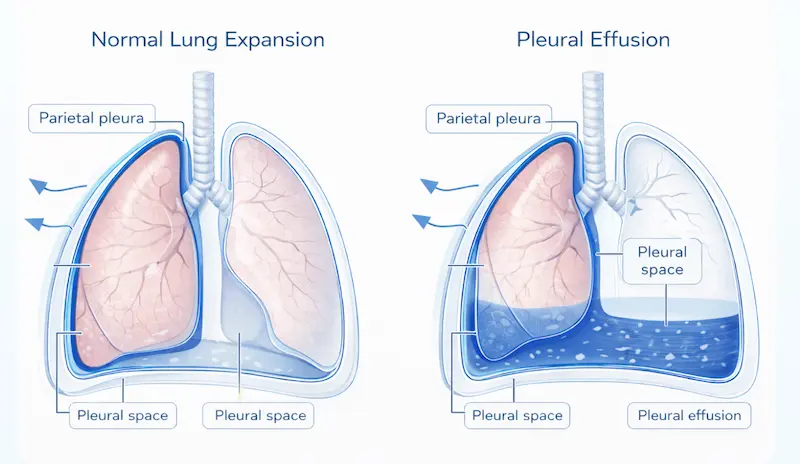
When is a pleural biopsy recommended?
Why your doctor has suggested a pleural biopsy
A recommendation for a biopsy is not a sentence — it is your medical team being thorough. It means they want certainty, not guesswork, before deciding on treatment.
Unexplained pleural effusion
Fluid has built up around the lung, but the cause is unclear after initial tests. A biopsy identifies whether this is infection, inflammation, cancer, or another condition — and determines the right treatment pathway.
→ Guides targeted treatment, avoiding months of trial and error
Suspected malignant pleural disease
If imaging or fluid analysis suggests cancer may be involved — lung cancer, mesothelioma, or metastatic disease — a pleural biopsy provides the tissue diagnosis that oncologists need before treatment can begin.
→ Definitive diagnosis; enables staging and treatment planning
History of asbestos exposure
Patients with a history of occupational asbestos exposure are at risk of mesothelioma. If thickening or fluid is found, a biopsy is essential for definitive diagnosis. Early, accurate diagnosis is your most valuable asset.
→ Mesothelioma diagnosis, legal documentation, specialist referral
Ruling out serious infection (TB)
Tuberculosis can cause pleural effusion and pleural thickening. A biopsy quickly confirms or excludes this — and a TB diagnosis leads directly to a cure with antibiotics.
→ Diagnosis of treatable infection → targeted antibiotic therapy
Recurrent pleural effusion
If fluid keeps returning after repeated drainage, a biopsy identifies why — so that the underlying condition can be treated, and pleurodesis can be planned to prevent further recurrence.
→ Breaks the cycle of recurring hospital admissions
Tissue for molecular profiling
Pleural biopsy provides tissue for genetic and receptor analysis (PDL1, EGFR, ALK) that determines which systemic treatments are likely to work — information that cannot be obtained any other way.
→ Enables precision oncology; avoids ineffective treatments
How a pleural biopsy is performed
There are two main approaches. The right one depends on what is being looked for, the results of initial tests, and your overall health.
CT or Ultrasound-Guided Needle Biopsy
A thin needle is guided to the precise location using real-time ultrasound or CT imaging. Performed under local anaesthetic, usually as a day-case procedure. Appropriate for accessible pleural thickening or effusion where imaging has clearly identified a target. Diagnostic yield is moderate — adequate for many cases, but not always sufficient for complex or subtle disease.
VATS Pleural Biopsy — Video-Assisted Thoracoscopic Surgery
VATS is the most accurate and effective method for pleural biopsy, with the highest diagnostic yield of any technique. Under general anaesthetic, a small camera is introduced through one or two tiny incisions, allowing direct visual inspection of the entire pleural surface. Multiple targeted biopsies are taken under direct vision. When pleurodesis is also planned, it is performed simultaneously — one anaesthetic, one recovery, two goals achieved.
Why VATS biopsy sets the standard
No other technique gives a surgeon what VATS gives them: a direct view of the pleural surface, the ability to take multiple targeted samples, and the option to perform pleurodesis at the same time if appropriate.
Discuss your case with Mr Scarci →Pleurodesis — the definitive solution for recurrent pleural effusion
If fluid or air keeps coming back, drainage alone is not a solution — it is a delay. Pleurodesis permanently eliminates the space where the problem occurs.
How pleurodesis works — in plain English
Between your lung and the chest wall is a space — the pleural cavity — where fluid or air can accumulate. Pleurodesis works by deliberately causing the two lining surfaces to adhere permanently together, effectively sealing that space.
Think of it like applying adhesive between two surfaces: once they bond together, there is no longer a cavity for fluid to fill. The “controlled inflammation” that achieves this is a carefully managed, therapeutic process — not a harmful response. The procedure has been performed for decades with a well-established safety record.
Types of pleurodesis
Talc Pleurodesis (Talc Poudrage)
Medical-grade sterile talc is introduced into the pleural space through a thoracoscope (VATS) as a fine powder spray. This achieves the highest and most uniform distribution across the pleural surface. Medical-grade talc has been used safely for this purpose for over 50 years.
✓ Success rate exceeding 90% in preventing recurrent effusion
Talc Slurry via Chest Drain
Talc mixed with saline solution is instilled through an existing chest drain — without requiring general anaesthetic or keyhole surgery. A less invasive option when surgery is not appropriate.
Good results — preferred for patients unsuitable for general anaesthetic
Mechanical Pleurodesis (VATS)
Physical abrasion of the pleural surfaces during thoracoscopy encourages the two layers to adhere without chemical agents. Often combined with talc poudrage for maximum effectiveness.
Preferred when biopsy and treatment are planned together
When pleurodesis is not possible: Indwelling Pleural Catheter (IPC)
If the lung remains partially trapped after drainage (non-expandable lung), pleurodesis cannot be performed effectively. In this situation, an indwelling pleural catheter (IPC) is the preferred approach — a small, soft tube tunnelled beneath the skin, allowing regular drainage at home without repeated hospital admissions. The 2023 BTS guidelines now recommend IPC as a first-line option for malignant pleural effusion alongside pleurodesis, based on patient preference and clinical circumstances.
Patients who benefit most from private pleural biopsy or pleurodesis
Private thoracic surgery means being seen by the right specialist, within days — not waiting months on an NHS waiting list while fluid keeps returning or a diagnosis remains unconfirmed.
Recurrent pleural effusion — fluid that keeps coming back
If you have had fluid drained two or more times without a definitive cause or prevention plan, pleurodesis is the appropriate next step. Repeated drainage is not a solution — it is a cycle that can be broken.
Undiagnosed pleural effusion — fluid with no confirmed cause
If tests so far have not identified why fluid is present, a VATS pleural biopsy provides the most accurate diagnostic answer. Uncertainty is not acceptable when effective treatment depends on an accurate diagnosis.
Malignant pleural effusion — cancer-related fluid
Fluid caused by cancer — lung cancer, mesothelioma, breast cancer, lymphoma — requires both diagnosis confirmation and a definitive plan. VATS biopsy and talc pleurodesis can be combined in one procedure.
Recurrent pneumothorax — collapsed lung that keeps returning
Pleurodesis is also used to prevent recurrence of pneumothorax — particularly in patients who have had two or more episodes. Combined with VATS, it offers a durable, definitive solution.
Asbestos exposure with pleural thickening or fluid
If you have a history of asbestos exposure and have developed pleural changes, an urgent accurate biopsy is essential — both for diagnosis and for any medicolegal or compensation claim you may need to pursue.
Second opinion — uncertain about the plan you’ve been given
If you’ve been told to “watch and wait” or are unsure whether surgery has been recommended appropriately, Mr Scarci offers expert second opinions on pleural disease.
What to expect — from first appointment to full recovery
Most patients tell us the anticipation is far worse than the procedure itself. Here is exactly what happens at each stage.
Your First Consultation
Mr Scarci reviews your CT scan, any existing biopsy results, blood tests, and clinical history in advance. At consultation, he explains the findings clearly, recommends the most appropriate procedure, and answers every question you have. You leave the appointment knowing exactly what will happen, why, and when.
The Procedure Itself
VATS procedures take approximately 45–90 minutes under general anaesthetic. You will feel nothing. The team monitors you throughout. If biopsy and pleurodesis are being performed together, both are completed in a single operation.
Recovery in Hospital
After VATS, a chest drain remains in place for 1–3 days to allow the lung to re-expand fully. Pain is well managed with medication tailored to your needs. Early mobilisation from the first day is encouraged. Most patients are ready to go home within 1–3 days after VATS.
Recovery at Home & Follow-Up
Mild discomfort at the incision sites and fatigue in the first 1–2 weeks are normal. Mr Scarci discusses results personally with you — you will not be left to interpret a letter alone.
Recovery timeline after VATS pleurodesis
VATS under general anaesthetic. Biopsy + pleurodesis if indicated.
Chest drain in situ. Walking from day one.
Light activity. Wound check. Biopsy results reviewed.
Breathing improved. Return to normal activity confirmed at review.
Why patients choose Mr Scarci
Private pleural care — without the wait, without the uncertainty.
When diagnosis and treatment are urgent, private thoracic surgery means being seen by the right expert within days — not months.
Subspecialty pleural expertise
Mr Scarci performs thoracic procedures exclusively. Pleural biopsy and pleurodesis are a core part of his practice, performed to the highest standard.
Seen within days, not months
Most patients are seen within one week of contact. When a diagnosis is needed urgently — or fluid is affecting your daily life — that speed matters.
Direct access to your surgeon
You speak with Mr Scarci, not a relay of secretaries. Questions between appointments are answered promptly and personally.
Insurance navigation built in
Pre-authorisation, insurer communication, and claims are managed by the team on your behalf — so you can focus entirely on your health.
Results explained personally
Biopsy results are reviewed with you in detail — you will never be left to interpret a letter alone or wait weeks for a follow-up appointment.
Five London locations
The London Clinic, Bupa Cromwell, The Wellington Hospital, HCA Elstree, and Imperial Private Healthcare. Surgery at your most convenient site.
Frequently asked questions
Clear, honest answers to the questions patients ask most often before their first consultation.
Get a clear answer about your pleural condition — within one week.
Unexplained fluid. Recurring effusion. A diagnosis you’re uncertain about. Mr Scarci sees new patients within one week, reviews existing imaging before your appointment, and explains findings clearly. No GP referral needed.
