
Diaphragmatic Plication · Phrenic Nerve Palsy · Minimally Invasive · London
Your diaphragm has stopped working. There is a surgical fix.
Diaphragmatic plication is a keyhole operation that corrects a paralysed or severely weakened diaphragm — restoring breathing mechanics, relieving breathlessness, and removing the need for long-term ventilatory support in selected patients. Mr Marco Scarci performs this procedure using minimally invasive VATS or robotic techniques, with a typical hospital stay of 2–3 days.

For patients living with unexplained or untreated breathlessness
Breathlessness that came after surgery and never left. Or breathlessness that arrived without warning and has quietly stolen your life.
For some patients, it started after a cardiac operation — a bypass, a valve repair, an ablation procedure. The surgery went well. But recovering from it was harder than expected, the breathlessness lingered, and every follow-up appointment produced the same reassurance: “your heart is fine.” They weren’t wrong. But the phrenic nerve — the nerve that controls your diaphragm — was damaged during the procedure. Nobody told you. And nobody looked.
For others, it arrived differently — after a car accident, a neck injury, a virus, or seemingly from nowhere. The diaphragm on one side no longer drops when you breathe in. Instead it rises — compressing your lung from below, stealing 20–30% of your breathing capacity every single breath. You can’t climb stairs without stopping. You can’t lie down to sleep. The world has quietly contracted around the limitations of your breath.
“The tragedy of diaphragm paralysis is not the condition itself — it is how long patients live with it before anyone identifies what’s actually wrong. A single chest X-ray showing an elevated hemidiaphragm is often the first clue that has been sitting in someone’s notes for years, unrecognised. Once we see it, there is almost always something we can do.”
Diaphragmatic plication is a surgical procedure that folds and secures the paralysed portion of the diaphragm, restoring the normal geometry of the chest and dramatically improving lung function. In the right patient, 80–95% experience meaningful improvement in breathlessness — often dramatic. This guide explains everything: what the diaphragm does, what goes wrong, how it’s diagnosed, and what surgery involves.
Speak with a specialist
Whether you were referred or found us yourself, a consultation gives you a clear picture of whether plication is right for you.
 Call 020 7459 4367
What the diaphragm does — and what happens when it fails
Normal diaphragm function
Your diaphragm is your primary breathing muscle. The diaphragm is a large dome-shaped muscle sitting at the base of your chest, separating the chest cavity from the abdomen. When you inhale, it contracts and flattens downward — expanding the chest cavity and drawing air into the lungs. When you exhale, it relaxes and rises. This happens around 20,000 times each day, driven by signals from the phrenic nerve, which originates in the neck at cervical levels C3, C4, and C5.
What plication does mechanically
The diaphragm accounts for approximately 70–80% of breathing effort at rest. When one side is paralysed, instead of moving downward on inhalation, it moves paradoxically upward — compressing the lung beneath it and working directly against breathing. The affected lung cannot expand fully. Lung capacity on that side may be reduced by 20–30%.
This is why diaphragm paralysis causes not just exertional breathlessness but profound orthopnoea — inability to lie flat. When you lie down, abdominal contents press against the paralysed diaphragm from below, worsening the compression. Patients sleep semi-reclined, in chairs, or with multiple pillows to avoid this — sometimes for years before anyone identifies the cause.
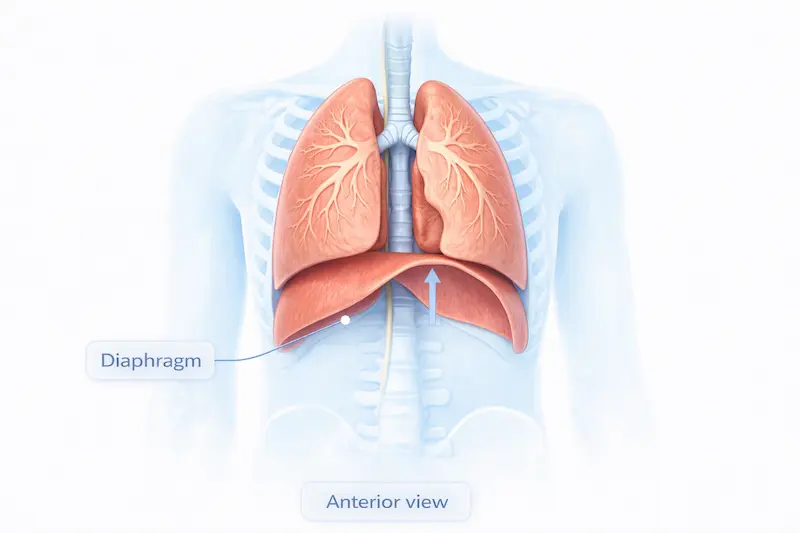
The elevated, paralysed hemidiaphragm compresses the lung and works against breathing with every breath. A chest X-ray showing an elevated hemidiaphragm in a breathless patient should always prompt formal diaphragm assessment — fluoroscopy (the sniff test) takes minutes and provides a definitive answer.
Causes of diaphragmatic paralysis and eventration
The phrenic nerve is the fragile thread that controls your diaphragm. Anything that damages it — surgery, trauma, compression, or infection — can interrupt the signal and paralyse the muscle it controls.
Cardiac and thoracic surgery
Phrenic nerve injury is a recognised complication of cardiac bypass surgery, valve procedures, and atrial fibrillation (AF) ablation. The nerve passes close to the heart and can be stretched, cooled, cauterised, or cut during these procedures. Post-surgical diaphragm paralysis is underdiagnosed — patients are often told their breathlessness is “post-operative” or cardiac, and the diaphragm is never investigated.
Lung surgery / mediastinal procedures
Lobectomy, pneumonectomy, and mediastinal operations (lymph node dissection, thymectomy) can injure the phrenic nerve either directly or through thermal injury. VATS procedures carry lower risk than open surgery, but phrenic nerve injury remains possible, particularly for complex mediastinal cases.
Neuralgic amyotrophy (Parsonage-Turner)
An idiopathic inflammatory condition causing sudden, severe shoulder and neck pain followed by weakness and paralysis — including of the phrenic nerve. Onset is often dramatic and alarming; the breathlessness develops over days to weeks following the painful episode. Recovery is possible but slow; diaphragm paralysis may persist for years.
Neck and chest trauma
Road traffic accidents, falls, or direct blows to the neck or chest can stretch or tear the phrenic nerve. The cervical spine injury may have been recognised and treated, while the resulting diaphragm paralysis goes unnoticed for months or years. Careful clinical evaluation after neck or chest trauma should include diaphragmatic assessment.
Tumour or mass compression
Mediastinal tumours, enlarged lymph nodes, lung cancer, or thyroid masses can compress the phrenic nerve along its course from the neck to the diaphragm. Breathlessness in a patient with known cancer that develops progressively should prompt evaluation of diaphragm function — it may be treatable even in the context of malignancy.
Idiopathic — no identifiable cause
In up to 40–50% of cases of diaphragm paralysis, no clear cause can be identified. This does not mean there is nothing wrong or that treatment is unavailable — it means the phrenic nerve was damaged by a process that left no obvious footprint. Surgery remains equally effective regardless of whether the cause is known.
Congenital diaphragmatic eventration
Some individuals are born with a thin, poorly muscularised hemidiaphragm that bulges upward into the chest (eventration) rather than being truly paralysed. This may be asymptomatic in childhood but become progressively problematic in adulthood — particularly as fitness declines or weight increases. Plication is highly effective for eventration.
Post-viral and inflammatory
Herpes zoster (shingles) affecting the cervical dermatomes, viral neuritis, and COVID-19-associated nerve injury have all been reported as causes of phrenic nerve palsy and diaphragm paralysis. Post-COVID breathlessness that doesn’t improve should prompt diaphragm evaluation — fluoroscopy and the sniff test are straightforward investigations.
A specific message for patients whose breathlessness started after cardiac surgery. Phrenic nerve injury is one of the most under-recognised complications of cardiac procedures. Studies suggest it occurs in up to 20–30% of cases involving hypothermic cardioplegia and significantly in AF ablation procedures. In many patients, it is never identified because breathlessness post-cardiac surgery has many possible explanations, and the diaphragm is rarely investigated. If you had cardiac surgery and your breathlessness never fully resolved, your diaphragm should be formally assessed. A fluoroscopy (sniff test) takes minutes and provides a definitive answer. Plication, when indicated, typically produces dramatic improvement even in patients who have been struggling for years post-cardiac intervention.
Symptoms of diaphragmatic paralysis and eventration
The symptoms of diaphragm paralysis are dominated by breathlessness — but the specific pattern is distinctive and, once recognised, highly characteristic.
Exertional breathlessness
Disproportionate breathlessness with activities that used to be effortless — climbing stairs, walking uphill, carrying shopping. Often attributed to deconditioning or cardiac causes.
Orthopnoea — can’t lie flat
Breathlessness that dramatically worsens lying down is the most characteristic symptom of diaphragm paralysis. Patients sleep reclined, in chairs, or propped on multiple pillows. Often the single most life-disrupting symptom.
Sleep-disordered breathing
Waking breathless, frequent nocturnal arousal, non-restorative sleep, and morning headache from overnight hypoventilation. May mimic or co-exist with sleep apnoea.
Recurrent chest infections
The paralysed, elevated diaphragm impairs mucus clearance from the lower lung on the affected side. Repeated pneumonia or bronchitis on the same side should raise suspicion.
Fatigue and reduced stamina
The additional effort of compensatory breathing depletes energy. Many patients describe a profound, disproportionate fatigue that makes ordinary daily activities exhausting.
Worse after meals
A full stomach pushes the abdominal contents upward, further elevating the paralysed diaphragm. Breathlessness that reliably worsens after eating is a clue to diaphragmatic cause.
How diaphragmatic paralysis is diagnosed
The investigation of diaphragm paralysis uses a specific set of tests — most of which are not routinely ordered in a standard breathlessness workup. The key tests are straightforward once the diagnosis is considered.
Chest X-ray — elevated hemidiaphragm
The classic finding on a plain chest X-ray is an elevated hemidiaphragm — typically 3–5 cm higher than the normal side. This is often described in X-ray reports as an incidental finding and then ignored. An elevated hemidiaphragm in a breathless patient should always prompt formal diaphragm assessment.
Fluoroscopy — the Sniff Test
Real-time X-ray (fluoroscopy) of the diaphragm during a sharp sniff inhalation. In a normal diaphragm, both sides move downward simultaneously. In paralysis, the affected side moves paradoxically upward — confirming the diagnosis. The sniff test is the gold standard and takes minutes to perform.
Ultrasound of the diaphragm
Real-time ultrasound can visualise diaphragm movement and measure its thickness during contraction. Useful as an accessible, radiation-free alternative to fluoroscopy, and particularly helpful for assessing bilateral paralysis. An experienced sonographer performing a dedicated diaphragm assessment is needed.
Pulmonary function tests — supine vs upright
Spirometry in both the upright and supine positions is a simple and revealing test. In diaphragm paralysis, the FVC drops by more than 25–30% when lying down. A >25% drop in FVC from upright to supine strongly suggests diaphragmatic paralysis.
Phrenic nerve conduction studies
Electrophysiological assessment of phrenic nerve function. Confirms the diagnosis and helps determine whether the nerve is entirely absent (complete palsy), markedly reduced, or partially preserved. Guides decisions about whether phrenic nerve reconstruction might be appropriate alongside or instead of plication.
CT scan of the chest and neck
Identifies any structural cause of phrenic nerve compression — mediastinal mass, enlarged lymph nodes, apical lung tumour, or thyroid pathology. Essential before any surgical planning for plication, and to exclude a remediable compressive cause that should be treated first.
What diaphragmatic plication is — and how it restores breathing
The word “plication” comes from the Latin plicare — to fold. In diaphragmatic plication, the surgeon folds and sutures the weakened or paralysed portion of the diaphragm, creating a tightened, tensioned surface that sits at a more normal position in the chest.
The procedure does not restore nerve function or cause the diaphragm to contract actively again. What it does is eliminate the paradoxical upward movement that is working against every breath. By creating a fixed, tensioned platform, it allows the remaining functional lung on that side to expand more fully, and prevents the abdominal contents from pushing the diaphragm into the chest.
The result: more lung space, less paradoxical movement, better lung mechanics — and for most patients, a dramatic improvement in breathlessness, sleep quality, and exercise tolerance. The improvement is typically maintained for many years after surgery.
How diaphragmatic plication is performed
The goal of all approaches is identical: to fold the diaphragm upon itself using a series of sutures, creating a taut, flat platform that sits at a lower, more normal position. The choice of approach depends on the patient’s condition, the surgeon’s experience, and whether other procedures need to be combined.
VATS — minimally invasive thoracoscopic plication
Video-Assisted Thoracoscopic Surgery uses small incisions and a high-definition camera to access the diaphragm through the chest. The diaphragm is folded and secured with sutures under direct vision. Mr Scarci has published his own VATS plication technique — patients typically go home the following day with minimal pain, and the recovery is dramatically faster than with open surgery.
Robotic-assisted plication
Robotic surgery offers enhanced visualisation and instrument articulation through similarly small incisions — particularly useful for complex cases where precise suture placement is critical, or where obesity or previous surgery makes thoracoscopic work more technically demanding. Comparable recovery to standard VATS.
Open thoracotomy
The traditional approach, requiring a larger incision through the chest wall. Occasionally still necessary for very complex cases, bilateral plication, or when other procedures need to be performed at the same time. Recovery is longer — typically 4–7 days in hospital. Reserved for complex or bilateral cases.
Recovery after diaphragmatic plication
Most patients are surprised by how quickly they feel the benefit — and how manageable the recovery is with a minimally invasive approach.
Surgery and immediate recovery
VATS plication is performed under general anaesthetic, typically taking 1–2 hours. A chest drain is left briefly to remove any air or fluid. Pain is well-managed. Most VATS patients go home the following day — a striking contrast with the traditional open approach, which required 5–7 nights in hospital.
Rest and breathing exercises
Mild discomfort at the port sites. Breathing exercises — particularly incentive spirometry — are important to maximise the benefit of the newly restored diaphragm position. Most patients notice improvement in breathlessness remarkably quickly after surgery, often within the first 1–2 weeks.
Increasing activity and pulmonary rehab
Gradual return to normal activities. Driving and return to desk work typically in weeks 3–4. Pulmonary rehabilitation — supervised aerobic exercise — maximises the functional gain from restored lung expansion and helps rebuild the conditioning lost during months or years of breathlessness.
Return to full activity and objective improvement
Repeat pulmonary function testing typically shows measurable improvement in FVC and exercise capacity. Orthopnoea usually resolves completely — patients can lie flat for the first time in months or years. Energy levels improve. Many patients describe this phase as feeling better than they have in years.
Long-term follow-up
Published data show that the majority of patients maintain their breathing improvement for many years after plication. Regular follow-up with chest X-ray and spirometry monitors the durability of the result. In the small minority where plication fails or recurrence occurs, revision surgery is possible.
Other treatment options for diaphragmatic paralysis
Plication is the most effective intervention for most patients with symptomatic diaphragm paralysis — but it is not the only option. The right treatment depends on the cause, severity, and whether the phrenic nerve has any preserved function.
Watchful waiting
For mild or recently acquired unilateral paralysis, watchful waiting is appropriate — some cases (particularly post-viral or traumatic) spontaneously recover over months. Regular review with pulmonary function tests and symptomatic assessment is needed. Surgery is reserved for patients with persistent significant symptoms beyond 12–18 months.
Non-invasive ventilation (NIV)
CPAP or BiPAP overnight can support breathing during sleep in bilateral paralysis or in patients not fit for surgery. Manages symptoms but does not address the underlying mechanical problem. May be appropriate as a bridge to surgery or for patients unsuitable for an operation.
Diaphragmatic pacing
An implanted device stimulates the phrenic nerve electrically to contract the diaphragm. Requires a functioning nerve — only appropriate if phrenic nerve conduction studies confirm preserved nerve viability. Not widely available; specialist centres only. More commonly used in bilateral paralysis and in ventilator-dependent patients.
Phrenic nerve reconstruction
Surgical repair or reconstruction of the phrenic nerve — decompression, nerve grafting, or neurotisation — aims to restore active diaphragm function rather than simply immobilising it (as plication does). Results are promising but outcomes take months to develop as the nerve regrows. Best suited to selected cases of relatively recent phrenic nerve injury where the diaphragm muscle has not atrophied irreversibly.
“I had a CABG three years ago and never got my breath back properly. Everyone said my heart was fine. I slept in a recliner for two and a half years. Mr Scarci was the first doctor who looked at my diaphragm. VATS plication was done on a Thursday. I was home on Friday. I slept flat in my own bed for the first time in years by Saturday night. I cried.”
Why patients choose Mr Scarci for diaphragmatic plication
Specialist expertise where it matters most
Diaphragmatic plication is a technically demanding procedure performed by a small number of thoracic surgeons. Experience, operative volume, and dedicated expertise make a measurable difference to outcomes.
Published VATS plication technique
Mr Scarci has published his own minimally invasive VATS plication technique. This is not a procedure he performs occasionally — it is a core part of his specialist practice, and his results reflect that experience.
Home the next day — our standard
Most patients are discharged the day after VATS plication. This is only possible with a minimally invasive technique performed by a surgeon with extensive experience. It is not the norm elsewhere for this procedure.
Diagnosis where others haven’t looked
Many patients arrive having been told their breathlessness is cardiac, respiratory, or anxiety-related — with an elevated diaphragm sitting in the imaging notes unrecognised. Mr Scarci investigates the diaphragm specifically.
Direct access between appointments
You speak directly with Mr Scarci. Post-operative concerns are addressed promptly and personally. For a procedure where breathing is the outcome, close follow-up is not optional — it is part of the care.
Seen within days
Most patients are seen within one week of contact. When breathlessness is significantly impairing daily life and sleep, waiting months on a waiting list is not the right answer.
Insurance and self-pay
All major UK private insurers are accepted. Diaphragmatic plication is covered as a medically necessary procedure. Transparent self-pay pricing is also available with no hidden extras.
Everything you need to know about diaphragmatic plication
-
The most telling clues are: breathlessness that is significantly worse lying flat than sitting or standing (orthopnoea), breathlessness that started or worsened after cardiac or thoracic surgery, an elevated hemidiaphragm visible on chest X-ray, and breathlessness that has persisted despite normal cardiac investigations. A fluoroscopy (sniff test) is the definitive test — it takes minutes and provides a clear answer. Mr Scarci will arrange this as part of your initial assessment.
-
It depends on the cause and how long symptoms have been present. Post-surgical phrenic nerve injury (particularly from cardiac surgery) has a spontaneous recovery rate of approximately 50–70% within 12 months. Post-viral cases can also recover. However, if 12–18 months have elapsed with no significant improvement — or if symptoms are severe — spontaneous recovery is unlikely and plication is appropriate. Idiopathic cases rarely recover spontaneously.
-
Plication is a durable procedure — the permanent sutures do not resorb or loosen over time. Published long-term follow-up studies show that the majority of patients maintain their functional improvement for many years after surgery. In patients with progressive neuromuscular conditions, some deterioration may occur over time — but this reflects disease progression, not failure of the plication itself.
-
Yes — it is far more common than most patients realise. Phrenic nerve injury is a recognised complication of cardiac bypass surgery, valve procedures, and AF ablation, but it is frequently not communicated to patients and rarely investigated. The breathlessness is often attributed to the cardiac condition or to deconditioning. If your breathlessness has never returned to pre-operative baseline, or is significantly worse lying flat, a diaphragm assessment is worthwhile regardless of how long ago the surgery was.
-
Paralysis means the diaphragm muscle is normal but receives no nerve signal — it is inactive. Eventration means the diaphragm muscle itself is thin and poorly formed (usually congenital) — it may have some movement but cannot generate normal force. Both conditions result in an elevated, non-functional hemidiaphragm, and both are treated effectively with plication. The surgical technique is essentially the same.
-
Yes. Diaphragmatic plication for phrenic nerve palsy or eventration is covered by all major UK private health insurers as a medically necessary procedure. Mr Scarci’s team handles pre-authorisation from the outset — you do not need to navigate the insurance process yourself. Self-pay pricing is available with transparent costs provided in advance.
-
Bilateral plication is technically feasible but is approached with considerable caution. Operating on both sides under the same anaesthetic requires each lung to independently support ventilation during the procedure — which significantly increases risk. In most cases bilateral plication is staged: one side first, followed by recovery and re-assessment, then the second side if indicated. Mr Scarci manages bilateral cases in close collaboration with respiratory and intensive care colleagues.
You should be able to breathe freely — and sleep lying down.
If a paralysed or weakened diaphragm is the explanation for your breathlessness, diaphragmatic plication can change your life. A specialist consultation determines whether you are a candidate — and gives you a clear plan for what happens next.
