
Collapsed Lung · Pneumothorax Specialist · London
When breathing becomes frightening, you deserve answers — and a plan.
A collapsed lung can come from nowhere. One moment you’re fine; the next you’re in A&E, scared, and uncertain what comes next. This guide explains everything — clearly, honestly, and without jargon.

What every pneumothorax patient should know
With the right specialist, a collapsed lung is very treatable. Here’s where to start.
Most people who experience a pneumothorax describe the same moment: a sudden, sharp pain on one side of the chest, breathlessness that doesn’t make sense, and a creeping sense that something is seriously wrong. If that’s you — or someone you love — the first thing to know is that this is a well-understood, treatable condition.
The second thing to know is that what happens next matters enormously. A pneumothorax managed poorly — or one that recurs because the underlying cause was never addressed — can have lasting consequences for your breathing and quality of life. The right specialist, at the right time, changes outcomes.
This page walks you through everything: what a pneumothorax is, how it is diagnosed, and what your treatment options are — from watchful waiting to keyhole surgery. Read at your own pace, then reach out when you’re ready.
“I see patients who have had three or four collapses because nobody offered them a definitive solution the first time. That delay is almost always unnecessary — and preventable.”
Speak with a specialist
Whether this is your first episode or your third, a consultation gives you a clear picture of your situation and the options available to you.
 Call 020 7459 4367
What exactly is a pneumothorax?
The lung inside a box
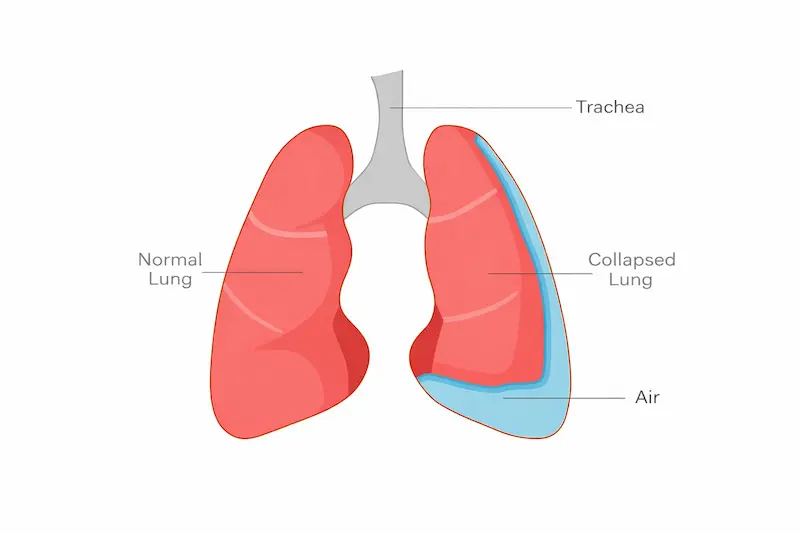
Think of your lung as a balloon inside a sealed box — your chest cavity. Normally, a tiny vacuum between the balloon and the box holds it fully inflated every time you breathe in.
A pneumothorax happens when air leaks into that space, breaking the vacuum. The balloon — your lung — starts to collapse inward. This can happen suddenly, gradually, or after an injury. What matters most is catching it, understanding why it happened, and making sure it cannot easily happen again.
Not all pneumothoraces need surgery — small, stable cases often resolve with monitoring
Keyhole surgery (VATS) is the modern gold standard — small cuts, fast recovery
Pleurodesis reduces recurrence risk by over 90% — most patients home within 1–4 days
Types of pneumothorax
Understanding which type you have shapes every decision that follows — from whether you need immediate surgery to how we prevent it happening again.

Primary Spontaneous
Occurs without warning in otherwise healthy lungs — often in tall, lean young men. Caused by small air blisters (blebs) on the lung surface that rupture without any obvious trigger.

Secondary Spontaneous
Occurs against a background of existing lung disease — COPD, cystic fibrosis, asthma, or interstitial lung disease. Includes catamenial pneumothorax linked to endometriosis.

Traumatic
Caused by chest injury — road accidents, falls, sports, or penetrating wounds. Often accompanies rib fractures. Requires urgent, coordinated care.

Iatrogenic
A complication of medical procedures — lung biopsy, central line placement, or mechanical ventilation. A recognised risk that experienced clinicians can promptly identify and manage.
⚠ Emergency — Tension Pneumothorax
Air enters the pleural space but cannot escape, building dangerous pressure that compresses the heart and great vessels. This is a life-threatening emergency requiring immediate decompression.
If you suspect this, call 999 immediately — do not wait.
Symptoms of a collapsed lung
Symptoms can arrive suddenly and intensely, or build gradually over hours. Either way, they should never be dismissed.
Sudden, sharp chest pain
Typically on one side only — can be stabbing or a dull ache that worsens on breathing
Shortness of breath
May worsen rapidly, especially with activity or deep breathing
Racing heart rate
The body’s response to reduced oxygen delivery
Dry, persistent cough
Often accompanies the breathlessness
Fatigue and weakness
The effort of breathing with a compromised lung is exhausting
🚨 Seek emergency care immediately if you notice:
Lips or fingertips turning blue (cyanosis) · Rapidly worsening breathlessness at rest · Sudden severe chest pain with collapse · Feeling faint or losing consciousness · Inability to speak a full sentence
These may indicate a tension pneumothorax — a medical emergency. Do not wait. Call 999 or go immediately to your nearest A&E.
How a pneumothorax is diagnosed
Diagnosis is usually swift and straightforward — what matters most is what happens next.
Clinical Examination
A stethoscope reveals reduced or absent breath sounds on the affected side. Percussion produces a hollow sound. These signs guide the urgency of next steps.

Chest X-Ray
The standard first test. Shows air in the pleural space and confirms how much of the lung has collapsed. Fast, accessible, and usually definitive for straightforward cases.

CT Scan
Used for complex cases, to detect blebs or bullae, assess underlying disease, and plan surgery precisely. Provides far more detail than a plain X-ray.
Treatment options — from watchful waiting to keyhole surgery
The right approach depends on how large the collapse is, whether it has happened before, your overall lung health, and your lifestyle and priorities.
Monitoring & Observation
For small pneumothoraces with mild symptoms, the body can often reabsorb trapped air over days to weeks without intervention. Supplemental oxygen speeds this process. Appropriate for a first, small episode in an otherwise healthy person — with close monitoring to ensure stability.
Needle Aspiration or Chest Drain
For larger collapses or significant symptoms, air is removed through a fine needle or drainage tube placed under local anaesthetic. The lung can then re-expand. This is the standard acute hospital treatment — but it does not address the underlying cause, and recurrence risk remains high without further treatment.
VATS — Keyhole Surgery
Video-Assisted Thoracoscopic Surgery uses small incisions and a camera to inspect the lung directly, remove damaged tissue (blebs or bullae), and seal air leaks. Hospital stay: 1–4 days. Return to normal life: 1–2 weeks.
VATS + Pleurodesis
Pleurodesis permanently bonds the lung lining to the chest wall, eliminating the pleural space where air can accumulate. Combined with VATS, recurrence rates drop to below 5% — compared to 30–50% with drainage alone.
Key outcomes
Your recovery timeline after VATS
Most patients are surprised by how quickly they feel like themselves again.
The procedure
Minimally invasive procedure under general anaesthetic. Three small incisions. You are asleep throughout.
In hospital
Drain removed once the lung is stable. Walking encouraged from day one. Most patients are home within a few days.
Early recovery
Light activity, gradual increase. Most patients return to desk work by week 2.
Full recovery
Sport, travel, manual work. Full recovery confirmed at follow-up review with Mr Scarci.
What happens when you contact us
No confusing referral chains. Clear steps, clear communication, clear plan.
Initial Consultation
You speak with Mr Scarci directly — not a secretary. He reviews your history and existing imaging before you arrive. No repeated tests. Most patients seen within one week.
Investigation & Decision
Further imaging is arranged promptly if needed. You receive a clear recommendation — conservative management, drainage, or surgery — with the reasons explained honestly. You make the decision.
Surgery & Recovery
Keyhole surgery at your most convenient London hospital. Mr Scarci is present at every step. Follow-up is direct and personal, continuing until you’re fully back to your life.
“After my second pneumothorax I was terrified it would keep happening. Mr Scarci explained the situation clearly, recommended surgery, and I have had zero recurrences in three years. I wish I had seen him after the first one.”
Frequently asked questions
-
Surgery is usually recommended after a second episode, after a first episode that fails to resolve with drainage, or in patients at high risk of recurrence — including pilots, divers, those with underlying lung disease, or anyone with a bilateral or large first collapse. Mr Scarci will advise based on your specific situation, not a protocol.
-
Yes. VATS is a mature, well-established technique with low complication rates and an excellent safety record. The vast majority of patients experience no significant complications and go home within a few days. Mr Scarci has performed more than 5,000 minimally invasive thoracic procedures.
-
Without definitive treatment, recurrence rates are 30–50% after a first episode. With VATS and pleurodesis combined, recurrence drops below 5%. No procedure offers zero risk — but this combined approach dramatically changes the odds in your favour.
-
Smoking significantly increases the risk of pneumothorax and of recurrence. Stopping before surgery improves healing and anaesthetic safety. Mr Scarci will discuss this openly with you and will not refuse to operate solely because you smoke — but quitting is strongly encouraged and supported.
-
Pneumothorax surgery is covered by all major private health insurers in the UK. Mr Scarci’s team handles pre-authorisation on your behalf. If you are self-funding, a transparent cost estimate is available before any commitment is made.
-
Most new patients are seen within one week. If your situation is urgent — for example, you’ve just been discharged from hospital — please call directly on 020 7459 4367 and we will do everything possible to accommodate you sooner.
Expert consultation.
Clear, definitive answers.
Mr Scarci reviews your history, your imaging, your risk of recurrence, and your treatment options in full. You leave knowing exactly where you stand and what comes next.
