
That sharp, sudden pain in your chest after a fall or knock can be pretty frightening. The first question that usually springs to mind is, “Is it just a bad bruise, or have I actually broken a rib?” While both can be incredibly painful, a fracture needs to be managed carefully to sidestep any nasty complications.
A patient of mine, let's call him John, came to my clinic after a cycling accident. He’d fallen onto his side but felt well enough to dust himself off and ride home. The next morning was a different story. Every breath felt like a sharp jab, and one particular spot on his side was excruciating to the touch. This classic scenario, which I discuss in the video below, highlights the key giveaways: a very specific, tender spot on your chest and pain that shoots up dramatically when you breathe deeply, cough, or twist your body.
That Sharp Pain in Your Chest: Is It a Broken Rib?

It’s a scenario I’ve seen countless times, just like with John, the cyclist I mentioned. His experience is a perfect example of how the initial shock and adrenaline rush can easily mask how serious an injury is. The real, deep-seated pain often only kicks in hours or even a day later. This delay can make it tough to tell a simple bruised muscle from a more significant fracture.
Distinguishing a Fracture From a Strain
The most telling sign of a broken rib is what we call point tenderness—a very precise, localised spot that hurts intensely when you press on it. A strained intercostal muscle (the muscles between your ribs) tends to cause a more generalised, dull ache across a wider area.
Another key difference is how it hurts. With a fracture, any movement that expands or contracts the ribcage will trigger a sharp, stabbing sensation. Think about things like:
Taking a deep breath
Coughing or sneezing
Twisting or bending your torso
Laughing
Some people also recall hearing or feeling a "pop" or "crack" at the moment of impact. If that happened, it’s a strong clue that a bone may have given way.
Why Early Recognition Matters
Catching the signs early is more than just about managing pain; it's about preventing complications. Rib fractures are surprisingly common, accounting for a hefty 15% of all emergency department admissions in the UK for chest trauma.
The real danger lies in what can happen next. Studies show that 12% of patients with rib fractures may develop pneumonia. This often happens because the pain is so severe that they can't breathe deeply, which prevents them from clearing their lungs properly. You can read more about these NHS findings on rib fracture care here.
Of course, not all chest pain is due to an injury. It's worth being aware of other potential causes, and this guide on understanding chest pain caused by anxiety can be a useful resource.
Broken Rib vs Muscle Strain Key Differences
To help you get a clearer picture, I've put together this quick comparison table. It's a simple way to help you distinguish between the symptoms of a fractured rib and a less severe intercostal muscle strain.
| Symptom | Likely a Broken Rib | Likely a Muscle Strain |
|---|---|---|
| Pain Location | Highly localised to one specific spot (point tenderness). | A more generalised, dull ache across a wider area. |
| Pain on Breathing | Sharp, stabbing pain, especially with deep breaths. | Mild to moderate discomfort, but less sharp. |
| Pain with Movement | Intense pain when coughing, sneezing, laughing, or twisting. | Pain increases with movement but is often a stretching ache. |
| Sound/Sensation | May have heard or felt a "crack" or "pop" on impact. | Unlikely to have a distinct sound at the time of injury. |
| Bruising/Swelling | Often visible swelling and bruising directly over the spot. | Swelling and bruising may be present but are less focused. |
Remember, this table is a guide, not a diagnosis. If your symptoms lean towards a broken rib, or if you're in any doubt at all, getting a proper medical opinion is always the safest bet.
How to Safely Check for a Rib Injury at Home

After a nasty knock or fall, it’s only natural to want to figure out the extent of the damage. But when you suspect a rib injury, poking and prodding is the last thing you should do. A careful, methodical self-check is the right approach.
This isn’t about making a final diagnosis—that's a job for a professional. It's about gathering information to help you decide on your next steps and to give your doctor a clear picture of what's happening. The aim is to identify key signs without making anything worse.
Let’s go back to John, the cyclist from earlier. The morning after his fall, he did a cautious self-check. Standing in front of a mirror, he saw a faint, purplish mark blooming on his side. That’s a tell-tale sign of trauma. A quick visual inspection like this is always a good place to start.
The Gentle Palpation Technique
The most revealing part of a self-check is gently feeling the area. I can't stress this enough: you must be incredibly careful. The goal is to find that classic sign of a fracture—what we call "point tenderness."
Here's how to do it safely:
Start with a light touch. Use just the fingertips of one hand and begin pressing very gently on an area you know doesn't hurt, well away from the suspected injury.
Work your way closer. Slowly and methodically, move your fingers along the curve of each rib, inching towards the painful spot.
Pinpoint the pain. If you find one specific point that shoots a sharp, intense spike of pain when touched, you've almost certainly found the injury site.
This was the lightbulb moment for John. As he gently traced his ribs, most of the area was just generally sore. But when one fingertip landed on a very precise spot, the pain was immediate and excruciating. This is worlds away from the dull, widespread ache of a pulled muscle. You'll find we recommend a similar approach in our guide for bruised rib treatment, where gentle assessment is also key.
Expert Insight: The crucial difference you are looking for is a single, exquisitely tender point. A bruised rib or a muscle strain will almost always cause a more generalised ache over a much wider surface area.
What Not to Do During a Self-Check
Knowing what to avoid is just as critical as knowing what to do. Being too aggressive can easily worsen a simple fracture or, in a worst-case scenario, cause damage to the delicate organs your ribs protect.
It is absolutely vital that you avoid:
Applying firm pressure: Never push hard on a suspected fracture to "test" how much it hurts.
Twisting or bending forcefully: Don't try to replicate the movement that caused the pain just to see if it still hurts. It will.
Ignoring sharp breathing pain: If taking anything more than a shallow breath is agony, don't force it. Your body is trying to protect itself.
This careful self-assessment gives you powerful clues. If you have visible bruising combined with a distinct point of tenderness, that's a very strong signal that it’s time to get a professional medical opinion to confirm what's really going on.
Red Flag Symptoms That Mean Go to A&E Now
While most rib fractures heal just fine with time and sensible management at home, some symptoms are more than just painful. They're urgent warning signs that something far more serious is going on. It's vital to know when to stop the self-assessment and get yourself straight to Accident & Emergency.
These "red flag" symptoms point to potentially life-threatening complications that need immediate medical help.
I once treated a patient, let's call her Sarah, who initially put her shortness of breath down to the sheer pain from her fall. But over a few hours, it became a real struggle to get enough air in, and she started feeling light-headed. That was her gut telling her this was more than a simple break. Her instinct was spot on; a sharp fragment of the broken rib had punctured her lung.
When You Must Act Immediately
Sarah’s story is a perfect example of a key danger. If a broken rib shifts, it can easily damage nearby organs, especially the lungs. This can cause a pneumothorax, what's more commonly known as a collapsed lung—a true medical emergency. You can get a deeper understanding of the specific signs from our detailed guide on collapsed lung symptoms.
You need to call 999 or get to your nearest A&E without a moment's hesitation if you experience any of the following alongside your rib pain:
Severe difficulty breathing: This isn't just a sharp pain when you breathe deeply. It’s a genuine struggle to get enough air, feeling completely winded even when you’re sitting still.
Feeling dizzy, confused, or faint: These are classic signs of either internal bleeding or a lack of oxygen getting to your brain.
Coughing up blood: Any blood at all, even just small specks mixed with saliva, is a major red flag.
A rapid, weak pulse: If this happens along with pale, clammy skin, it can be a sign of shock.
Intense abdominal pain: A fracture in the lower ribs can sometimes injure the spleen or liver, leading to serious pain in your stomach area.
Crucial Takeaway: Don't wait around to see if these symptoms get better on their own. Complications like a punctured lung or internal organ damage can escalate incredibly quickly. Your absolute priority must be getting to a hospital for an urgent assessment.
Think of these red flags as your body's built-in alarm system. They're signalling that the injury is more complex than a straightforward fracture. Listening to these signs and acting fast is the single most important thing you can do for a safe recovery.
What to Do if You Think You’ve Broken a Rib: Navigating the System
So, you’ve had a fall or taken a knock, done a quick self-check, and it feels very much like a rib might be broken. Making the decision to see a doctor is absolutely the right one. But what happens next? Knowing what to expect can make the process a lot less daunting.
Your journey will almost certainly start with your GP or a local Minor Injuries Unit. If the pain is severe, knowing how to get a same day GP appointment is a massive help for getting seen quickly. When you see the doctor, they'll want the full story of what happened and will then perform a gentle physical examination, much like the self-check, to pinpoint the source of the pain.
The Diagnostic Journey: What to Expect
Let’s walk through a common scenario. Imagine David, a weekend rugby player who took a heavy tackle. At first, he brushed it off, but by Monday morning, every breath was a sharp, stabbing pain. He managed to get an urgent GP appointment. After listening to David and carefully examining his chest, the doctor was fairly certain it was a fracture.
The next step? An X-ray. This is the go-to diagnostic tool for a reason: it’s quick, readily available, and very good at showing most rib fractures. David was sent off to the local hospital for imaging, and sure enough, it confirmed a clean break in his seventh rib.
An X-ray is our first port of call. It confirms the break, but just as crucially, it helps us rule out any immediate and obvious complications, like a collapsed lung. It gives us a solid baseline for your care.
For a straightforward case like David's, an X-ray is usually all that’s needed. However, if the injury is more complex or the doctor has other concerns, a CT scan might be ordered. This is more common if:
You’ve been in a serious accident, like a road traffic collision.
The doctor suspects multiple ribs are broken.
There are any signs of internal injury (those red flags we talked about).
A CT scan gives a much more detailed, 3D picture of your chest. It can spot subtle fractures an X-ray might miss and gives a clear view of your internal organs—lungs, spleen, liver—to check for any damage.
Understanding Your Care Pathway
In the UK, blunt chest trauma involving multiple rib fractures is taken very seriously, making up a notable 15% of all trauma centre admissions. It's a stark reminder of how common and potentially severe these injuries can be. Your specific care path will be tailored to how bad your injury is.
For a simple, uncomplicated fracture like David’s, the treatment plan focuses on managing the pain and giving clear advice on breathing exercises to prevent chest infections. He was sent home from the hospital the same day with a recovery plan.
But if any of those red flags are present, the whole process changes, becoming much more urgent. The decision protocol below shows exactly why.
This flowchart highlights the critical symptoms—like severe breathing difficulty, dizziness, or coughing up blood—that mean you need to get to A&E immediately.
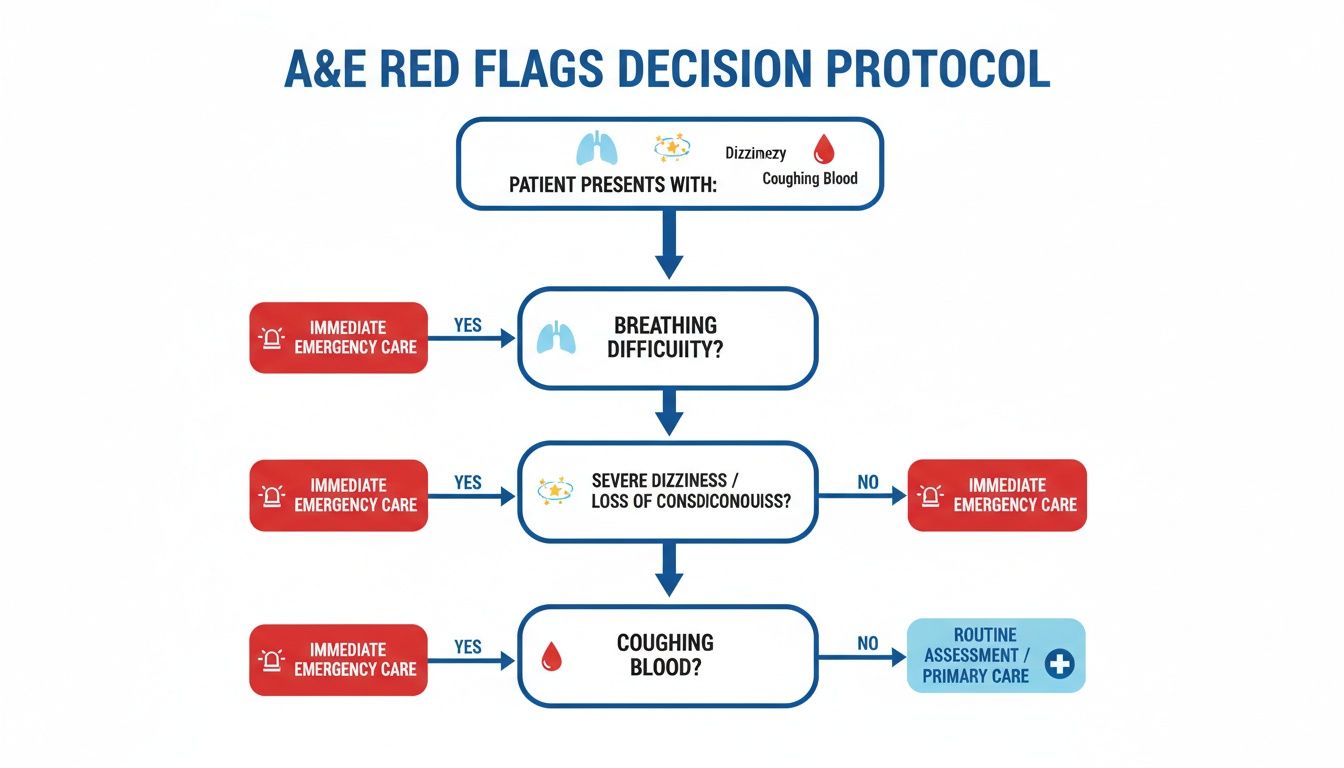
While most broken ribs can be managed safely at home, this visual guide reinforces the fact that any hint of a serious complication is a true emergency. Knowing what to expect from your consultation and treatment helps you prepare for what’s ahead, every step of the way.
Your Recovery Plan: Pain Management and Healing at Home

Once you have a confirmed diagnosis, your focus shifts. You’re no longer wondering how to tell if you broke a rib—now it’s all about the recovery. Unlike a broken arm or leg, we can’t put your ribs in a cast. Healing is a delicate balance of careful pain management, sensible rest, and, most importantly, protecting your lungs.
Let’s check back in with John, our cyclist. After his X-ray confirmed the fracture, the hospital sent him home with a clear plan. That first week was the toughest. Every movement sent a sharp, jabbing reminder of his injury, and sleeping felt almost impossible. He soon found that propping himself up with pillows into a semi-reclined position was the only way to get any real rest, as it took the pressure off his chest.
This kind of trial-and-error is something almost everyone with a broken rib goes through. Finding what works for you is one of the first and most critical steps on your road to recovery.
Mastering Pain Control and Breathing
Effective pain management is the absolute cornerstone of a safe recovery. This isn't just about comfort; it's about function. If you can keep the pain at a manageable level, you'll be able to breathe more deeply and cough properly—two things that are vital for preventing serious chest infections like pneumonia.
Your doctor will likely suggest a routine of over-the-counter painkillers, such as paracetamol and ibuprofen. The key is to take them regularly, as prescribed, rather than waiting for the pain to become unbearable. Staying ahead of the pain makes everything else so much easier to handle.
Patient Story: "The first few days were brutal," John recalled. "I set an alarm on my phone to take my painkillers every four hours, even through the night. It felt like overkill at first, but it made a massive difference. It was the only way I could manage the deep breathing exercises the doctor insisted on."
These breathing exercises are non-negotiable. Seriously. Make it your goal to take 10 slow, deep breaths every single hour you're awake. To make it a bit less painful, try this little trick:
Hold a pillow or a folded towel firmly against your injured ribs. This acts as a splint.
Breathe in as slowly and deeply as you can tolerate.
Hold that breath for just a few seconds, then breathe out gently.
This simple act helps keep your lungs fully expanded and clear of fluid, which dramatically reduces your risk of complications.
Navigating Daily Life and Activity
For the first couple of weeks, you'll need to hit pause on your normal routine. That means no strenuous activity, no heavy lifting, and avoiding any movements that cause a sharp pain, like twisting or bending. But it’s just as important not to become completely static. Gentle walking is actually encouraged, as it keeps your circulation going and helps prevent blood clots.
It’s worth noting that in England, falls are the leading cause of rib fractures. In 2019, age-standardised incidence rates were 15.65 per 100,000 for females and a staggering 30.33 per 100,000 for males. This data highlights just how common these injuries are, and why a careful recovery is so important, as the risks can climb with age and the number of ribs involved. You can read the full research about these fracture statistics here.
Ultimately, you need to listen to your body—it will definitely tell you when you're overdoing it. Healing takes time. The bone itself will take around six weeks to mend, but your active participation in pain control and breathing exercises is what will truly pave the way for a smoother, safer recovery.
Common Questions About Broken Rib Recovery
Once you’ve got a proper diagnosis, the anxiety of ‘what is it?’ shifts to the practical side of things: ‘how do I get through this?’ The healing journey always throws up new questions about day-to-day life. Let's walk through some of the most common concerns I hear from patients after they've been told they have a broken rib.
A Patient's Perspective on Recovery
I remember a patient, Chloe, a self-employed graphic designer who was incredibly worried about taking time off work. She had a simple fracture from a fall, but the pain made it impossible to sit at her desk for more than an hour.
"It’s not just the pain," she told me, "it's the frustration of not being able to do normal things. When will I feel like myself again?" Her questions are the same ones I hear time and time again.
Can I Go to Work with a Broken Rib?
This really comes down to what you do for a living.
For someone like Chloe with a desk job, getting back to work part-time or with some adjustments might be possible once the worst of the pain has passed. But for anyone in a physically demanding role – think lifting, bending, or any kind of manual labour – you will absolutely need more time off. Pushing yourself too soon is one of the surest ways to set your healing back and ramp up the pain.
How Long Does the Pain from a Broken Rib Last?
The most intense, sharp pain usually gets a lot better within the first one to two weeks. After that, it’s common to feel a dull ache or get the odd sharp twinge when you move a certain way. This can last for around six weeks, and sometimes longer.
Your age, your general health, and the specifics of the fracture all play a role in this timeline.
Key Takeaway: While the bone itself takes about six weeks to mend, that nagging discomfort can stick around for a bit longer. The healing process is a gradual one, and it’s different for everyone, so patience really is key.
Is It Safe to Drive with a Broken Rib?
I strongly advise against driving in the early stages of recovery.
Just think about the movements involved: turning the wheel, twisting to check your blind spot, or having to brake suddenly in an emergency. Any of these can trigger a sudden, excruciating spike of pain, which is incredibly dangerous when you’re in control of a car.
Before you even think about getting behind the wheel, you must be able to do all these things without pain. It’s also a good idea to double-check the terms of your car insurance policy.
Will My Broken Rib Heal on Its Own?
Yes, the vast majority of simple rib fractures heal perfectly well on their own. We don't use casts or splints for ribs. The main focus of treatment is managing your pain so you can breathe deeply and cough properly, which is crucial for preventing chest infections.
Even so, getting a proper diagnosis is vital to make sure it's a straightforward break and to rule out anything more serious. To understand more, you can explore our detailed guide on potential broken ribs complications.
In very rare and severe cases, like when multiple ribs are broken in several places (a condition called "flail chest"), surgery might be needed to stabilise the chest wall.
At Marco Scarci Thoracic Surgery, we offer rapid access to specialist consultations for chest injuries, ensuring you get a precise diagnosis and a clear recovery plan without delay. If you're concerned about a rib injury and want expert care, find out more about our private services at https://marcoscarci.co.uk.

