
A pectus carinatum brace is a specially designed medical device that corrects a ‘pigeon chest’ without the need for surgery. It works by applying gentle, constant pressure to the part of the chest that juts out. Over time, this pressure gradually reshapes the chest wall, especially when a child is going through their adolescent growth spurts.
Understanding Pectus Carinatum And How Bracing Works

It can be unsettling to learn your child has a chest wall deformity, but it’s helpful to know that pectus carinatum is not only common but also very treatable. The condition develops when the cartilage joining the ribs to the breastbone (sternum) grows unevenly, pushing the chest outwards.
For many young people, the first sign is a practical one. We recently saw a 13-year-old boy from London who became concerned when his T-shirts stopped fitting properly, making him feel self-conscious, particularly during sports. This is a very typical story.
This is exactly where a pectus carinatum brace comes in as the first and best line of treatment. The easiest way to think of it is like orthodontics for the chest. In the same way that dental braces slowly guide teeth into the correct position, a chest brace gently directs the flexible chest wall back into its natural shape.
The principle behind it is beautifully simple but incredibly effective. By applying gentle, sustained pressure to the most prominent part of the chest, we encourage the cartilage and bone to remodel themselves. This process works best during the teenage growth spurt, when the chest is at its most pliable and responds well to this external guidance.
A Gentle And Effective Approach
The whole process starts with a careful assessment. We need to create a brace that is custom-fitted to your child's unique chest shape – there is no one-size-fits-all solution. This personalised device is then worn consistently, gradually reshaping the chest and avoiding the need for any kind of invasive surgery.
The success of this approach is well-established. In the UK, pectus carinatum affects a significant number of teenagers, with boys being about four times more likely to have it than girls. A key Scottish study that followed patients offered bracing found a 90.6% success rate in achieving either a full correction or a major improvement. This really highlights just how powerful this non-surgical treatment can be.
Why Bracing Is The Gold Standard
For patients who are good candidates, bracing is recognised as the gold standard of care for a few very good reasons:
- It's Non-Invasive: This approach completely avoids the risks, recovery time, and scars that come with a surgical operation.
- It's Highly Effective: When patients stick to their prescribed wear schedule, the success rates are incredibly high.
- It Causes Minimal Disruption: Today's braces are lightweight and slim, designed to be worn discreetly under clothes, so daily life, school, and sports can continue as normal.
Understandably, parents often have questions about the safety and quality of medical devices like these. Learning about the rigorous FDA approval process for medical devices can provide peace of mind about the high standards and reliability required.
Here at our London clinic, Mr Marco Scarci specialises in the diagnosis and management of all types of chest wall deformities. Our philosophy is to always start with a personalised treatment plan that prioritises the least invasive, most effective solution first.
Who Is an Ideal Candidate for a Pectus Carinatum Brace?
Figuring out who will get the best results from a pectus carinatum brace really comes down to a few key things. The most important by far are the patient's age and how much growing they still have left to do.
The best candidates are almost always children and adolescents. At this stage, their skeletons are still growing and flexible, meaning the chest wall is pliable enough to respond well to the gentle, external pressure of a brace.
This is exactly why getting an early assessment is so crucial. For many young people, the condition really becomes obvious during the big growth spurt around puberty, usually between the ages of 11 and 14. This is the sweet spot—the perfect window to start treatment and guide the chest wall back into a flatter position.
What Makes for a Successful Bracing Journey?
A specialist like Mr Scarci will look at a few specific factors to determine if bracing is the right call. It’s all about making sure the treatment has the best possible chance of working.
- Chest Wall Flexibility: The surgeon will physically check how soft or rigid the chest is. It's simple, really: a more flexible chest will respond much more quickly and effectively to the brace.
- Severity of Protrusion: We also measure how much the breastbone juts out. Bracing can handle a wide range of cases, but this measurement helps us set a realistic timeline and manage everyone's expectations from the start.
- Patient Motivation: This one is huge. Consistency is everything. The ideal candidate is a young person who understands the plan and is truly committed to wearing their brace exactly as prescribed.
"We often find that the most successful outcomes are in young people who are motivated to see a change. They understand that wearing the brace is an active part of their own treatment, and that commitment makes all the difference."
A Patient's Story of Perfect Timing
Not long ago, we saw a 12-year-old boy who was getting really self-conscious about his chest, especially when it came to swimming. His parents brought him in for a chat just as he was hitting his adolescent growth spurt.
Because his chest wall was still so pliable, he was a textbook candidate for bracing. He was also incredibly motivated and stuck to his personalised wearing schedule without fail. In just a few months, the whole family could see a real difference, which did wonders for his confidence. His story is a brilliant example of how catching it at the right time can lead to fantastic, life-changing results without needing surgery.
While that early teenage window is ideal, bracing can sometimes still be an option for older teens or even young adults. The key is to have realistic expectations. A more mature, rigid chest will likely need a much longer treatment time to see significant correction. The only way to know for sure is to have a specialist take a proper look.
What to Expect: Your Pectus Carinatum Bracing Journey from Start to Finish
Starting treatment with a pectus carinatum brace can feel like a big step, but the process is actually quite straightforward. From the moment you walk into the clinic to the day the brace is no longer needed, we've broken the journey down into clear, manageable stages to get the best possible result.
The First Steps: Consultation and Customisation
It all begins with a detailed initial consultation with a specialist like Mr Marco Scarci. This first meeting is where we get to the heart of the matter. We'll confirm the diagnosis, carefully assess how flexible the chest wall is, and sit down with you and your child to talk through your goals. This is your time to ask absolutely anything—we want every family to leave feeling confident and fully informed.
Once we’ve established that bracing is the right path, we move on to creating the brace itself. We use advanced 3D scanning or take a series of precise measurements to capture the exact contours of your child’s chest. This data allows us to create a brace that’s a perfect, custom fit, designed to apply gentle pressure only where it's needed most.
The Fitting and Your Personalised Schedule
When your custom brace is ready, you'll come back for a fitting. This is a hands-on session where we make sure the brace fits comfortably and correctly. Just as importantly, this is where we map out your child's personalised wear schedule.
No two schedules are the same because every child is different, but they all start with the same idea: gradual adaptation.
- Starting Out: We'll begin slowly, with your child wearing the brace for just a few hours each day.
- Building Up: Over the next few weeks, we'll steadily increase this time as they get used to the feel of it.
- The Goal: The aim is to reach the prescribed daily wear time. Often, we focus on overnight wear to cause as little disruption as possible to school, sports, and daily life.
The single most important key to success is consistency. Sticking to the schedule is what allows the gentle, continuous pressure to effectively remodel the chest wall as it grows.
This flowchart shows the key factors—age, chest flexibility, and motivation—that we look at to see if a young person is a strong candidate for this journey.
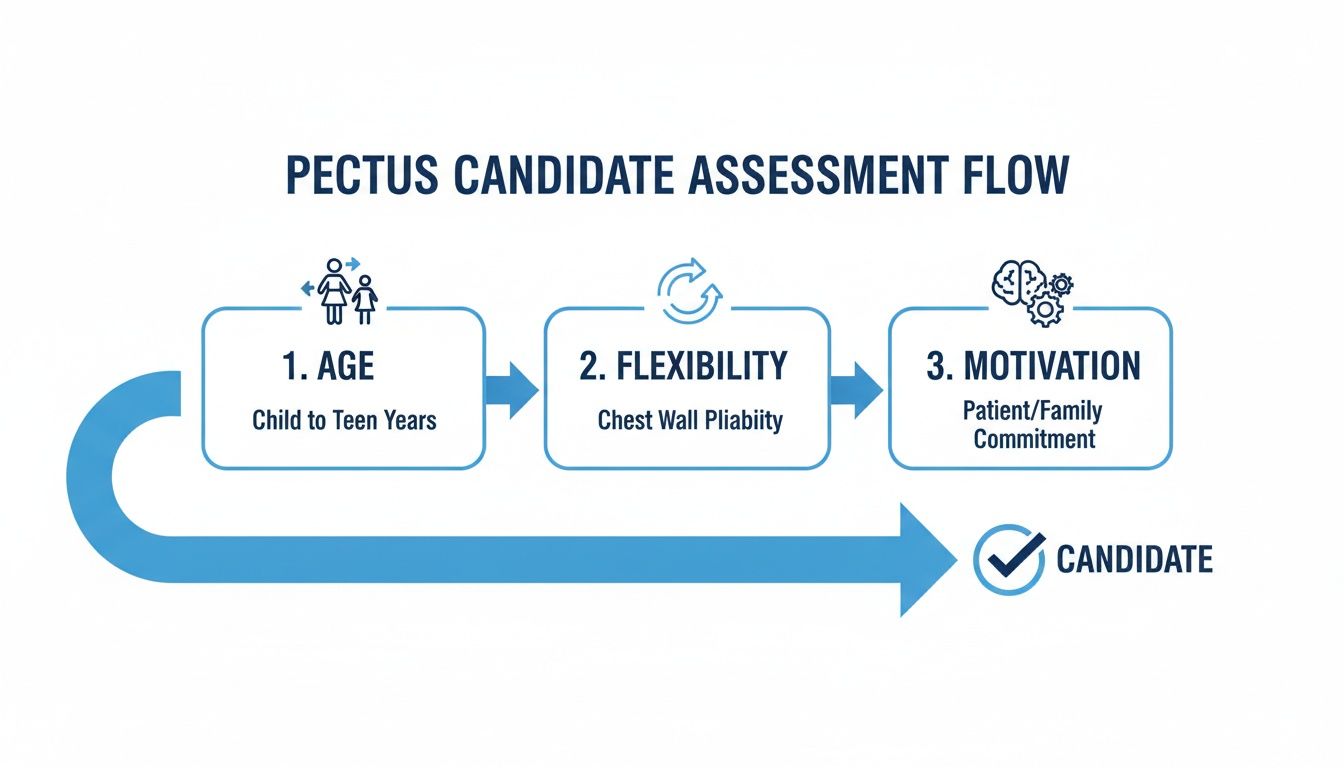
As you can see, a combination of physical readiness and a committed mindset really paves the way for the most successful outcomes.
Seeing the Transformation in Action
Sometimes, the best way to understand the process is to see it through someone else’s eyes. One of our patients, Alex, shared his experience, and it perfectly illustrates the impact of a dedicated bracing programme. His journey, from the initial consultation to the final, remarkable results, shows just how effective this treatment can be when managed by specialists.
You can watch Alex's complete transformation and hear about his experience in his own words in this video from our clinic.
Alex's story is a fantastic example of the positive change that’s possible with a custom brace and a consistent plan. Seeing his confidence return as his chest flattened was the best outcome we could have hoped for.
"The difference we see in our patients goes far beyond the physical correction. It's about restoring confidence and allowing them to get back to their lives without feeling self-conscious. That is always the ultimate goal."
Follow-Ups and Finishing Treatment
The journey doesn't stop once the brace is fitted. We'll schedule regular follow-up appointments to check on progress and make small adjustments as needed. As the chest begins to flatten, the brace will likely need to be tightened slightly to maintain that effective, corrective pressure.
Once the chest has reached the desired shape—a process that can take anywhere from several months to over a year—we start the final phase. Just like we ramped up the wear time at the beginning, we’ll now gradually reduce it. This weaning-off period is the final step, ensuring the correction holds firm and becomes permanent, marking the successful end of treatment.
What to Expect on Your Bracing Journey: A Realistic Guide to Success

Starting treatment with a pectus carinatum brace is a real commitment. Knowing what to expect is probably the most important factor in getting a great result, and it’s about more than just a flatter chest—it's about regaining confidence.
One of the first things we discuss is setting realistic goals. How long the treatment takes really depends on the individual, especially how flexible their chest wall is and, crucially, how consistently they wear the brace. The good news is that many people start to see noticeable changes within the first few months, which is a fantastic motivator to keep going.
Understanding Typical Timelines and Outcomes
When the plan is followed, bracing is incredibly effective. Clinics right here in the UK have seen that when patients stick with it, nearly everyone experiences an initial reduction in their chest prominence. In fact, studies point to success rates often exceeding 90%, resulting in either a full correction or a vast improvement that patients are delighted with.
It's important to remember that this is a gradual process. The brace applies gentle, consistent pressure that allows the chest wall to slowly remodel. The entire journey can take anywhere from several months to over a year, so patience and persistence are your best friends.
Navigating Common Challenges
Like any treatment, wearing a brace can have its moments, but any issues are almost always manageable. The most common thing we see is a bit of skin irritation or redness under the brace pads. This is usually easy to prevent by wearing a soft, seamless t-shirt as a barrier and making sure your skin is always clean and dry.
For some, exploring options for managing discomfort with complementary therapies can be a helpful part of the process.
There’s also a psychological side to it. Getting used to wearing a brace is a new experience, and staying motivated is key. I always tell my patients to focus on the end goal and to celebrate the small victories along the way—it makes all the difference.
"The most successful patients are those who see the brace not as a burden, but as their tool for change. They take ownership of their treatment, and that positive mindset is incredibly powerful in achieving a great result."
Jack's Story: A Real-Life Success
Let me tell you about Jack, a 14-year-old who felt his prominent chest was stopping him from enjoying sports and just being a teenager. He was an ideal candidate for bracing and really committed to the personalised schedule we created for him.
At first, he found sleeping with the brace a bit strange, but after a week or two, it just became part of his routine. With great support from his family and our team, and the boost he got from seeing early changes in the mirror, he stayed the course. Just over a year later, Jack finished his treatment with a result that completely transformed his confidence.
His story is a perfect example that while the process takes dedication, the physical and psychological rewards are absolutely worth it.
Comparing Modern Bracing Schedules
The way we approach bracing today is far more patient-friendly than it used to be. We now understand that less intensive schedules—which are much easier to stick to—can produce the same excellent results.
Below is a quick look at how modern protocols have evolved to improve both adherence and outcomes.
Comparison of Pectus Carinatum Bracing Protocols
| Bracing Protocol | Typical Daily Wear Time | Reported Adherence Rate | Success Rate |
|---|---|---|---|
| High-Intensity (Older Method) | 20–23 hours | Lower | High |
| Moderate (Modern Method) | 8–12 hours (often overnight) | Significantly Higher | Excellent |
As you can see, the modern approach is all about balancing effectiveness with quality of life. By focusing on schedules that patients can realistically follow, we've made achieving success with a pectus carinatum brace more manageable than ever.
Bracing vs. Surgery: Understanding Your Options
When it comes to treating pectus carinatum, families are often weighing up two main choices: non-surgical bracing or a surgical procedure. For the vast majority of children and teenagers we see, a custom-fitted pectus carinatum brace is the clear starting point and the gold-standard treatment.
Why? It's simple, really. Bracing works with the body's natural growth and flexibility to gently reshape the chest wall. It’s a highly effective, non-invasive approach that completely avoids the risks, recovery time, and scarring that come with any operation. We always think of it as the primary, preferred path for any suitable candidate.
When Might Surgery Be a Better Fit?
Of course, bracing isn't the perfect solution for everyone. There are a handful of specific situations where it might not be the best option, and a conversation about surgery becomes the right next step. We typically start to consider a surgical referral in a few key scenarios:
- A Very Rigid Chest Wall: Once a patient, usually an older adolescent or young adult, has stopped growing, their chest wall can become too stiff. At this point, it may not respond to the gentle, external pressure of a brace.
- When Bracing Hasn't Worked: It's rare, especially when the treatment plan is followed closely, but sometimes bracing just doesn't deliver the full correction we're aiming for.
- Patient Preference: Occasionally, an older patient might feel the long-term commitment of wearing a brace isn't for them and would prefer the more immediate result of a surgical correction.
It's crucial to know that we only suggest a surgical consultation after a thorough assessment confirms that bracing is unlikely to succeed.
Alex's Story: Choosing the Best Path
Let me tell you about Alex. He was 16 when he came to our clinic, concerned that his pectus had become much more noticeable over the last year. Like many teenagers, he was a bit wary about the idea of wearing a brace every day.
We sat down and had an open chat about all the options. We explained that because his chest was still flexible, he was a fantastic candidate for bracing with a very high chance of success. After seeing photos of the results other patients had achieved and realising he could completely avoid an operation, Alex was on board. He committed to the programme, and his hard work paid off beautifully—he got a fantastic result without ever needing to think about surgery again.
"Our philosophy is to always begin with the least invasive, most effective treatment. For most young people with pectus carinatum, that is unquestionably a custom-fitted brace. Surgery is a powerful tool, but one we reserve for when it's truly needed."
Modern Surgical Techniques
For the small number of patients who do need an operation, the good news is that surgical techniques have come a long way. Mr Scarci is a specialist in minimally invasive procedures like VATS (Video-Assisted Thoracoscopic Surgery) and robotic surgery. These modern approaches have massive advantages over older, traditional open surgery. We're talking smaller incisions, much less pain, and a significantly faster recovery.
This complete care pathway means every patient gets the right treatment for their unique situation, from conservative bracing all the way through to the very latest surgical solutions. You can explore more about the various alternatives to surgery for thoracic conditions to get a better sense of the full spectrum of care we offer.
Costs and Insurance for Pectus Bracing in London
For many families, one of the first and most important questions is about the cost of private treatment. It's completely understandable. Thinking about private pectus carinatum bracing in London naturally brings up questions about finances, so let's walk through what's involved.
The total cost isn't just for the brace itself. It's a complete care package that typically covers your initial consultation, the custom-moulded brace, and all the essential follow-up appointments where we track progress and adjust the fit.
We work with all the major private health insurers, like Bupa, AXA, and Aviva. Our team is well-versed in navigating their systems and can help you get the necessary authorisations for treatment.
A Patient's Story: Making Private Care Accessible
If you don't have private insurance or simply prefer to pay directly, we make sure our pricing is completely transparent from the start. We recently worked with the parents of a 15-year-old boy who were worried about long waiting lists. By opting to self-fund, their son was fitted with his brace and started treatment within a week of his first visit. Seeing their relief and his immediate start on the path to correction was incredibly rewarding for everyone.
We firmly believe that finances shouldn't stand in the way of getting the right care at the right time. That’s why we offer different ways to manage the cost. You can explore the finance options for thoracic surgery and treatments in the UK on our website to find what works for you.
Your Questions Answered: Life with a Pectus Carinatum Brace
Starting any new treatment comes with a lot of questions. It's completely normal. Here, I've gathered some of the most common queries I hear from families in my London clinic to help put your mind at ease.
Can my child still play sports?
Absolutely, and we actively encourage it! Keeping active is important. The simple rule is to remove the brace for any contact sports (like rugby or football), swimming, or really intense training sessions. This is just to protect both your child and the brace itself. For general running around or non-contact sports, it’s usually fine to keep it on, but we'll give you specific advice tailored to your child's activities.
How quickly will we see a change?
Patience is key, but the results can be surprisingly fast. While everyone's journey is unique, most families start to see a real, visible improvement in the chest's shape within the first 3 to 6 months of wearing the brace consistently. To get the full, permanent correction, the total time usually falls somewhere between 6 and 18 months, depending on how old your child is and how flexible their chest wall is.
"A common worry is whether the treatment will be too difficult to stick with. It’s always reassuring for families to learn that compliance rates in the UK are very high, often exceeding 80%."
What about skin irritation? Is that a problem?
It’s quite normal to see some mild redness on the skin where the brace pads sit, especially in the first few weeks. We manage this by having your child wear a soft, seamless cotton t-shirt underneath the brace and making sure the skin is always clean and dry. A study from St George's University found that while about 18% of patients experienced this mild irritation, it almost never became a reason to stop the treatment. You can read more about the study's excellent outcomes and high patient compliance.
A Patient's Story of Bracing with an Active Life
I recently worked with a 15-year-old rugby player who was convinced the brace would mean giving up his sport. We sat down and worked out a schedule that focused heavily on overnight wear, which left him completely free for training and matches. He was brilliant with his skincare routine and only took the brace off for the most intense sessions. The result? A fantastic correction in just over a year, and he never missed a moment of the sport he loves.
If you're ready to see how a custom pectus carinatum brace could work for your child, my team at Marco Scarci Thoracic Surgery is here to help. The first step is a simple consultation to get a clear picture and a personalised plan.

