
For many teenagers and their families, dealing with pectus carinatum, often called 'pigeon chest', can be a source of real self-consciousness. This condition, where the breastbone juts outwards, tends to become more obvious during the big growth spurts of adolescence. While the idea of surgery can seem intimidating, there's an incredibly effective non-surgical option available.
A pectus carinatum brace is a custom-fitted device that works a bit like orthodontics for the chest. It applies gentle, steady pressure to guide the protruding breastbone back into a more natural position over time. For younger patients whose chest walls are still flexible, it's often the very best first step.
How Does a Brace Actually Work?
Think about how braces slowly move teeth into alignment. A pectus brace operates on a similar principle. By applying precise, constant pressure to the most prominent part of the chest, it encourages the still-pliable cartilage and bone to remodel. Gradually, the chest wall flattens out.
This process is most successful in children and adolescents whose skeletons haven't finished growing, making their chest walls much more responsive to this gentle guidance.
The goal of bracing is simple but powerful: to reshape the chest wall without needing an operation. It's about restoring a natural chest contour, which in turn boosts confidence and helps young people feel better about their bodies.
Who Is a Good Candidate for Bracing?
Pectus carinatum is more common than you might think. It primarily affects adolescent boys, with studies showing a male-to-female ratio of about 3 or 4 to 1. The condition often becomes noticeable around early puberty.
This timing is actually a good thing, as it lines up perfectly with the window when bracing is most effective. Most patients start a bracing programme between the ages of 9.5 and 12.5 years old, right when they’re hitting that pubertal growth spurt.
It's important to remember this isn't just about appearances. We see many young patients who are hesitant to take their shirt off for sports or swimming. The psychological impact can be significant. By offering a non-surgical path, we can address these very real concerns without the risks and downtime of an operation.
You can learn more about the different types of chest wall deformities and their treatments.
Your Pectus Carinatum Brace Journey, Step by Step
Starting treatment with a pectus carinatum brace can feel like a big commitment, but understanding the road ahead makes the entire process feel much more manageable. Think of this as your roadmap, guiding you from that first appointment right through to celebrating your final results.
The Initial Consultation and Assessment
Everything begins with a detailed consultation. The main goal of this first meeting is simple: to figure out if bracing is the right path for you. A specialist will take a close look at your chest, and one of the most important things they'll assess is the flexibility of your chest wall. A pliable chest wall is a fantastic sign, as it responds beautifully to the gentle, steady pressure of a brace.
We’ll also chat about your lifestyle, hobbies, and what you hope to achieve. This isn't a one-way street; it's a conversation to make sure the treatment plan fits seamlessly into your life.
Custom Fitting Your Pectus Carinatum Brace
Once we’ve agreed that bracing is the best option, we move on to the custom fitting. No two people are the same, and neither are their chests, so an off-the-shelf brace just won't cut it. We use precise measurements or even a digital scan of your torso to create a brace that's made just for you.
This tailored approach ensures the brace applies pressure exactly where needed, maximising its corrective power while keeping you comfortable. The end result is a lightweight, low-profile device you can wear discreetly.
Why a Custom Fit Matters: A bespoke brace is the cornerstone of successful treatment. It guarantees that the corrective force is perfectly targeted and that the device is comfortable enough to wear consistently—and consistency is everything.
The principle behind it is quite straightforward, as this diagram shows.
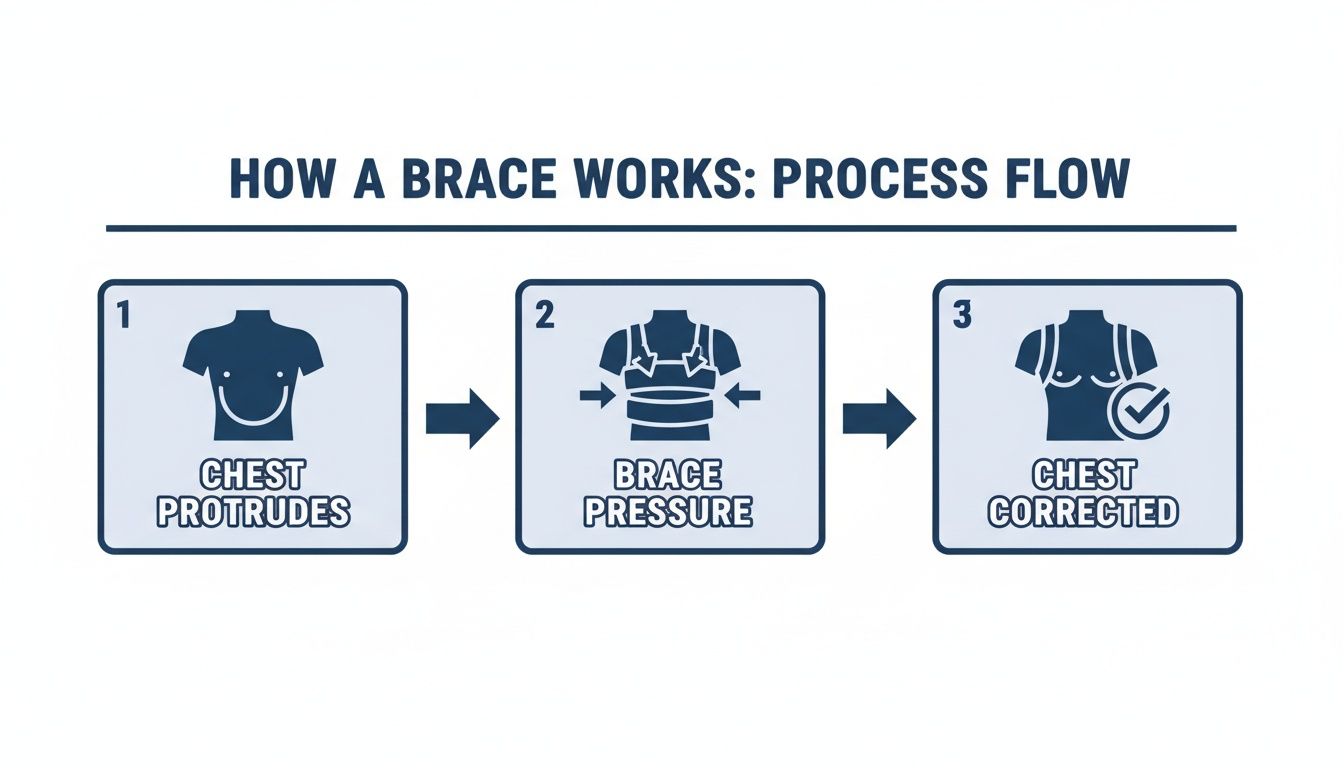
It's all about applying constant, gentle pressure to gradually remodel the cartilage and bone into a flatter position.
Your Daily Wear Schedule
If there’s one secret to a great result with bracing, it’s consistency. Your specialist will map out a daily wear schedule, but the idea is to integrate it into your routine, not take over your life. Most patients wear their brace at home in the evenings and overnight, leaving them completely free for school, sports, and hanging out with friends.
While schedules can vary, the evidence from UK specialist centres is clear. A review by the Scottish Health Technologies Group found that more manageable schedules of 8–12 hours per day often result in better adherence (around 89.6%) without slowing down progress. This really drives home that a realistic schedule you can stick to is the key to success.
Regular Monitoring and Adjustments
Getting the brace fitted is just the beginning. Regular follow-up appointments are a crucial part of the journey. We'll typically see you every few months to:
- Track your progress: We’ll take measurements to see how your chest is reshaping and make sure everything is on track.
- Adjust the brace: As your chest changes, the brace will need small tweaks to maintain the ideal pressure.
- Answer your questions: These appointments are your time to discuss anything, from comfort and skin care to your wearing schedule.
These check-ins ensure the treatment stays effective, safe, and comfortable from start to finish.
This journey is broken down into distinct phases, each with its own focus and timeline.
Here’s a look at what you can typically expect:
Typical Pectus Carinatum Bracing Timeline
| Phase | Key Activities | Typical Duration |
|---|---|---|
| 1. Assessment & Fitting | Initial consultation, chest flexibility check, clinical photos, and custom brace measurement/fabrication. | 2-4 weeks |
| 2. Active Correction | Daily brace wear (8-12+ hours/day), regular follow-up appointments every 2-3 months for adjustments and progress monitoring. | 6-18 months |
| 3. Weaning & Stabilisation | Gradual reduction in daily brace wear time once the desired correction is achieved. | 3-6 months |
| 4. Completion | Final review and discontinuation of the brace. | N/A |
This table provides a general outline, but remember, every patient's journey is unique and will be tailored to their specific clinical needs and rate of correction.
Completing Treatment and Weaning Off the Brace
After months of dedicated wear, you'll reach the final phase. Once your chest has reached its target shape, you don't just stop wearing the brace overnight. Instead, we'll guide you through a gradual weaning process.
This means slowly cutting back on the number of hours you wear the brace each day. This gives the chest wall time to solidify in its new position, dramatically reducing the chance of it springing back. Finishing this phase successfully marks the end of your active treatment and the start of enjoying a fantastic, long-lasting result.
A Patient's Story: From Self-Conscious to Confident
Sometimes the best way to grasp what a treatment really involves is to hear from someone who has been through it. Clinical terms and statistics can tell you what a pectus carinatum brace does, but a personal story can show you what it feels like. This is the journey of one of our young patients, a keen rugby player, from self-consciousness to a well-earned sense of confidence.
Like so many teenagers, he first became aware that his chest looked different around age 13, right in the middle of a summer growth spurt. What had been a barely noticeable bump seemed to become more prominent, making him think twice about taking his t-shirt off at the beach or during PE. It wasn't causing him any pain, but it was a constant source of worry.
His main concern was about his rugby. Would treatment mean he’d have to give up the sport he loved? After talking with his family, they sought expert advice, relieved to discover that a non-surgical brace was the ideal solution and that it wouldn't interfere with his active lifestyle.
Getting Started with the Brace
That first appointment was a game-changer. We confirmed his chest wall was still flexible—perfect for bracing. The plan was explained clearly: a custom-fitted brace would apply steady, gentle pressure to reshape his chest. Crucially, the wearing schedule was designed for evenings and overnight, leaving his days completely free for school and rugby.
Getting the brace fitted was a simple process. After taking precise measurements, his bespoke device was ready a few weeks later. He was surprised by how light and discreet it was. He said the firm pressure felt strange at first, but not painful.
"The first week was an adjustment, but once I got into the routine of putting it on after school, it just became a normal part of my day. I could still do my homework, watch TV, and sleep fine, and I never had to miss training."
This consistency was the key. He stuck to the schedule, knowing that every hour he wore the brace was another step towards his goal.
Seeing and Feeling the Difference
It wasn't long before the hard work started to pay off. After just a few months, he could see the first real changes in the mirror—his chest was gradually getting flatter. Seeing that progress was a massive motivator. His follow-up appointments confirmed the improvement, and we made minor tweaks to the brace to maintain optimal pressure as his chest continued to reshape.
After about a year of consistent use, the results were fantastic. The protrusion had gone down significantly. The final stage involved a gradual "weaning" period, where he wore the brace less and less to allow the chest wall to stabilise in its new position. The physical transformation was incredible, but the change in his confidence was even more profound. The old hesitation and worry had been replaced with a sense of pride and relief.
You can hear more about his experience and see how the treatment fit around his life in the video below. It’s stories like this that show how a simple device, combined with dedication, can truly make a life-changing difference.
Comparing Your Treatment Options: Bracing vs Surgery
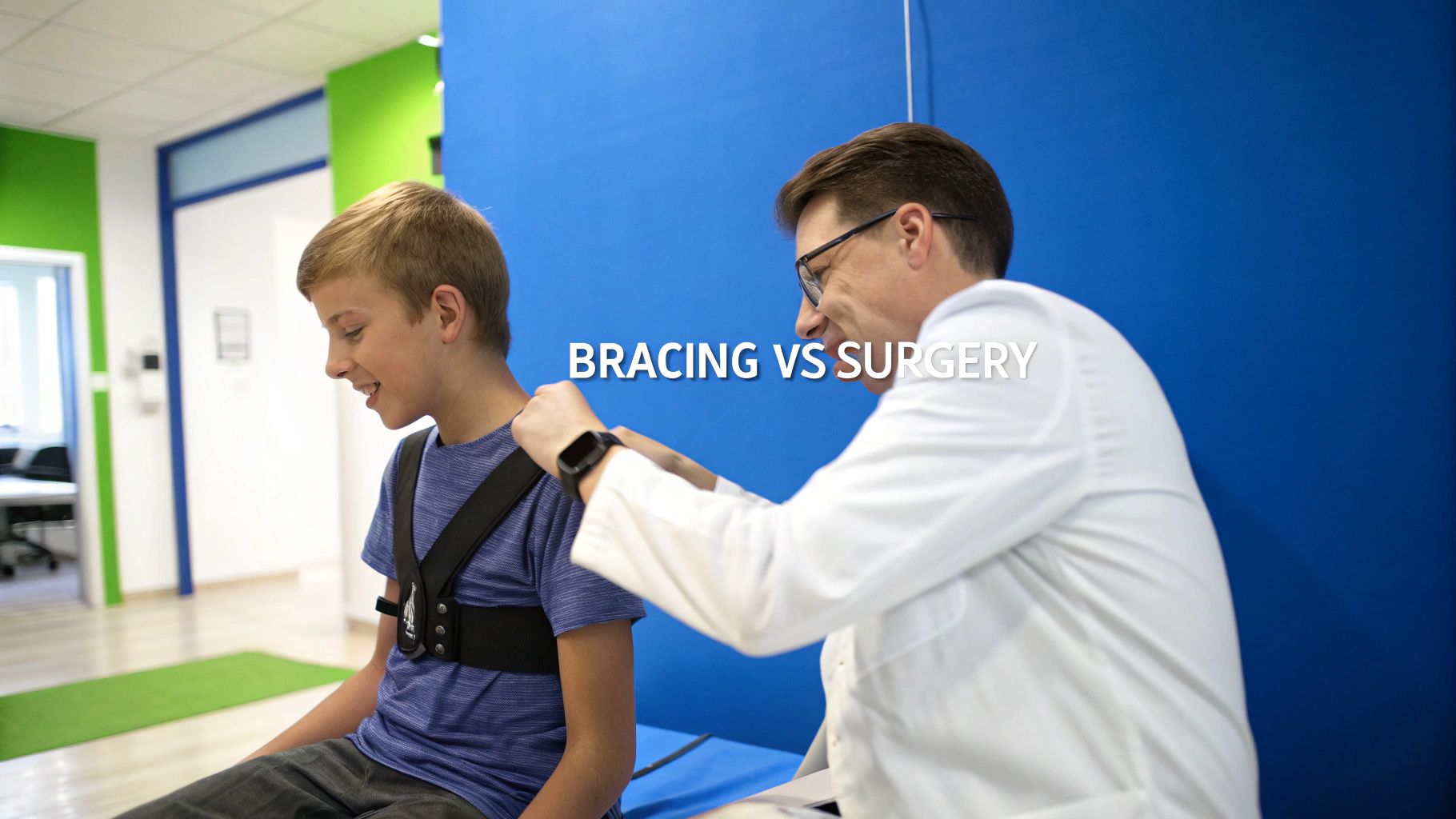
When you’re looking at how to manage pectus carinatum, it really comes down to two main paths: non-surgical bracing and surgical correction. Understanding the pros and cons of each is the first step towards making a confident decision for yourself or your child.
For the vast majority of my younger patients, the journey always starts with the least invasive, most effective option available. That’s where the pectus carinatum brace comes in as the gold-standard, first-line treatment.
The reasoning behind this is quite simple. In children and adolescents, the chest wall is still growing and remarkably flexible. This natural pliability means it responds incredibly well to the gentle, consistent pressure from a custom-fitted brace. Think of it as a highly successful, conservative approach that helps most patients avoid an operation entirely.
Surgery, on the other hand, tends to be reserved for very specific circumstances. It’s a much better fit for adults whose chest walls have fully matured and hardened, meaning they won't respond to external pressure. It can also be the right choice for someone who, for one reason or another, didn't get the result they wanted from bracing.
Who Is the Ideal Candidate for Each Method?
Figuring out the best treatment path really hinges on the patient's age and, crucially, their chest wall flexibility. This initial hands-on assessment is one of the most important things I do.
A pectus carinatum brace is the perfect fit for someone who is:
- A child or adolescent. The treatment is most effective during the pubertal growth spurt when the chest is at its most malleable.
- Assessed as having a flexible chest wall. I can determine this during a physical examination.
- Ready to be consistent. The success of bracing is all about sticking to the prescribed daily wear schedule.
Surgery may be the more appropriate route for:
- Adults with a rigid, mature chest wall. Once the skeleton has stopped growing, bracing simply won't work.
- Individuals with particularly severe or complex deformities. In very rare cases, the protrusion is too significant for a brace to handle alone.
- Patients where a well-managed bracing programme was unsuccessful. If bracing doesn't deliver the expected results, surgery becomes the next logical step.
Key Differences at a Glance
Making a decision is easier when you can see the differences side-by-side. The table below helps clarify why bracing has become the established starting point in modern thoracic care.
Pectus Carinatum Treatment Comparison: Brace vs Surgery
| Factor | Pectus Carinatum Brace | Surgical Correction |
|---|---|---|
| Invasiveness | Non-invasive, external device worn on the body. | An invasive surgical procedure that requires general anaesthesia. |
| Recovery Time | No downtime. Normal activities can continue as usual. | Several weeks to months of recovery with significant activity restrictions. |
| Primary Risks | Minor skin irritation, which is almost always manageable. | Standard surgical risks like infection, pain, and scarring, plus risks from anaesthesia. |
| Treatment Setting | Fully outpatient. The treatment is managed from home with follow-up appointments. | Requires a hospital stay, followed by weeks of post-operative care at home. |
This table shows a clear contrast. The brace offers a way to correct the chest shape without the disruption, risks, and lengthy recovery that come with an operation.
A Patient’s Story: Choosing Bracing
Let me share a typical story that illustrates this perfectly. I recently saw a 15-year-old boy who was getting more and more self-conscious about his chest. His parents were worried, but like most, they were very hesitant about the idea of surgery.
During our consultation, the deciding factor was his chest wall flexibility – it was still pliable enough for a brace to work beautifully.
The choice became obvious. Why put him through an invasive operation with a long, painful recovery when a non-surgical method had such a high chance of success? He began a bracing programme, wearing the device mainly overnight. We started seeing results within a few months, and after just over a year, he had a full correction. His story is one I see all the time, and it highlights the clinical logic we follow: always start with the safest, least disruptive treatment that can get the job done.
For young patients, bracing represents a powerful opportunity to correct the chest wall deformity effectively, sidestepping the significant physical and emotional demands of a surgical operation and its lengthy recovery period.
Ultimately, my goal is to find the clearest, safest path to a successful outcome. By starting with a pectus carinatum brace for every suitable candidate, we're not just following best practice—we're prioritising our patients' safety and comfort while achieving excellent, lasting results.
How to Get Pectus Carinatum Treatment in London
Once your child has a pectus carinatum diagnosis, the next question is always, "What do we do now?" In the UK, you essentially have two paths you can take: the National Health Service (NHS) or the private healthcare sector. Both can deliver fantastic results, but the journey, particularly the speed and ease of access, can be quite different.
For many families, trying to get a pectus carinatum brace through the NHS can mean long waits. There's the wait for the initial GP referral, then another wait to see a specialist, and finally, a further delay before treatment can actually begin. When you're dealing with a condition where timing is everything—especially during a teenager's growth spurt—these delays can be a real source of anxiety.
This is why many families find the private healthcare route in London to be a much more straightforward alternative.
The Advantages of Going Private
Choosing a private consultation with a specialist thoracic surgeon gives you a direct, fast-tracked approach. Instead of waiting months just for that first appointment, you can often be seen within a week or two.
This speed is more than just a convenience. Getting an earlier assessment means a faster diagnosis and, if bracing is the right call, getting a custom plan underway immediately. This proactive approach ensures you're starting treatment during that critical window when the chest wall is still flexible, giving you the best possible chance of correcting the condition without surgery.
For so many families, the single most important factor is being able to skip the long waiting lists and get started straight away. It brings peace of mind and puts their child on the path to recovery without losing precious time.
An NHS evidence review itself points out that while surgery is an option, most patients are managed with non-surgical treatments like bracing. The review stresses that successful bracing programmes need structured, regular follow-ups, usually every three months. This really highlights the value of private care, which can provide this prompt assessment and consistent follow-up without the typical NHS delays. You can read more about the findings from this NHS evidence review yourself.
How to Manage the Costs of Private Care
Of course, one of the first questions that comes up is about cost. It's vital to have full transparency, and thankfully, there are a few different ways to fund private care.
- Paying for Treatment Yourself: Many families choose to self-fund the treatment directly. A good clinic will provide a clear, itemised quote that covers everything—the initial consultation, the custom-made brace, and all the follow-up appointments. Financing plans are also often available to help you spread the cost.
- Using Private Health Insurance: If you have a private medical insurance policy, it may well cover the treatment. Major providers like Bupa, AXA, and Aviva often cover consultations and treatment for chest wall conditions. It's always wise to call your provider first to check the details of your cover and get a pre-authorisation code.
Choosing a clinic in London means you have access to some of the world's best medical facilities. As you research your options, look for clinics that use efficient medical appointment scheduling software, as this can make the whole process of booking your first consultation much smoother. For more insight, you might find our guide on some of the best private hospitals in London helpful.
A Patient's Story: Accessing Private Care
I recently treated a 14-year-old boy who was becoming incredibly self-conscious and withdrawn because of his pectus carinatum. His family had gone to their GP and got a referral, but they were told the wait to see an NHS specialist could be as long as a year. They were terrified of missing the best window for treatment while he was still growing.
They decided to seek a private consultation. Just ten days after they first got in touch, I saw him in my clinic. We confirmed his chest was an ideal candidate for bracing and took all the measurements for his custom device right there and then. He started his treatment just three weeks later. For his parents, that speed and direct access took away all their anxiety. It empowered them to take control of the situation and get their son the help he needed, right when it mattered most.
Your Pectus Carinatum Brace Questions Answered
Even with all the information, it's natural to have more questions. A pectus carinatum brace becomes a big part of a young person’s life for a good few months, so feeling completely comfortable and in the know is vital for a confident start. Here, we’ve put together the most common questions we hear from patients and families, with clear, straightforward answers.
How Long Will I Actually Need to Wear the Brace?
This is usually the first thing everyone wants to know. While it’s a bit different for everyone, most people actively wear their brace for anywhere between 6 to 18 months. The main things that affect this timeline are how prominent the pectus is, how flexible the chest wall is, and—this is the big one—how consistently the brace is worn.
Think of it like training at the gym; consistent effort over time gets the best results. Once we've achieved the shape we're aiming for, there's a "weaning" period for another 3 to 6 months. During this final stage, you'll gradually wear the brace for fewer hours each day, which really helps to lock the new chest shape in place for good.
Is the Pectus Carinatum Brace Painful?
A well-fitted brace should never be painful. When you first start, you’ll definitely feel a firm, constant pressure, which can feel a little odd, but it absolutely shouldn't hurt. The whole idea is to apply gentle, corrective force, not to cause any real discomfort.
The most common issue is some minor skin irritation or redness under the pads. This is usually easy to manage with good hygiene and by always wearing a thin, seamless t-shirt underneath. If any real pain or significant skin problems pop up, it’s a clear sign the brace needs a small adjustment, which is a quick and simple fix at a follow-up appointment.
Can I Still Play Sports and Do Normal Stuff?
Absolutely! One of the best things about modern bracing is that it’s designed to fit into your life, not take it over. Since the schedule usually involves wearing it in the evenings and overnight, your days are completely free for school, sports, and whatever else you’re into.
You just take the brace off for things like PE, football training, or going for a swim, and then pop it back on afterwards. The treatment plan is specifically set up to make sure you don't miss out on the things you love doing.
What Happens If I Skip Wearing the Brace?
Honestly, consistency is the secret sauce for a great result. Missing a single night here or there won't throw things off course, but regularly skipping wear time will definitely slow things down and make your overall treatment take longer.
The brace works by applying non-stop pressure to gently reshape the chest cartilage. If that pressure isn't consistent, the cartilage can start to spring back towards its original position, basically undoing some of the hard work you’ve already put in. Sticking to your schedule is the fastest and most effective way to get a fantastic, lasting result.
Could the Pigeon Chest Come Back After Treatment?
This is a really important question. When the treatment is seen through to the end properly—including that gradual weaning-off phase—the risk of it coming back is very low. That weaning period is critical because it gives the chest wall time to stabilise and "set" in its corrected position.
Following the full plan laid out by your specialist gives you the absolute best chance of a permanent correction. For a deeper look into how it all works, our detailed guide on the brace for pectus carinatum has more information.
The goal of a structured bracing programme isn't just to correct the chest's appearance now, but to ensure that correction is stable and long-lasting, giving you confidence for years to come.
How Obvious Is the Brace Under Clothes?
Today's pectus carinatum braces are designed to be as discreet as possible. They are lightweight and contoured to fit snugly against the body. When worn under a t-shirt and a jumper or hoodie, it's usually not noticeable to other people at all.
This low-profile design helps patients feel much more comfortable and confident, especially at the beginning of treatment. Most people find that after a very short time, they barely notice they're wearing it, and their friends and classmates are none the wiser.
If you have more questions or you’re ready to see if a pectus carinatum brace is the right path for your child, the team at Marco Scarci Thoracic Surgery is here to help. We offer quick access to expert consultations, giving you a clear diagnosis and a personalised treatment plan without a long wait.
Book your consultation today to take the first step towards a confident future.

