
When you're considering private pectus excavatum surgery in the UK, the first number you’ll probably hear is a range from £17,000 to £25,000. It's a significant figure, and what you ultimately pay will depend on the surgical technique used, the hospital you choose, and the unique complexity of your situation.
Figuring out the financial side of this surgery can feel overwhelming, but it really boils down to two main routes in the UK: pursuing treatment through the NHS or self-funding a private procedure. Each path has its own set of rules and costs, and understanding them is key to moving forward.
Understanding the Pectus Excavatum Surgery Cost Spectrum
For most people, the journey starts with the NHS. Pectus excavatum is fairly common, affecting around 1 in 400 births in the UK. Despite this, getting the surgery funded by the NHS has been a rollercoaster.
Funding was largely stopped around 2019 before the policies were revisited. As of 2023, NHS England will only fund surgery for the most severe cases, and every single one is reviewed by a national expert multi-disciplinary team. This centralisation means all care is delivered at just two hospitals in England, which often means navigating a long and very strict qualification process.
NHS vs Private Care
Because the NHS criteria are so tight, many people with noticeable deformities that impact their quality of life find they don't qualify for treatment on the NHS. This is where private healthcare provides a crucial alternative, offering much faster access to specialist care.
So, the choice between NHS and private often hinges on a few key things:
- Urgency and Waiting Times: Going private means you can schedule surgery relatively quickly, completely bypassing the long NHS waiting lists.
- Surgeon and Hospital Choice: The private route gives you the freedom to choose your surgeon and the hospital where you feel most comfortable.
- Eligibility: Private care is an option for everyone, whether you meet the strict physiological and psychological criteria set by the NHS or not.
"I remember feeling completely lost. The NHS said my case wasn't severe enough, but the dent in my chest was affecting my confidence and even my breathing during exercise. The thought of waiting years with no guarantee was disheartening. Deciding to go private was about taking back control."
Getting to grips with these different pathways is the first step toward making a decision you feel good about. For a deeper dive into various chest wall conditions, you can explore our comprehensive guide on https://marcoscarci.co.uk/conditions/chest-wall-deformities/. It's also worth looking into broader strategies for reducing healthcare costs to get a better handle on managing the overall expense.
Navigating the NHS Pathway for Pectus Surgery
For most people in the UK, the NHS is the natural first step for any health issue. When it comes to pectus excavatum, getting surgery through the NHS is possible, but it’s a path reserved for those with the most severe physiological symptoms. The days when pectus surgery was more widely available are behind us; the system now runs on a much tighter, evidence-based framework.
This means that having a visible chest indentation, no matter how much it affects your confidence, isn't enough to qualify for NHS treatment. The health service has set out very clear, measurable benchmarks to distinguish between cosmetic concerns and medically necessary surgery. It’s a way of making sure that limited resources go to patients whose health is genuinely at risk from the condition.
The Strict Criteria for NHS Funding
To even be considered for NHS-funded surgery, your case has to show significant functional problems. The whole assessment really boils down to a few key clinical signs that prove the deformity is impacting how your body works.
The main measurement they use is the Haller Index, which is calculated from a CT scan of your chest. To meet the NHS threshold, your Haller Index must be greater than 3.25. A number this high points to a severe level of compression inside the chest.
But the Haller Index alone isn't enough. You also need to show clear evidence that your heart and lungs are being squeezed or pushed out of place by your sternum. This usually involves tests that can link the compression to symptoms like:
- Shortness of breath, especially during exercise
- Poor stamina and getting tired easily
- Chest pain or heart palpitations
The Referral and Assessment Process
It all starts with your GP. If they believe your symptoms are serious enough to look into further, they can refer you to a specialist for the required scans and tests. Once those results are in, they’re sent off to a national Multi-Disciplinary Team (MDT) to be reviewed.
Think of this expert panel as the gatekeepers for NHS pectus surgery. They scrutinise every single case against the strict national criteria. Following policy changes after 2023, the NHS has funnelled all pectus care into just two specialist centres in the entire country. This was done to manage the historically high demand and ensure surgery is only offered when absolutely necessary, while also gathering more data on its long-term value. You can read more about the NHS England commissioning policy and its evidence review for the full details.
A Patient’s Perspective
"I spent years feeling breathless and frustrated. My GP was sympathetic but explained the NHS bar was incredibly high. We went through all the tests—the CT scan, the heart echoes. Waiting for the MDT's decision was agonising. It felt less like a medical process and more like an application. It was a stark reminder that the NHS path is only for the most extreme cases, which is why so many of us end up looking for private alternatives to reclaim our quality of life sooner."
If the MDT gives your case the green light, you’ll be put on the waiting list at one of the two national centres. If you don't meet the criteria, you’ll be told your condition doesn’t qualify for NHS funding, which leaves private treatment as the main alternative.
What a Private Surgery Quote Actually Includes
When you first get a quote for private pectus excavatum surgery, it's easy to focus on that one big number at the bottom of the page. But that figure isn't just pulled out of thin air. A proper, transparent quote is a detailed breakdown of every single service, specialist, and resource needed to get you from your first consultation to your final recovery.
Think of it like getting a detailed estimate from a master builder. The final price isn't just for labour; it covers the architect's designs, the raw materials, and the specialised skills of every tradesperson involved. Your surgical quote works the same way, bundling together all the essential components to ensure a safe and successful outcome.
The image below shows the strict criteria, like a Haller Index greater than 3.25, that the NHS uses to determine eligibility for funded surgery. This is a major reason why so many people turn to private care, as their condition may be significant but not meet these specific physiological thresholds.
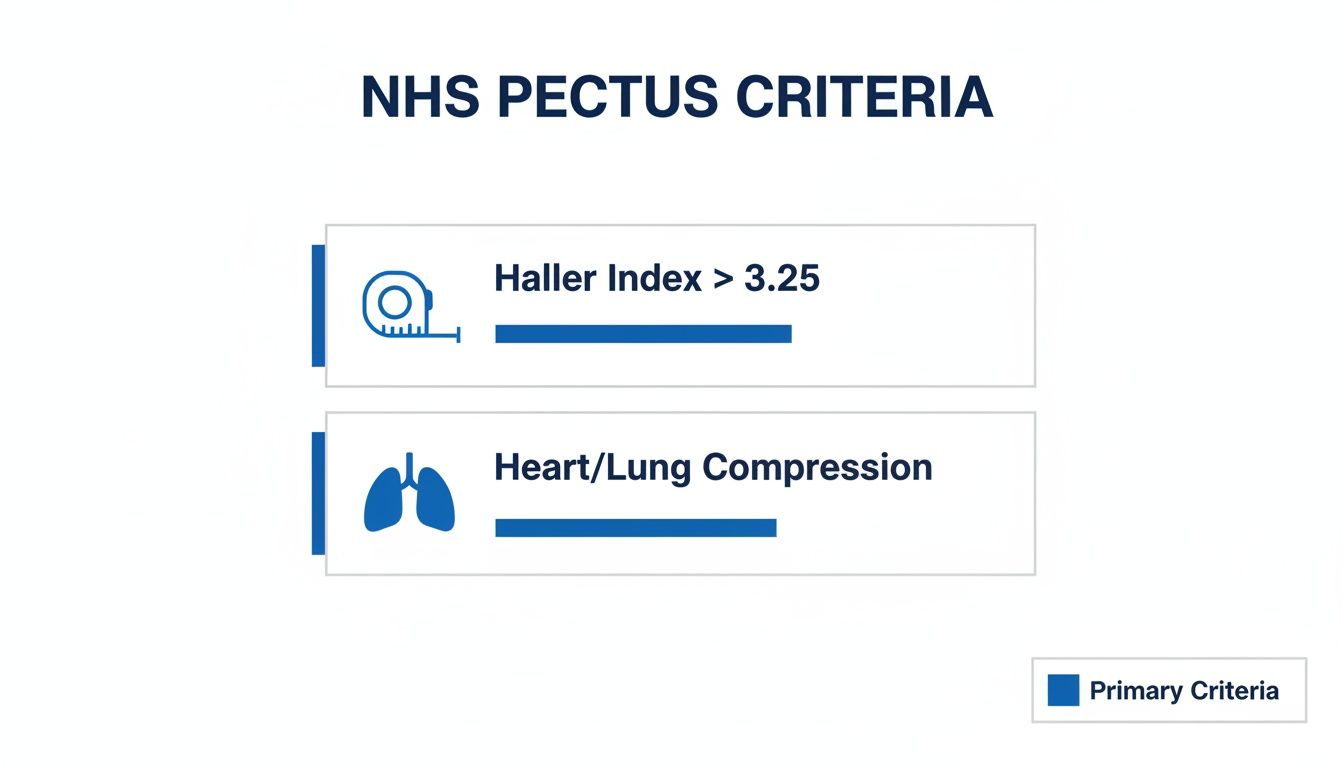
As you can see, NHS funding is quite rightly reserved for the most severe cases where there's clear evidence of heart or lung compression. This leaves a large number of people who are still deeply affected by their pectus to find a solution privately.
Itemising Your Surgical Bill
So, what exactly are you paying for? A good quote will be completely transparent, leaving no room for surprise costs later on.
Here’s a look at the typical line items you should expect to see:
- The Surgeon's Fee: This isn't just for the time spent in the operating theatre. It covers the surgeon's specialist expertise, the planning of your unique procedure, and all your follow-up appointments.
- The Anaesthetist's Fee: A highly skilled anaesthetist is crucial for your safety and comfort throughout the operation. This fee covers their professional time and management of your anaesthesia.
- Hospital Charges: This is often the largest single component. It includes the cost of using the operating theatre, your private room, 24/7 nursing care, and all the medications and consumables used during your stay.
- Cost of Implants: For a Nuss procedure, this is the price of the bespoke metal bar (or bars) that will reshape your sternum. The cost can vary depending on the type and number of implants required.
These are usually bundled into an all-inclusive package price, which is a good thing—it gives you a fixed cost and peace of mind. For a more personalised estimate based on your situation, you can use our London private thoracic surgery cost estimator.
A Patient’s Experience Understanding the Quote
"When I first saw my quote, I'll admit my heart sank a bit," one of my recent patients told me. "It was just a big number, and I didn't really grasp what it all covered. But then the team sat down with me and walked through it, item by item."
"Seeing it broken down made all the difference," he said. "It stopped being this one scary figure and became a clear, understandable investment in my health. I realised I wasn't just paying for an operation; I was paying for a whole team of experts, a top-class hospital, and the specific implant that was going to fix my chest. That transparency gave me the confidence I needed to go ahead."
Itemised Cost Comparison for Nuss vs Ravitch Procedures
The two main surgical approaches, the Nuss and Ravitch procedures, have different cost structures. While one might seem cheaper in one area, it can be more expensive in another. This table breaks down how the costs typically compare.
| Cost Component | Nuss Procedure (Estimate) | Ravitch Procedure (Estimate) | Notes |
|---|---|---|---|
| Surgeon’s Fee | ££ | £££ | The Ravitch is a more complex open procedure, often requiring a higher surgical fee. |
| Anaesthetist’s Fee | ££ | £££ | Correlates with the length and complexity of the surgery; Ravitch is typically longer. |
| Hospital Charges | ££ | £££ | A longer hospital stay is often required for Ravitch recovery, increasing these costs. |
| Implant Costs | £££ | £ | The Nuss requires a custom titanium bar, which is a significant cost. Ravitch rarely uses implants. |
Ultimately, while the Nuss procedure has a higher upfront cost for the implant itself, the Ravitch can often end up being more expensive overall due to the longer time needed in the operating theatre and for in-patient recovery. The quote you receive will reflect the expertise, technology, and total care package dedicated to achieving the best possible outcome for you.
What Actually Affects the Final Cost of Your Surgery?
So, why isn't there just a single, fixed price for pectus excavatum surgery? It's a fair question. The answer is that your surgery is as individual as you are. The final figure isn't a simple price tag; it's a completely bespoke quote that reflects the nuances of your anatomy and the specific surgical plan we create together.
Think of it this way: you’re not buying an off-the-shelf product. You’re investing in a custom-built solution for your body. Let's break down the main variables that can cause the total cost to shift, sometimes quite significantly.
Your Own Anatomy and Surgical History
This is, without a doubt, the biggest factor. No two chest walls are the same, and the complexity of your particular case will directly influence the time, skill, and resources needed to get the best result.
Here's what we look at:
- Severity of the Indent: A deeper, more pronounced pectus often requires a more intricate and longer procedure. This naturally impacts the surgeon's fee and the time you'll need in the operating theatre.
- Symmetry (or Lack Thereof): Many patients have an asymmetrical defect, where one side of the chest is more sunken than the other. This presents a much trickier surgical puzzle to solve and may require more complex bar shaping or even multiple implants to achieve a balanced look.
- Previous Operations: If you're coming to us for a revision surgery, the procedure is automatically more complex. Dealing with old scar tissue and working around altered anatomy demands a huge amount of experience and takes more time, which is reflected in the cost.
Your Choice of Surgeon and Hospital
Where you have the surgery and who performs it are massive parts of the cost equation. These choices aren’t just about location; they’re about the level of expertise, care, and service you’ll receive.
A consultant's experience is a primary driver. A surgeon who has performed thousands of these operations, especially using minimally invasive techniques, will rightly command a higher fee. What you're paying for is that deep well of experience—a proven track record of safety, precision, and fantastic outcomes.
The hospital itself plays a big role, too. A top clinic in Central London, for instance, has higher running costs than a hospital elsewhere, and that gets factored into the patient's bill. The quality of the facilities, the nurse-to-patient ratio, and the standard of post-operative care all contribute to the hospital's fees.
"I admit I had a bit of sticker shock when I first saw the quotes," a recent patient told me. "But then my surgeon sat me down and explained that my asymmetry was particularly severe. He pulled up 3D models and showed me exactly why a standard, single-bar approach wouldn't work for me and why I needed two custom-shaped bars. It just clicked. I realised I wasn't paying for a generic operation; I was paying for a plan designed just for my chest. That change in perspective made me feel so much more confident in the investment."
The Cost of Implants and Technology
For a Nuss procedure, the hardware itself—the titanium bar or bars—is a significant line item on your bill. It’s not a one-size-fits-all situation.
While some people only need a single, standard-sized bar, many complex cases require more:
- Multiple Bars: Often necessary to support a correction across a wider or deeper area of the chest.
- Custom-Shaped Implants: For very unusual chest shapes or severe asymmetry, we may need to have bars specially fabricated to get that perfect contour.
- Advanced Fixation: Sometimes we need special stabilisers or securing techniques to ensure the bars stay exactly where they need to be, which can add to the material costs.
Each of these additions is there for a reason: to give you a better, more stable, and longer-lasting result. While they do add to the total cost, they are crucial for a successful outcome. At the end of the day, the price reflects the unique needs of your body and the expertise required to meet them.
Alex's Story: From Consultation to Recovery
While numbers and itemised bills give you the logical breakdown of pectus excavatum surgery costs, they can feel a bit sterile. They don't quite capture the very human story behind the decision to have surgery—a choice often made after years of frustration and a powerful desire for change.
To paint a clearer picture of what this journey actually looks like, let's follow the story of a patient we'll call 'Alex'.
For most of their life, Alex had carried the psychological weight of their condition. Summers brought on a familiar dread, and simple things like a trip to the gym felt like being under a spotlight. After a quick look into the NHS pathway, the reality of long waiting lists and strict criteria sank in, leaving Alex feeling powerless. It was at that point they decided to take matters into their own hands and see what the private route could offer.
That decision led them to a consultation with Mr Marco Scarci and his team.
The Moment of Clarity
Alex walked into the consultation room armed with questions but also weighed down by a great of uncertainty. The conversation that followed was the real turning point. Mr Scarci didn't just launch into surgical details; he listened. He wanted to understand Alex's lifestyle, their goals, and the real-world impact the condition had on their day-to-day confidence.
Using detailed imaging, he walked Alex through the specific anatomy of their chest, explaining exactly why a certain minimally invasive technique would deliver the best outcome. It wasn't a generic pitch but a surgical plan built just for them. For the first time, Alex could see a clear path forward.
Then, they discussed the cost. A transparent, all-inclusive quote was laid out, breaking down every single element—the surgeon's fee, the anaesthetist, the hospital stay, and the custom implant. Having it all itemised demystified the process and removed the fear of hidden surprises.
"Suddenly, it wasn't just one big, scary number anymore," Alex recalled. "It became a clear investment in myself. The team explained that the price covered more than just the two hours in the operating theatre; it was the whole package. The rapid access, the specialist nursing, the complete follow-up plan. I realised I was paying for expertise and certainty."
This transparency and genuine empathy gave Alex the confidence they needed. The value wasn't just in fixing a physical issue anymore; it was about reclaiming a quality of life that had been missing for far too long.
More Than Just an Operation
Alex's surgery was booked within weeks, a world away from the indefinite wait of the public system. The procedure itself went without a hitch, and the recovery began immediately, supported by a coordinated multidisciplinary team. Nurses, physiotherapists, and the surgical team worked in sync, making the entire experience feel seamless.
The entire focus was on a quick, comfortable recovery. This efficient, modern approach meant Alex's hospital stay was shorter than the national average, minimising disruption to their life and getting them back on their feet much faster. Follow-up appointments were proactive, designed to catch and address any small concerns before they could become bigger issues.
This is the hidden value behind the pectus excavatum surgery costs: the peace of mind that comes from having an entire team dedicated to your outcome. Alex's story shows that the investment is about so much more than a procedure. It’s about a comprehensive, rapid, and compassionate journey back to physical and personal confidence.
How to Pay for Your Pectus Excavatum Surgery
Once you have a clear picture of the costs involved, the next question is a practical one: how do you actually pay for it? The financial side of private surgery can feel a bit daunting, but there are a few well-trodden paths. Whether you have private health insurance, plan to pay for it yourself, or need to look into finance, there are ways to make your surgery a reality.
For many people, the first thought is to use their private medical insurance. But as one of my recent patients discovered, it's not always a straightforward process.
A Patient's Journey Through Insurance
I recently treated a young man who was a keen cyclist. His pectus excavatum was getting in the way of his performance, causing significant shortness of breath and heart palpitations during his rides. He had insurance through his work and thought getting the surgery approved would be a simple formality.
He quickly learned about the importance of the pre-authorisation process. His insurer, Bupa, needed more than just a diagnosis; they required a detailed clinical case. This meant gathering specific reports from his cardiologist and respiratory physician to prove the surgery was medically essential, not just for cosmetic reasons. We had to pull together all his test results and consultation notes to build a strong argument.
His experience really highlights a key lesson: start the conversation with your insurer early and be ready with all the medical documentation they'll need.
Navigating Private Medical Insurance
The major UK health insurers like Bupa, AXA, and Aviva will often cover pectus excavatum surgery, but there's a big condition: it has to be deemed medically necessary. Every policy is different, so getting approval before you do anything else is absolutely vital.
Here's how it usually works:
- Get a Referral: This typically comes from your GP or a specialist who confirms your diagnosis.
- Seek Pre-authorisation: This is the crucial step. You or my team will contact your insurer with the proposed treatment plan and a breakdown of the costs.
- Receive Confirmation: The insurer reviews everything and sends written confirmation of what they'll cover. This will also detail any excess you need to pay or any specific limits on your policy.
It’s really important to understand what prior authorization in healthcare entails, because without this official green light, you could find yourself responsible for the entire bill.
Self-Pay and Financing Options
If you don’t have insurance or your policy won't cover the procedure, paying for it yourself is the most direct option. My practice and many others offer all-inclusive package prices to give you complete peace of mind and cost certainty from the start.
These packages wrap everything into a single, fixed fee—the surgeon's fee, the anaesthetist, all hospital charges, and your follow-up appointments. It means no surprise bills later on.
If you’d rather spread the cost over time, many private hospitals work with specialist medical finance companies. These plans let you pay for your surgery in manageable monthly instalments, so you can go ahead with the procedure without having to find the full amount upfront. To see what that might look like, have a look at our detailed guide on the various finance options for thoracic surgery in the UK.
Frequently Asked Questions About Surgery Costs
It's completely normal to have a lot of questions when you start looking into the financial side of surgery. Let's tackle some of the most common ones we hear from patients trying to get a clear picture of the costs involved.
Insurance Coverage and Hidden Costs
Does private medical insurance actually cover the full cost of pectus surgery?
This is a big one, and the answer really depends on your specific policy. Most of the major UK insurers – think Bupa, AXA, and Aviva – will often cover the procedure if there's a clear medical need for it. However, the golden rule is to get pre-authorisation before you do anything else.
You need to dig into the details of your plan. Check for things like annual limits on what they'll pay out, any excess you're responsible for, and specific exclusions. Sometimes, policies won't cover the initial consultation or the cost of certain implants, so it’s vital to get written confirmation of your exact coverage before committing.
Are there hidden costs I should be watching out for?
A good private surgeon will be upfront about costs, often offering an all-inclusive package price to avoid nasty surprises. Still, it's wise to ask a few direct questions.
Find out what happens, financially speaking, if you have complications that mean a longer hospital stay or require unexpected procedures. You should also confirm that the package price covers everything from pre-op tests and take-home medications to all your follow-up appointments. Don't forget to factor in external costs like your own travel and accommodation, too.
Considering Surgery Abroad
Is it cheaper to have this surgery done abroad?
On paper, the price tag for surgery in another country can look very appealing. But it’s crucial to look beyond that initial number and think about the total cost and the risks involved. You have to add flights, accommodation, and the time you (and likely a companion) will need to take off work.
"I briefly looked at clinics in Turkey," a recent patient shared. "The price was tempting, but the idea of being so far from my surgeon if something went wrong was terrifying. The peace of mind that came with knowing my expert team was just a phone call away in London was worth every penny."
More importantly, what happens if you have an issue once you're back in the UK? Arranging follow-up care or managing complications can become incredibly difficult. The continuous care and direct line to your original surgical team are huge safety advantages of having your treatment closer to home.
If you're ready to explore your options and want a clear, transparent breakdown of your potential pectus excavatum surgery costs, the next step is a personal consultation. Get the expert guidance you need to move forward with confidence by scheduling an appointment with Marco Scarci Thoracic Surgery. You can learn more at https://marcoscarci.co.uk.

