
A rib flare test is a quick physical check a clinician uses to see how your lower ribs are positioned. If your ribs angle outwards instead of sitting flush against your abdomen, this is known as a rib flare, and this simple test helps to spot it.
What Is a Rib Flare and Why Does It Matter?
Picture your rib cage as a protective barrel, keeping your heart and lungs safe. When your posture is well-aligned, this barrel sits neatly stacked right on top of your pelvis. A rib flare happens when the bottom of this barrel juts forward and outwards, creating an angle wider than 90 degrees where your ribs meet your sternum.
This is more than just a cosmetic concern. It's like a house with a shaky foundation. When the rib cage is out of alignment, it’s a big clue that your entire core system—your diaphragm, abdominal muscles, and back muscles—isn't working together as it should.
The Link Between Rib Flare, Core Stability, and Breathing
Your lower ribs are the anchor points for some of the most important core muscles, especially the diaphragm, which does most of the work when you breathe. When your ribs flare out, it often forces the diaphragm into a flattened, less powerful position.
This can cascade into several problems:
- Shallow, Inefficient Breathing: You might start overusing your neck and shoulder muscles to breathe, which can lead to aches and tension.
- A Weaker Core: The abdominal muscles get stretched out and can't provide the support your spine needs.
- Postural Strain: To make up for the lack of core stability, your body might compensate by arching the lower back.
This is why a clinician in the UK will often start with a rib flare test. It's an immediate, visible clue that points towards deeper issues, whether they're simple postural habits or more complex structural conditions. It provides instant insight into your body's mechanics and can be an early warning sign of issues that cause lower rib cage pain, as explored in these expert insights.
A flared rib cage is often a visual sign of an underlying imbalance between posture, breathing patterns, and core muscle strength. It’s the body's way of compensating for instability elsewhere.
Recognising that a rib flare is a symptom, not the root cause, is the first and most crucial step. From there, you and your specialist can work together to uncover what’s really going on and build a plan to fix it.
A Patient's Journey From Diagnosis to Confidence
Meet James, a fit and active sixteen-year-old who lives for football but had started to feel really self-conscious about his body. Even though he was lean, he had a stubborn "pot belly" and a slumped posture he couldn't seem to shake, no matter how hard he tried to stand straight. T-shirts never hung properly, and the feeling of his lower ribs sticking out was a constant, nagging frustration.
Sensing his unease, his mum booked him an appointment with their GP. During the visit, James opened up about his worries. The doctor listened intently before asking him to lie flat on the examination table. With a few simple movements, the GP performed a rib flare test, gently assessing the angle of his lower rib cage as he breathed. It was quick and painless, but it turned out to be the key that unlocked the whole puzzle.
From Confusion to Clarity
The test revealed a significant bilateral rib flare. This finding, along with a noticeable dip in his breastbone, made the GP suspect a structural chest wall deformity. James was referred to a thoracic specialist for a closer look. The initial cloud of confusion and anxiety began to lift, replaced by a sense of relief—at last, there was a reason for what he’d been feeling.
The specialist confirmed the diagnosis: pectus excavatum with associated rib flaring. For James, just hearing the name was empowering. This wasn't just "bad posture" or something he was imagining; there was a genuine clinical reason for his body's shape. And, most importantly, there was a clear way forward.
A Path to Empowerment
Instead of heading straight for surgery, the specialist laid out a non-surgical treatment plan. The strategy was two-pronged:
- Targeted Physiotherapy: James started seeing a physiotherapist who knew all about chest wall conditions. He was taught specific exercises to strengthen his deep core muscles and master diaphragmatic breathing, essentially learning how to stabilise his rib cage from the inside out.
- Dynamic Bracing: He was also fitted for a custom brace. Its job was to apply gentle, consistent pressure to his flared ribs and chest. He wore it for several hours each day, and it worked hand-in-hand with his exercises to gradually guide his ribs back into a more natural alignment.
The change didn't happen overnight, but the combination of physiotherapy and bracing started to pay off. James felt stronger, his breathing was deeper, and the visible flaring slowly began to fade. That simple rib flare test in his GP's office had set him on a path from self-consciousness to taking control. It gave him the answers he needed to build his confidence and finally get back to focusing on football, feeling comfortable in his own skin.
How Clinicians Perform and Interpret the Test
When a clinician performs a rib flare test, they’re looking for subtle clues about your body's alignment and function. Think of it as a practical, hands-on assessment. The whole process is straightforward and non-invasive, designed to build a clear picture of your core stability and breathing mechanics.
The Assessment Process
First, we start with a simple visual check. I’ll ask you to stand naturally so I can observe your posture from the front, side, and back. I’m looking to see if your lower ribs jut forward, creating a noticeable angle instead of a smooth line down to your abdomen.
Next, you'll lie flat on your back with your knees bent. This position helps to settle your pelvis, giving a much clearer view of the rib cage without your posture compensating. From here, I’ll ask you to take a deep breath in and then a full breath out, while I watch how your ribs move. This dynamic part of the test shows me how your diaphragm is working and whether you’re over-relying on the muscles in your neck and chest to breathe.
Finally, I’ll do a gentle manual check. I’ll place my hands on either side of your lower rib cage to feel for the subcostal angle—that’s the angle where your ribs meet at the bottom of your breastbone. An angle greater than 90 degrees is the classic sign of a rib flare. This hands-on part confirms what the visual check suggests and tells me whether the flare is symmetrical (bilateral) or more obvious on one side (unilateral).
Decoding Your Rib Flare Test Results
The findings from a rib flare test aren't just abstract measurements; they tell a story about how your body is functioning. The table below breaks down some common observations and what they could mean for you.
| Observation | What It Might Mean | Common Associated Condition |
|---|---|---|
| Bilateral Flare | Ribs flare out on both sides | Often linked to poor postural habits like an "open scissors" stance or weak deep core muscles. |
| Unilateral Flare | One side of the rib cage juts out more | Suggests a muscular imbalance or even a slight rotation in the thoracic spine. |
| Ribs Rise on Inhale | Rib cage moves upwards instead of expanding outwards | Indicates shallow, or "apical," breathing, using neck/chest muscles instead of the diaphragm. |
| Angle > 90 Degrees | The subcostal angle is wider than normal | A primary indicator of flared ribs, pointing to a lack of core control and diaphragm stability. |
These observations are the starting point for a diagnosis, helping us connect the dots between your physical symptoms and the underlying cause.
To understand how this simple test fits into your overall healthcare journey, this flowchart shows the typical patient pathway in the UK, from first noticing a problem to getting a specialist diagnosis.
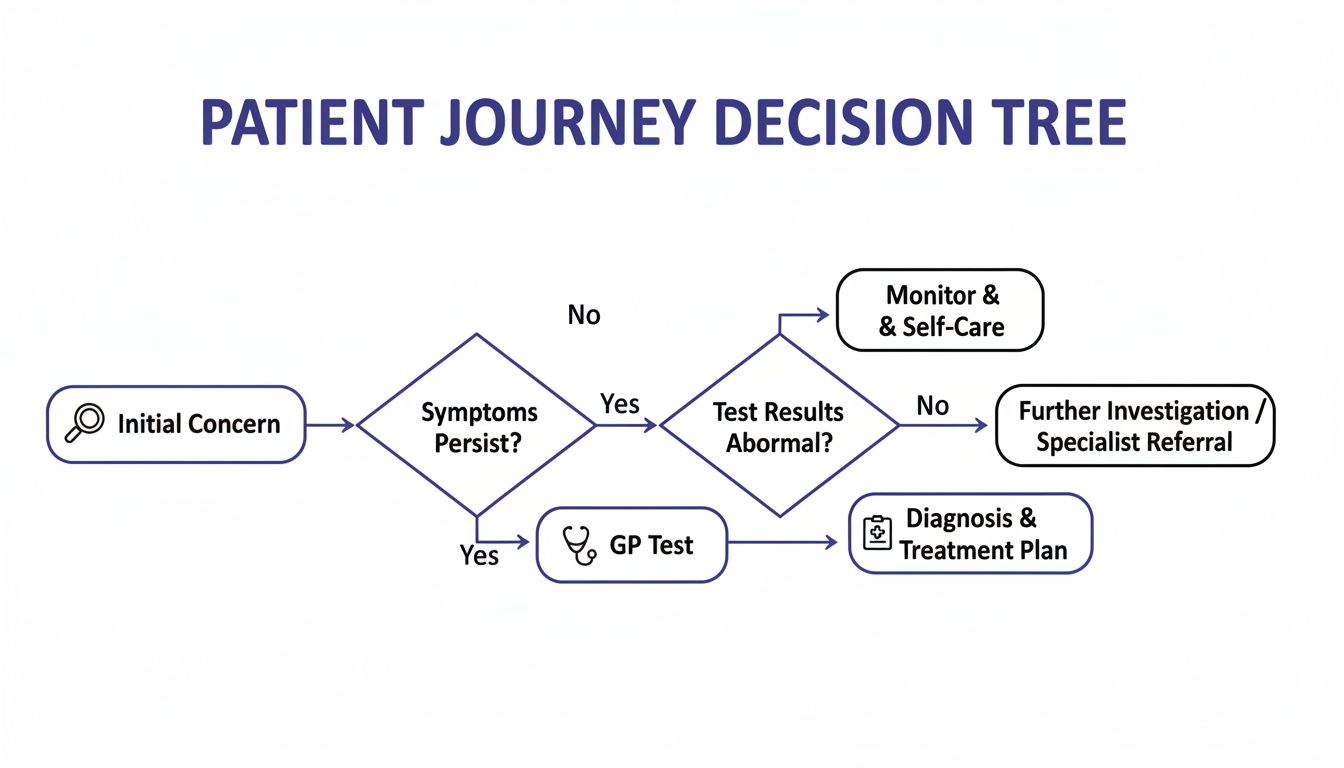
As you can see, a straightforward test with your GP can be the critical first step towards a clear diagnosis and a structured plan for treatment.
Interpreting these findings is where clinical expertise really comes into play. For instance, a bilateral flare often points me towards addressing postural habits and strengthening the deep abdominal muscles. An asymmetrical flare, on the other hand, might lead me to investigate muscular imbalances or spinal alignment. For many people, understanding what happens at a thoracic appointment can take the anxiety out of the process and help them feel prepared for what’s next.
Of course, sometimes we need to look deeper than what a physical examination can tell us. Modern diagnostic imaging gives us incredible insight. For example, new tools like AI in lung nodule detection show just how much technology can support clinical assessments in the broader thoracic field. Even so, the rib flare test remains a fundamental starting point that guides the entire diagnostic journey.
Conditions Linked to Rib Flaring
Think of a positive rib flare test as a signpost. It tells us something is going on, but it's not the final destination. The flare itself is a symptom, and it points towards a whole range of potential underlying causes, from the actual shape of your chest wall to how you've learned to hold yourself and breathe. Pinning down that root cause is the crucial first step.
For many people, the path to figuring this out starts with a simple observation. I remember a young patient, a dedicated swimmer, who couldn't understand why her lower ribs always seemed to stick out, no matter how hard she worked on her core strength. It was a small thing, but it made her self-conscious. That observation eventually led her to a specialist, where the rib flare test confirmed what she was seeing and started the journey towards a proper diagnosis.
Structural Chest Wall Deformities
Sometimes, the cause is purely structural – it's all about the physical shape of your skeleton. Rib flaring is a classic, often unmissable, feature in two well-known chest wall deformities:
- Pectus Excavatum (Sunken Chest): With this condition, the sternum, or breastbone, dips inwards. As the centre of the chest sinks, it often forces the lower ribs to push outwards to compensate, creating a very noticeable flare at the bottom of the ribcage.
- Pectus Carinatum (Pigeon Chest): This is the opposite scenario, where the breastbone juts forwards. The cartilage connecting the ribs to the sternum grows abnormally, pushing the whole structure out and causing the lower ribs to flare out to the sides.
For the young swimmer I mentioned, the diagnosis was pectus carinatum. The clear visual evidence from her rib flare test was a key piece of the puzzle that confirmed the condition. This isn't unusual at all; data from a leading UK pectus clinic shows that 88% of their pectus carinatum patients had left-sided rib flaring, with 78% showing it on the right. You can find more of their clinical insights on PectusClinic.com.
Functional and Postural Causes
But it's not always about the bones. Plenty of rib flares are 'functional', meaning they stem from learned habits, muscle imbalances, and posture.
A functional rib flare is often a sign that your body has found an inefficient shortcut. It’s compensating for weakness or poor coordination in the core muscles by tilting the rib cage, which feels easier in the short term but creates long-term strain.
Here are some of the most common functional culprits:
- Open Scissors Posture: Picture your rib cage and pelvis as the two blades of a pair of scissors. In this very common postural fault, the ribs are tilted up at the front while the pelvis tilts forward. This creates an 'open' gap in your core, disconnecting your diaphragm from your pelvic floor and seriously compromising your stability.
- Diaphragm Dysfunction: If you're not breathing properly – that is, deeply from your diaphragm – your rib cage doesn't move as it should. Shallow breathing that relies on neck and chest muscles encourages the lower ribs to lift up and stay in that flared, 'inhaled' position.
- Weak Core Muscles: Your deep abdominal muscles, especially the transverse abdominis, are like a natural corset for your middle. When they're weak, they can't provide the tension needed to counteract the pull of the diaphragm, allowing the bottom of the rib cage to pop forward.
The Role of Rib Flare in Trauma and Surgery
Beyond a simple postural check, the rib flare test becomes a powerful tool in the high-pressure world of emergency medicine, particularly within UK trauma centres. In A&E, where every moment is critical, how the ribs are moving can give a medic instant, life-saving clues about a severe chest injury.
Let’s picture a patient, Alex, who has just been rushed in after a serious car crash. He’s in a bad way, finding it hard to breathe through the pain. One of the very first things a trauma doctor will do is perform a quick physical examination, which includes a hands-on assessment of his rib cage. What they’re looking for is a devastating injury known as a flail chest.
Spotting a Life-Threatening Injury
A flail chest happens when a piece of the rib cage breaks and detaches from the rest of the chest wall. In a healthy person, the entire chest expands outwards together when they breathe in. With a flail chest, the opposite happens.
The broken section moves paradoxically – it gets sucked in on the inhale and pushed out on the exhale. This bizarre, unnatural movement is a massive red flag, and it's something a clinician can spot almost immediately with a visual and manual rib flare test.
Seeing this simple sign instantly shapes the next steps for Alex's care:
- Urgent Scans: It confirms the need for an immediate CT scan to see the full extent of the fractures and check for damage to internal organs.
- Intensive Care: Flail chest severely impacts breathing, meaning the patient will almost certainly need to be admitted to the ICU for respiratory support.
- Surgical Consideration: It immediately puts surgical rib fixation on the table as a necessary intervention.
From Bedside Test to Decisive Treatment
Spotting this level of instability isn't just about diagnosis; it’s a direct indicator of serious complications to come. Rib fractures are a huge issue in UK trauma care. They make up 55% of all blunt chest trauma cases and are a factor in 25% of trauma-related deaths each year. For patients like Alex, surgery isn't just an option; it can be the difference between life and death.
In a trauma situation, assessing rib movement isn't just another test—it's a rapid-fire triage tool. It allows clinicians to distinguish between straightforward fractures and a catastrophic flail chest, dictating the immediate plan to stabilise the patient and head off respiratory failure.
Research consistently shows that surgically stabilising the chest wall dramatically improves a patient's chances. The procedure restores normal breathing, cuts down on pain, and lowers the risk of pneumonia, which is an incredibly common and dangerous complication. A major review found that surgical fixation significantly reduces pneumonia rates and shortens the time a patient needs on a ventilator. You can read the full research about these surgical outcomes.
For Alex, that quick assessment at his bedside was the crucial first step in a treatment pathway that not only saved his life but also put him on the road to a faster and more complete recovery.
Your Treatment Path From Physiotherapy to Surgery
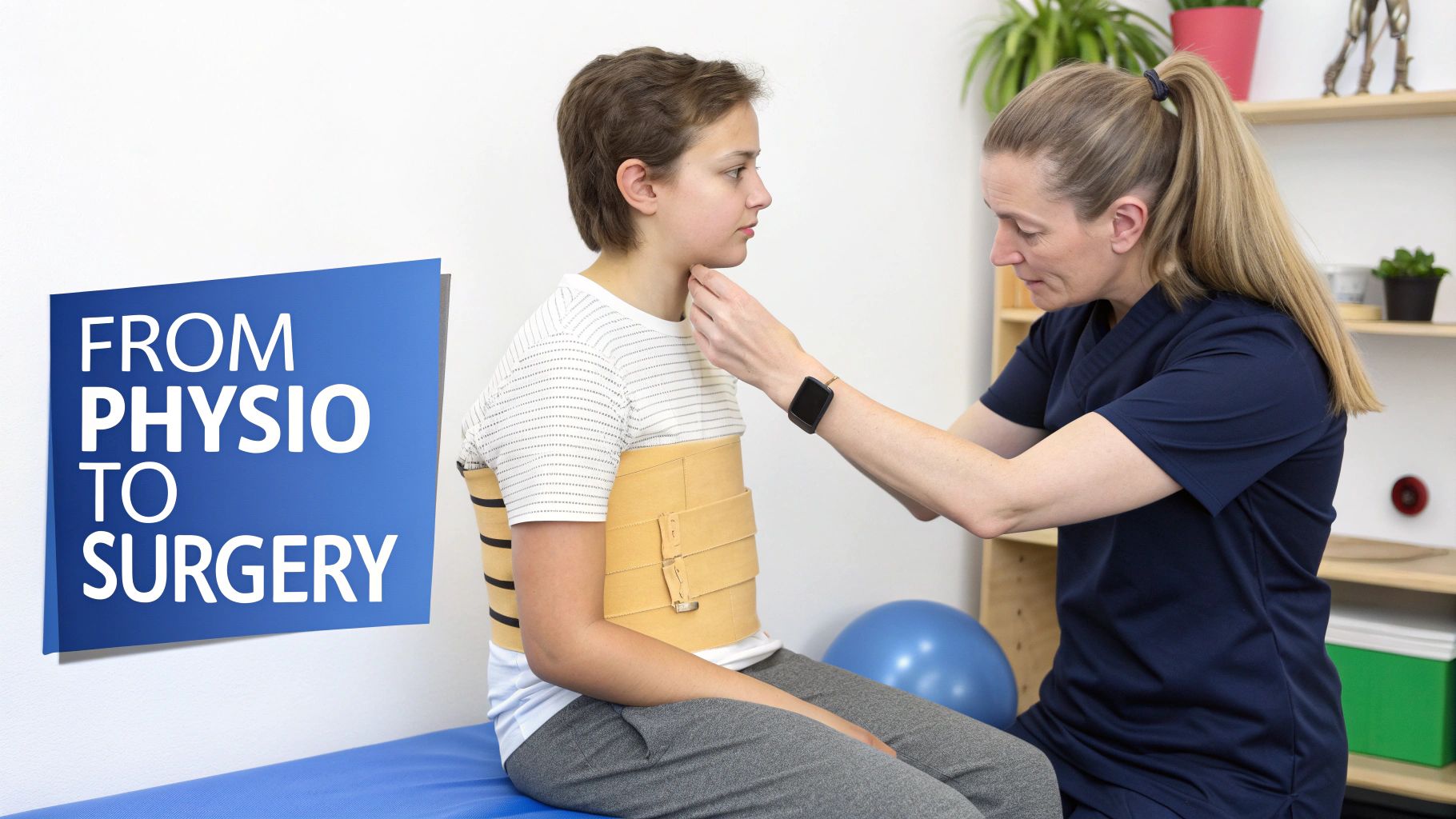
Discovering you have a rib flare is the first step, but what actually happens next? Knowing the potential treatment options is crucial for feeling in control of your health. Here in the UK, the journey almost always starts with the most conservative, non-invasive methods first. The goal is to correct the functional issues that are often the root cause of the flare.
For many, this journey looks a lot like Chloe’s. A young dancer, she noticed her flared ribs were messing with her core stability and breathing during routines. After a rib flare test confirmed a significant postural imbalance, her specialist didn't jump to invasive procedures. Instead, they mapped out a targeted physiotherapy programme.
Conservative Care: Physiotherapy and Bracing
Physiotherapy is the cornerstone of non-surgical treatment. This isn't just a list of generic core workouts; it's a specific, targeted strategy designed to retrain your body's most basic mechanics.
A specialist physiotherapist will guide you through exercises that:
- Strengthen Deep Core Muscles: The focus here is on muscles like the transverse abdominis. Think of it as your body's natural corset—when it's strong, it helps pull the ribs down and in.
- Teach Diaphragmatic Breathing: This involves re-educating your body to breathe from the diaphragm. Proper breathing allows the rib cage to expand and contract efficiently, rather than getting stuck in a flared position.
For people whose rib flare is tied to poor breathing habits, understanding the wider benefits of deep breathing exercises can be a huge help during their physio. For Chloe, mastering this technique was a complete game-changer for her performance.
In younger patients, particularly adolescents with structural conditions like pectus carinatum, bracing might be used alongside physiotherapy. A custom-fitted brace applies gentle, consistent pressure to help guide the growing rib cage into a better alignment.
When Surgery Becomes a Consideration
So, when does surgery enter the picture? It’s generally reserved for cases where conservative treatments haven't delivered the desired results, or when the rib flare is part of a severe structural deformity like pectus excavatum that’s causing significant physical symptoms.
Surgery for rib flaring is not a first-line treatment. It is considered when the underlying chest wall deformity is severe enough to impact heart or lung function, or when it causes persistent pain and fails to respond to non-surgical management.
Procedures like the Nuss or Ravitch operations are major surgeries intended to correct the entire chest wall structure; improving the rib flare is one of the positive outcomes. Deciding to go down the surgical route involves an in-depth discussion with a thoracic surgeon, where you'll weigh the potential benefits against the risks and recovery time.
To get a clearer picture of your options, you can explore this detailed rib flaring treatment and surgery guide. This overview will help you have a more informed conversation with your healthcare team, ensuring you choose the path that’s right for you.
Your Questions About Rib Flare Answered
It's completely normal to have questions when you notice something like a rib flare. Let's tackle some of the most common ones with straightforward, expert answers.
Can I Fix My Rib Flare at Home?
While exercises targeting your core and posture can make a real difference for functional rib flare, it's not a good idea to jump into a routine without a proper diagnosis. A physiotherapist is the best person to create a safe, effective plan designed just for you.
Trying to fix it yourself without knowing the root cause could be a waste of time, or worse, it could aggravate the problem if the flare is linked to a structural condition.
Is Having a Rib Flare Dangerous?
On its own, a rib flare is rarely dangerous. Think of it more as a signpost pointing to an underlying issue, which could be anything from poor posture and weak core muscles to a structural condition like pectus excavatum.
The real importance of the flare comes from what’s causing it. This is precisely why a clinical assessment using the rib flare test is so vital—it helps figure out the cause and what to do next.
At What Age Should a Rib Flare Be Looked At?
There's no wrong age to get a rib flare checked out. However, we often see it become more obvious during the teenage growth spurt. This is when postural habits can become ingrained and conditions like pectus deformities tend to become more noticeable.
If you spot a significant flare in yourself or your child, it’s always wise to have a GP or a specialist take a look.
Does the NHS Cover Treatment for Rib Flare?
The NHS may cover treatment for the underlying cause of a rib flare. This could include physiotherapy for postural problems or even surgery for severe pectus deformities that affect your health and physical function.
That said, NHS coverage and the criteria for treatment can vary. The best first step is always to have a detailed chat with your GP and a specialist to understand your options.
If you're looking for a rapid, specialist opinion on your rib flare or another chest wall condition, Marco Scarci Thoracic Surgery provides expert consultations and personalised treatment plans. To explore your private care options and book an appointment, please visit us at marcoscarci.co.uk.

