
When you’re first told you have pectus excavatum, it’s completely normal to feel a bit overwhelmed. But the good news is there’s a well-trodden path to improving it, with a range of excellent treatments for pectus excavatum available. The best option for you will depend on a few things: how severe the dip in your chest is, your age, and what you personally want to achieve.
Your Guide to Pectus Excavatum Treatment Options
Getting a diagnosis of pectus excavatum – sometimes called ‘funnel chest’ or ‘sunken chest’ – is the first real step towards making a change. It helps to understand exactly what it is: a condition where your breastbone (sternum) and some of your ribs grow inwards. For some, this can affect how their heart and lungs work, but for many, the main concern is how it looks and feels.
Whatever your situation, modern medicine has developed some very effective ways to correct it. Your journey forward starts with understanding the two main avenues of treatment. Your specialist will walk you through which one makes the most sense for your body and your life.
- Non-Surgical Treatments: These are methods that don’t involve an operation. They’re often the first choice for milder cases or for younger patients whose chests are still quite flexible.
- Surgical Corrections: When the indentation is deeper, the chest wall is more rigid, or non-surgical options just aren’t a good fit, surgery provides a more direct and permanent solution to reshape the chest.

To help you get a quick handle on what’s available, the table below gives a simple side-by-side look at the main treatments we’ll cover. Pectus excavatum is one of several chest wall deformities that we can manage effectively with specialised care.
Think of this table as a starting point. It’s designed to give you a quick grasp of the key differences, setting you up to better understand the more detailed explanations that follow.
At-a-Glance Comparison of Pectus Excavatum Treatments
| Treatment Type | Best Suited For | Procedure Type | Typical Recovery Time |
|---|---|---|---|
| Vacuum Bell Therapy | Children and adolescents with mild to moderate, flexible indentations. | Non-Surgical | Gradual improvement over 1-2+ years of consistent daily use. |
| The Nuss Procedure | Teenagers and young adults with moderate to severe indentations. | Minimally Invasive Surgery | Return to light activity in 2-4 weeks; full recovery in 3-6 months. |
| The Ravitch Procedure | Adults with severe, rigid, or complex deformities. | Open Surgery | Return to light activity in 4-6 weeks; full recovery in 3-6 months. |
Having this basic framework in mind will make it much easier to weigh the pros and cons of each approach as we dive into the specifics.
Exploring Non-Surgical Treatment with Vacuum Bell Therapy
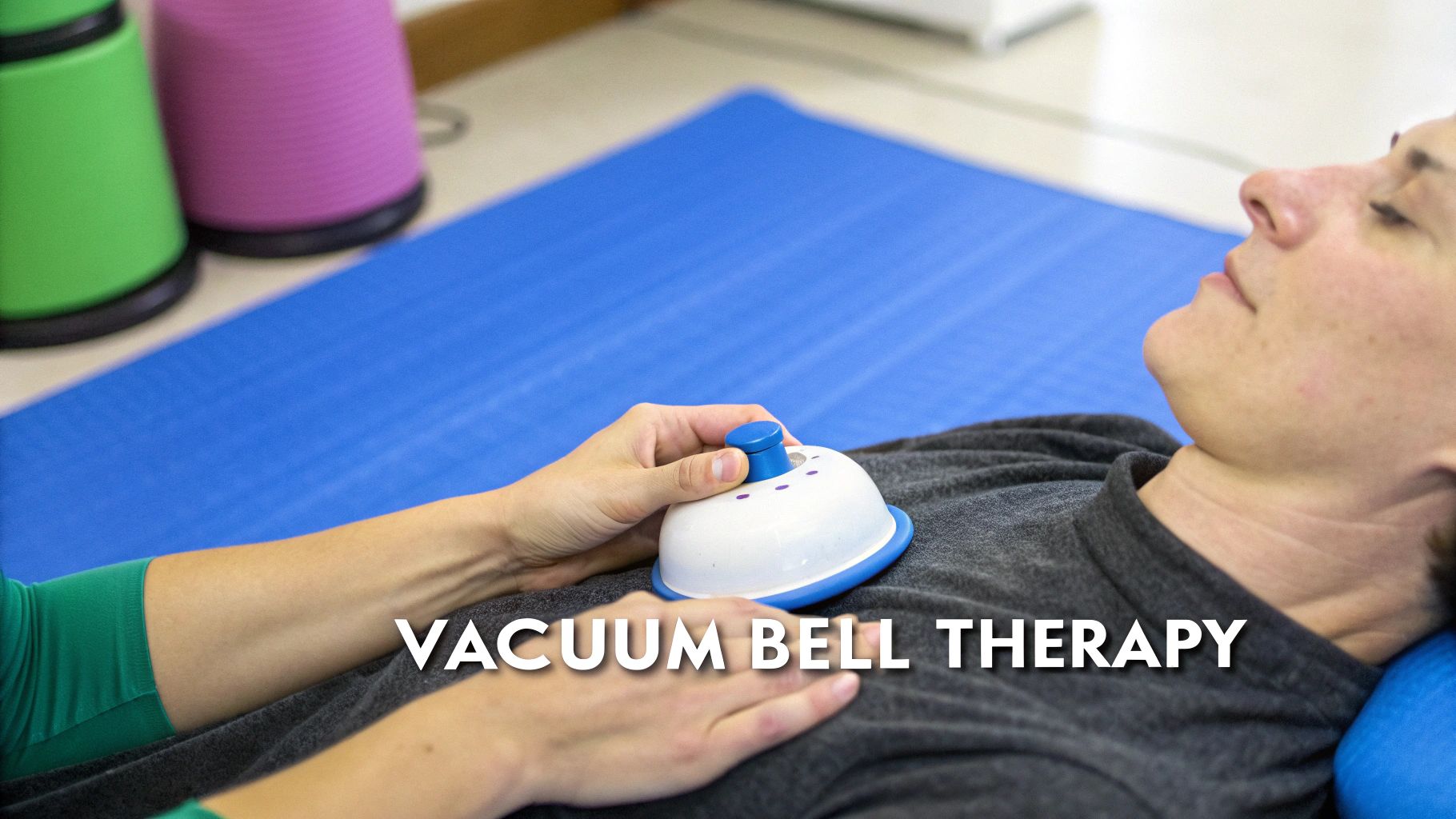
When you’re first looking into how to treat a sunken chest, surgery isn’t the only option on the table. For many people, the journey starts with non-surgical approaches, and Vacuum Bell Therapy (VBT) is right at the forefront. It’s a clever technique that sidesteps the need for an operation by using a simple but powerful idea: gentle, consistent pressure can reshape the chest wall over time.
Think of it like a specially designed suction cup that fits perfectly over the dip in your chest. This device, the vacuum bell, creates a seal and then generates a gentle suction. This negative pressure lifts the sternum and ribs outwards, pulling them into a more corrected, natural position. It’s definitely not an overnight fix, but rather a gradual, steady process of change.
This approach does require a real commitment. To see results, you’ll need to wear the device for several hours every single day, usually broken up into a couple of sessions. The whole point is to keep the breastbone in its new, lifted position long enough for the cartilage and bone to start adapting and, eventually, hold that shape on their own.
Who Is an Ideal Candidate for VBT?
Vacuum Bell Therapy isn’t a one-size-fits-all solution, and its success really depends on a few key things. That’s why the first step is always a proper assessment with a thoracic specialist to see if your specific anatomy makes you a good candidate.
Generally, the best candidates for VBT are:
- Younger Patients: The chest walls of children, teenagers, and young adults are naturally more flexible and pliable. This makes them much more responsive to the gentle, sustained force of the vacuum bell.
- Mild to Moderate Deformities: VBT tends to work best for less severe indentations. Deeper or more complicated cases might not see a satisfactory result and often need surgery to get there.
- Symmetrical Indentations: The device is most effective on classic ‘funnel chest’ deformities that are more or less centred. It can be adapted for some asymmetrical cases, but it’s a bit more predictable with symmetrical ones.
It’s crucial to go in with realistic expectations. VBT is a marathon, not a sprint. The best outcomes are almost always seen in patients who are really motivated and can stick to the daily schedule for one to two years or even longer. For those who are keen on exploring alternatives to surgery for thoracic conditions, this level of commitment is often a very welcome trade-off.
The Power of Combining VBT with Physiotherapy
While the vacuum bell itself is doing the heavy lifting, its effect can be massively boosted when you pair it with a targeted physiotherapy programme. Imagine your chest wall is a building frame; the muscles are the support network holding it all up. If those muscles are weak or out of balance, it can pull you into a slouch, making the pectus excavatum look even more noticeable.
Physiotherapy gets to work on correcting this by building a strong, supportive muscular framework.
A dedicated exercise regimen doesn’t just support the work of the Vacuum Bell; it enhances the final cosmetic outcome by correcting postural issues that often accompany pectus excavatum. This dual approach addresses both the skeletal and muscular components of the condition.
By strengthening the muscles in your chest, back, and core, you naturally start to pull your shoulders back and stand taller. This doesn’t just improve your overall posture; it helps maximise the visual improvement you’re getting from the VBT.
VBT is a relatively new addition to UK practice, including within the NHS, and it’s already showing impressive potential. A recent multicentre analysis found a successful initial sternal lift in 98% of patients. What’s more, they saw an average improvement of 3.5 cm in the depth of the dent after just 12 weeks. This combination of lifting from the outside and strengthening from the inside creates a powerful synergy for the best possible non-surgical result.
The Nuss Procedure: A Minimally Invasive Surgical Solution
When non-surgical treatments for pectus excavatum aren’t quite enough, surgery offers a more direct and lasting fix. Here in the UK, the go-to operation, especially for younger patients, is the Nuss procedure. It’s a clever technique that corrects the chest’s shape from the inside out, all without the need for large, open incisions.
Think of it like internal scaffolding for your chest wall. A surgeon places a custom-shaped metal bar behind the sternum, which then gently but firmly pushes the sunken bone forward into its proper place. This sustained pressure allows the chest to gradually remodel itself over time.
This approach works brilliantly for teenagers and young adults. Why? Because their bones and cartilage are still pliable, making the chest wall more responsive to being reshaped. This flexibility often leads to fantastic long-term results with a less invasive operation.

How The Nuss Procedure Works Step by Step
The real beauty of the Nuss procedure is how it achieves a major correction through minor access. The entire operation is done via a few small cuts, which means less visible scarring and a quicker start to your recovery.
Here’s a simple breakdown of what happens in the operating theatre:
- Small Incisions: The surgeon makes two small cuts, usually tucked away under the arms on each side of the chest.
- Creating a Tunnel: A tiny camera is used to guide the instruments, carefully creating a narrow pathway behind the breastbone, safely away from the heart and lungs.
- Placing the Bar: The custom-bent metal bar is then guided through this tunnel.
- Lifting the Sternum: This is the key moment. Once the bar is perfectly positioned, the surgeon rotates it 180 degrees. As it turns, its curved shape immediately lifts the sternum outwards.
- Securing the Bar: Finally, the ends of the bar are fixed to the ribs on either side to keep it stable. Then, the small incisions are closed.
This bar is meant to stay in place for about two to three years. During that time, your chest wall gets used to its new, corrected shape, and the bone and cartilage set permanently.
Who Is An Ideal Candidate For The Nuss Procedure?
While the Nuss is a highly effective procedure, it isn’t the right fit for everyone. A detailed assessment with a specialist thoracic surgeon is the only way to know for sure if it’s the best choice from all the available treatments for pectus excavatum.
Generally, the best candidates share a few common traits:
- Age: It’s most successful in teenagers and young adults, typically between 13 and 20 years old. Their flexible chest walls respond best to the gentle pressure of the bar.
- Severity: The procedure is usually reserved for those with moderate-to-severe pectus excavatum. This is often measured with a CT scan to calculate what’s known as the Haller Index.
- Symmetry: It works most predictably for symmetrical, “funnel chest” shapes, though experienced surgeons can certainly adapt it for some asymmetrical cases.
The Nuss procedure isn’t just about how your chest looks—it’s about how it works. By lifting the sternum, the surgery creates more room for your heart and lungs, which can genuinely improve breathing, stamina, and exercise tolerance.
The results in the UK speak for themselves. In terms of appearance, patient satisfaction scores jump from an average of 3.1 out of 10 before surgery to 8.4 out of 10 afterwards. What’s more, a large study found that 83% of patients achieved an “excellent” cosmetic outcome. You can read more about these UK patient outcomes and experiences.
Recovery and Bar Removal
After the operation, you’ll likely spend a few days in hospital so we can manage any discomfort and keep a close eye on your progress. Once you’re home, recovery is a gradual process of returning to your normal routine over several weeks. You’ll need to avoid heavy lifting and contact sports for a while to ensure the bar stays put.
After the two-to-three-year period, it’s time for the bar to come out. This is a much simpler, day-case procedure. The surgeon makes small incisions over the original sites, unfastens the bar, and slides it out. By then, your chest wall has permanently remodelled, locking in the results for good.
Beyond the Nuss: Traditional and Advanced Surgical Corrections
While the Nuss procedure is often the first thing people hear about, it’s far from the only surgical option for pectus excavatum. The field of thoracic surgery is incredibly nuanced, and the right approach always depends on the individual—your specific anatomy, your age, and what you want to achieve. For many people, especially adults or those with more complex or rigid chest shapes, a different, more hands-on technique is the better choice.
This is where the Ravitch procedure truly shines. If you think of the Nuss procedure as pushing the chest out from the inside with scaffolding, the Ravitch is more like a meticulous architectural reconstruction. It’s an open procedure, which gives the surgeon a direct, clear view of the sternum and ribs to perform a very precise and controlled reshaping.
We often find this method is the gold standard for older patients. As we age, our chest walls become less flexible and don’t respond as well to the gentle, sustained pressure of a Nuss bar. The Ravitch is also exceptionally good for correcting very complex or asymmetrical deformities where a simple bar just wouldn’t get the job done right.
The Ravitch Procedure: A Detailed Reconstruction
So, what actually happens during a Ravitch procedure? It all starts with a single incision down the middle of the chest, allowing the surgeon to directly access the cartilage that connects your ribs to your breastbone.
The process unfolds in a few key steps:
- Gaining Access: First, the surgeon carefully moves the chest muscles to one side, giving them a clear, unobstructed view of the sternum and the problematic rib cartilage.
- Releasing the Tension: The real work begins here. The surgeon removes small sections of the overgrown or misshapen cartilage that are physically pulling the sternum inwards. This immediately releases the tension that’s causing the dent.
- Lifting the Sternum: With the inward pull gone, the surgeon can perform a tiny, controlled fracture at the top of the sternum. This acts like a hinge, allowing the bone to be lifted forward into a flat, natural position.
- Securing the New Shape: Finally, the newly positioned sternum is secured in place. Sometimes a small, temporary metal strut or plate is placed behind it for extra support while everything heals. This is usually removed down the line.
Because it involves directly reshaping the chest’s framework, the Ravitch procedure gives an immediate and very stable correction. It’s a powerful and reliable technique for those more challenging cases.
The Future of Correction: Custom 3D Implants
Stepping away from reshaping the skeleton, there’s another path that focuses purely on restoring the outer contour of the chest. For people whose main concern is the cosmetic appearance of the dip, and who don’t have any related heart or lung issues, custom 3D-printed implants are a fantastic solution.
This technique is straight out of the future. We start with a high-resolution CT scan of your chest, which we use to create a perfect digital model of your unique indentation. From that model, a custom-made implant is designed and built from medical-grade silicone. It’s crafted to fit the exact shape of your chest like a missing puzzle piece.
This is a fundamentally different philosophy from the Nuss or Ravitch. It doesn’t change your bones or cartilage at all. Instead, the implant acts as a permanent, seamless filler that sits over the top of the sternum, completely masking the indentation from the outside.
The surgery itself is much simpler. Through a small incision, a pocket is created under the skin and muscle, and the bespoke implant is slipped into place. The outcome is a completely natural-looking chest contour, and the recovery is significantly faster than with skeletal surgeries. This makes it an absolutely brilliant option for adults who are looking for a purely aesthetic fix with minimal disruption to their lives.
Comparing Surgical Risks, Recovery, and Outcomes
Making the decision to have surgery is a big step, and getting your head around the key differences between the treatments for pectus excavatum is crucial. Each procedure—Nuss, Ravitch, and custom 3D implants—has its own set of pros and cons when it comes to risks, recovery, and what you can expect from the final result.
Think of it this way: the Nuss procedure is minimally invasive and the operation itself is quicker, but recovery means getting used to living with an internal bar for a few years. The Ravitch, on the other hand, is a more involved operation but gives an immediate, solid correction, which often makes it a better fit for adults whose chest walls are less flexible.
This decision tree gives a good visual overview of how we start to think about which surgical path might be best for you, based on your specific anatomy and what you hope to achieve.
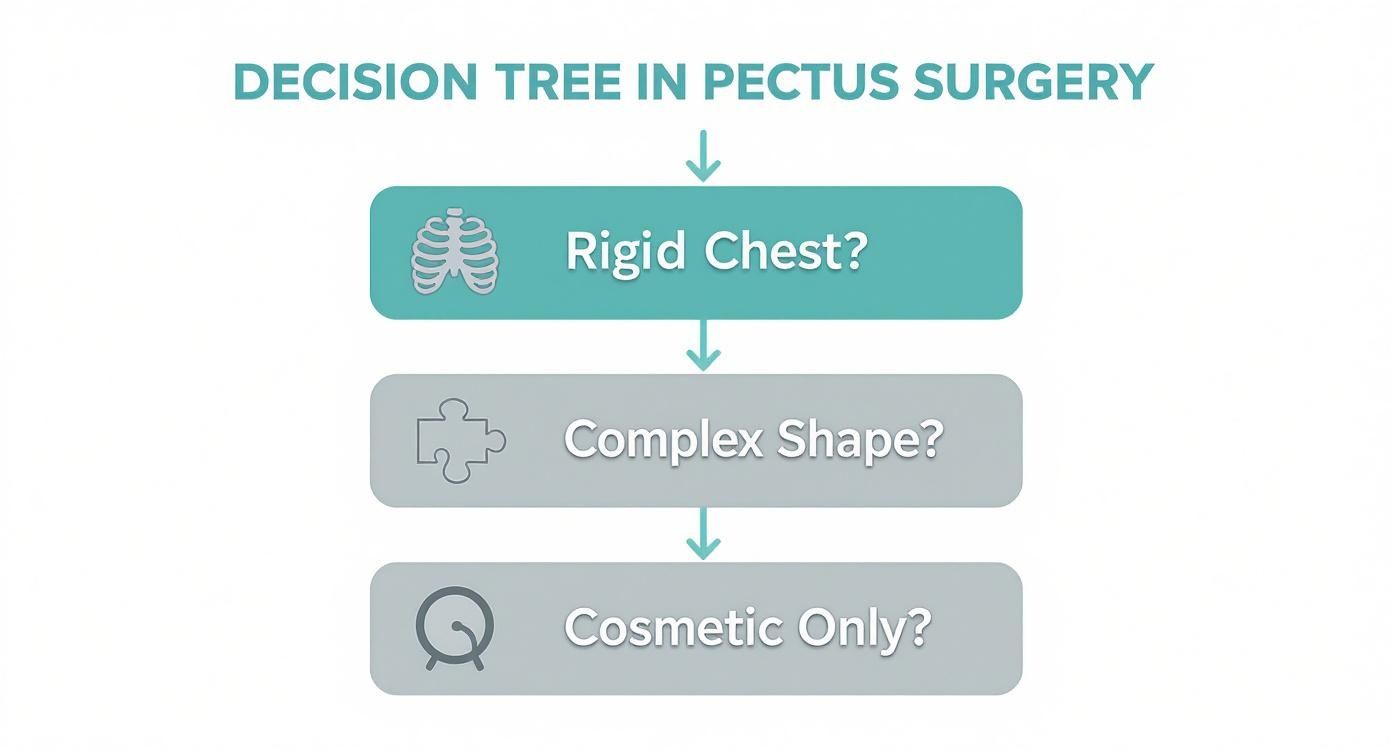
As you can see, things like the rigidity of your chest wall and whether your goals are purely cosmetic are major factors in narrowing down the most suitable surgical treatments for pectus excavatum.
Understanding the Trade-Offs
There’s no “one-size-fits-all” answer here; the best choice is always the one that’s right for your body and your life. Let’s break down the realistic trade-offs of each approach so you can weigh your options with confidence.
- Invasiveness and Scarring: The Nuss leaves small, discreet scars under the arms. The Ravitch requires a longer vertical incision down the front of the chest. Custom implants use a similar incision to the Ravitch but don’t involve any changes to the bone or cartilage underneath.
- Hospital Stay: Nuss patients are typically in hospital for a slightly shorter period than Ravitch patients, usually around 3-5 days. The shortest stay is often for custom implant surgery, which can be just 1-2 days.
- Pain Management: Let’s be honest, post-operative pain is a major factor for any surgery. For both the Nuss and Ravitch, managing this effectively in the first few days is a top priority, often using methods like an epidural. Pain control after implant surgery is generally less intensive.
The real goal of any surgical correction isn’t just to change how your chest looks—it’s about improving your quality of life. That means finding the right balance between the intensity of the operation, the demands of recovery, and the long-term stability of the outcome.
Complications and Long-Term Results
Every surgery comes with risks, but the specific types and rates differ between these procedures. Here in the UK, both the Nuss and Ravitch are considered very safe, with no reported deaths during surgery in children or adults. Still, it’s vital to be aware of what could happen.
With the Nuss procedure, the main long-term issue we watch for is the bar moving out of place, although this is quite rare thanks to modern stabilisation techniques. For the Ravitch, the main risks are usually related to wound healing and ensuring the reconstruction stays stable.
In England, it’s estimated that around 380 pectus excavatum correction operations are performed within the NHS each year. While both the Nuss and Ravitch are mainstays, complication rates do vary. For instance, implant-based procedures have the highest re-operation rates in adults at about 18.8%, often for cosmetic tweaks or issues with the implant itself. You can dig into more of the data on UK surgical rates and outcomes here.
To make things clearer, the table below puts all these key differences side-by-side.
Surgical Treatment Comparison: Nuss vs Ravitch vs Advanced Options
This table offers a straightforward comparison of the main surgical options. It’s designed to help you quickly see how each procedure stacks up in terms of who it’s for, what’s involved, and the potential hurdles.
| Feature | Nuss Procedure | Ravitch Procedure | 3D Implants |
|---|---|---|---|
| Ideal Candidate | Teenagers and young adults with flexible, symmetrical deformities. | Adults with rigid, complex, or asymmetrical deformities. | Adults seeking a purely cosmetic fix without skeletal change. |
| Incision Type | Small incisions on the sides of the chest (minimally invasive). | A single vertical incision over the sternum (open surgery). | A single vertical incision over the sternum. |
| Recovery Timeline | Full activity restricted for 3 months; bar remains for 2-3 years. | Return to full activity in 3-6 months; no internal hardware left long-term. | Fastest recovery, with a return to normal activity in 4-6 weeks. |
| Potential Risks | Bar displacement, allergic reaction to metal, nerve pain. | Infection, bleeding, issues with cartilage healing. | Implant shifting, fluid collection (seroma), visible implant edges. |
Ultimately, this comparison is a starting point. The most important step is a thorough discussion with a specialist who can assess your specific case and help you decide on the path that offers you the best possible outcome.
Navigating Your Treatment Journey in the UK
Getting to grips with the different treatments for pectus excavatum is one thing, but knowing how to take that next step is just as important. Whether you choose to go through the NHS or explore private care, understanding the pathway is key to accessing the specialist support you need.
For most people, the journey starts with their GP. This first chat is your chance to voice your concerns and talk about any symptoms you’re experiencing. If they agree it’s the right next step, your GP will refer you to a thoracic surgeon who specialises in chest wall conditions. This referral is essentially your ticket to getting a formal diagnosis and a personalised treatment plan.
Your First Specialist Appointment
Once that referral is in place, you’ll meet the specialist. This first consultation is all about getting to the bottom of your specific situation. It’s far more than just a quick look – it’s a deep dive to fully understand your anatomy and how the pectus excavatum is affecting you.
To build a complete picture, your surgeon will arrange for some detailed imaging.
- CT (Computed Tomography) Scan: This is the gold standard for diagnosis. It provides detailed, cross-sectional images of your chest, which allows the surgeon to accurately measure the depth of the indentation using a calculation called the Haller Index.
- Cardiopulmonary Tests: Sometimes, you might also need tests to check your heart and lung function. This helps us see if the condition is physically impacting your body’s performance.
All this information is absolutely crucial for deciding on the best course of action and figuring out if you’re a good candidate for non-surgical or surgical correction.
Considering the Private Care Pathway
Unfortunately, the NHS pathway can sometimes involve long waits. This is where private care offers a real alternative, giving you much faster access and a more streamlined experience. The biggest advantage is speed – we can often schedule consultations, scans, and surgery in a matter of weeks, rather than months or even years.
Going private isn’t just about skipping the queue; it’s about a dedicated, coordinated journey. From the moment you get in touch, a specialist team handles every detail, making sure your care is seamless, personal, and fits around your life.
This route gives you direct access to the consultant of your choice, so you have that consistency of care from beginning to end. It also offers more flexibility, with appointments and surgery scheduled at top private hospitals in London and across the UK.
Of course, thinking about the financial side is a key part of the decision. There are straightforward options for using private medical insurance or self-funding your treatment. To get a better idea of how this can work for you, you can explore the different finance options for thoracic surgery in the UK. This helps you feel fully prepared and in control as you move forward.
Your Pectus Excavatum Questions Answered
To finish up, let’s tackle some of the most common questions we hear from patients and families. These are the practical, real-world concerns that come up time and again, and getting clear answers can make all the difference.
Is Pectus Excavatum Treatment Covered by the NHS?
This is probably the number one question we get, and the answer isn’t always straightforward. For a long time in England, surgical correction was classified as a ‘Procedure of Limited Clinical Value’, which meant funding wasn’t routinely available.
That doesn’t mean it’s impossible, though. Funding can often be secured on an individual basis, but you’ll need to demonstrate that the pectus is causing significant physical problems, like impacting your heart or lung function. Non-surgical options like the Vacuum Bell are sometimes available too. Your first step should always be to speak with your GP to get a referral for a specialist opinion.
What Is the Best Age for Pectus Excavatum Surgery?
Timing is definitely a key factor in getting the best results. For the Nuss procedure, there’s a real sweet spot during the teenage years, generally between 13 and 18.
At this age, the chest wall is still quite pliable and growing. This flexibility helps the ribs and cartilage mould beautifully around the corrective bar, which often leads to a better long-term outcome and a smoother recovery.
While the teenage years are ideal for the Nuss, it’s a myth that you can’t have a successful correction as an adult. Procedures like the Ravitch or custom 3D implants are fantastic alternatives for older patients whose chest walls are more rigid.
Can Pectus Excavatum Be Fixed with Exercise Alone?
I wish it were that simple, but unfortunately, no. Exercise is brilliant for your overall health and posture, but it can’t fix the underlying bone and cartilage structure that causes the dip.
However, a targeted exercise programme is an incredibly important part of the puzzle. It helps in a few key ways:
- Improves Posture: By strengthening your back and core muscles, you can pull your shoulders back and stand taller, which often makes the indentation look less noticeable.
- Builds Chest Muscle: Developing your pectoral muscles can help to ‘fill out’ the chest and soften the appearance of the dip.
- Supports Formal Treatment: It’s an essential partner to Vacuum Bell therapy and a crucial part of getting your body ready for surgery and recovering well afterwards.
Think of exercise not as a cure on its own, but as a powerful tool that makes every other treatment more effective.
Navigating your treatment options can feel overwhelming, but you’re not on your own. At Marco Scarci Thoracic Surgery, we specialise in providing rapid access to expert diagnosis and creating personalised treatment plans for chest wall conditions. To get the clear, specialist advice you need, arrange a consultation by visiting us at https://marcoscarci.co.uk.

