
Pectus excavatum is a condition where the breastbone (sternum) and the cartilage connecting it to the ribs don't grow correctly, causing the chest to have a sunken or “caved-in” appearance. It’s often called a ‘funnel chest’ for this reason. This is something people are born with, but it usually becomes much more noticeable during the growth spurt of the teenage years.
Your First Questions About Pectus Excavatum Answered

Hearing a medical term like "pectus excavatum" for the first time can be a bit daunting, especially when it concerns you or your child. The good news is that breaking it down into simple terms is the first step towards taking control. At its heart, this is a structural issue with the chest wall.
Think of it like a potter working with clay. If they gently press their thumb into the centre of a freshly thrown pot, it creates an indentation. Pectus excavatum works similarly; an overgrowth of the cartilage that joins the ribs to the breastbone effectively pushes the sternum inwards, creating that characteristic dip.
Understanding Its Prevalence and Impact
If you’re dealing with this, you are far from alone. Pectus excavatum is actually the most common congenital chest wall deformity, affecting around 1 in every 400 children born in the UK. It’s also much more common in boys, who are affected about four times as often as girls. While the signs might be there from early on, the condition often becomes a bigger concern during adolescence when self-awareness is at its peak.
For many people, the visual appearance is just one part of the story. The real concerns often lie with its potential impact on heart and lung function, not to mention the emotional weight it can place on a person's self-esteem and confidence.
This is exactly why a comprehensive, person-focused approach is so important. We're not just looking at a chest; we're looking at how this condition affects a person’s life, both physically and emotionally. Addressing all these aspects is a cornerstone of a proper diagnosis and treatment plan.
Pectus Excavatum At a Glance
To simplify the key points, here’s a quick overview of what defines this condition.
Pectus Excavatum At a Glance
| Aspect | Description |
|---|---|
| Primary Sign | A visibly sunken or concave breastbone, creating a "dip" in the centre of the chest. |
| Origin | Congenital, meaning it is present from birth due to abnormal cartilage development. |
| Progression | Often becomes more pronounced during the rapid growth spurts of puberty. |
| Potential Symptoms | Can sometimes lead to shortness of breath, reduced exercise tolerance, or chest pain. |
This table provides a snapshot, but it's important to remember that every person's experience is unique.
Understanding these fundamentals gives you a solid base of knowledge as you begin to explore the next steps. For a broader overview of conditions that affect the chest’s structure, you can learn more about how we approach diagnosing and treating chest wall deformities.
Understanding Why Pectus Excavatum Happens
One of the first questions we always hear from families is, "Why did this happen?" It's a natural question, and the answer is reassuring: you didn't do anything to cause this. Pectus excavatum isn't the result of an injury, poor posture, or something you could have prevented. Its origins are developmental, tied to how the chest wall forms.
The most widely accepted explanation centres on the costal cartilages – these are the flexible strips of tissue that connect your ribs to your breastbone (the sternum). In people with pectus excavatum, these cartilages simply grow too much. This overgrowth pushes the sternum inwards, creating that characteristic sunken look.
This isn't a sudden event. It’s a slow process that often becomes much more noticeable during the rapid growth spurts of puberty. That's why many teenagers and their parents feel like the dip in the chest has appeared almost overnight.
Is It in the Genes?
While there isn’t a single "pectus gene," it definitely runs in families. There's a strong hereditary link here. In fact, studies have found that about 40% of people with the condition have a close relative with some kind of chest wall deformity. If a parent has pectus excavatum, their child has a higher chance of having it too.
Think of it this way: the genetic blueprint for how the chest should grow was slightly altered from the start. This helps explain why it sometimes appears with other conditions – it's all part of an individual's unique genetic makeup.
Knowing about this family connection gives specialists a more complete picture of a patient's health.
The Connection to Other Conditions
Occasionally, pectus excavatum isn't just an isolated issue. It can be a clue pointing to a wider condition known as a connective tissue disorder. These are conditions that affect the proteins giving strength and flexibility to our body's structures, from cartilage and bone to skin and blood vessels.
Two of the most common conditions linked to pectus excavatum are:
- Marfan Syndrome: This is a genetic disorder affecting connective tissue throughout the body. People with Marfan syndrome are often very tall and slender with long limbs. A sunken or protruding chest is one of the classic skeletal signs.
- Ehlers-Danlos Syndrome (EDS): This is a group of disorders that affect collagen, a key protein in connective tissue. It often results in unusually flexible joints (hypermobility), stretchy skin, and fragile tissues.
If someone with pectus excavatum also has other signs, like being extremely flexible or having a tall, lanky build, a specialist will often suggest a more thorough evaluation. It’s crucial to check for any underlying disorders to make sure the full picture is understood and any treatment plan is both safe and comprehensive. Getting to the root of these origins is the first, most important step toward managing the condition effectively.
Of course. Here is the rewritten section, crafted to sound natural, human, and expert-written, following all your specific instructions.
More Than Skin Deep: The Physical and Psychological Sides of Pectus Excavatum
At first glance, pectus excavatum is a structural issue – a sunken chest. But for those living with it, the impact goes far beyond what you can see. The true experience of this condition is a blend of physical symptoms and a heavy psychological burden, and this combination looks different for everyone. Understanding both sides of the coin is key to seeing why a proper, thorough evaluation is so important.
The physical symptoms are a direct result of the chest's anatomy. When the breastbone dips inward, it can start to crowd the space where the heart and lungs need to operate. This doesn't always cause problems, but when the indentation is moderate or severe, it can create very real physical limitations.
How Pectus Excavatum Can Feel Physically
Many people, especially as they hit their teenage growth spurts and get more active, start to notice symptoms that weren't there before. These feelings often pop up during exercise or any kind of strenuous activity when the body is crying out for more oxygen.
You might notice things like:
- Shortness of Breath: Getting winded far more easily than your friends during sports, or even just climbing a flight of stairs.
- Reduced Exercise Tolerance: Hitting a wall with physical activity much sooner than you'd expect, leading to early fatigue.
- Chest Pain: This can be a sharp, unsettling pain or a dull ache that comes and goes.
- Rapid Heartbeat (Palpitations): A feeling that your heart is fluttering or racing, which can happen if the heart is slightly displaced or squeezed by the sternum.
Clinicians pay close attention to the link between the chest's shape and these symptoms. Studies on the heart and lung (cardiopulmonary) effects have found that up to 95% of patients have some evidence of the heart being compressed on imaging scans. While this doesn't always cause noticeable symptoms, it can lead to measurable changes in function. If left untreated, these issues can sometimes worsen with age, which is why treatment is often considered during the teenage years. To dig deeper into the clinical evidence, you can explore the research on cardiopulmonary effects.
The Emotional Weight of a Visible Condition
For many, particularly teenagers trying to find their place, the psychological impact of pectus excavatum is actually the biggest hurdle. The visible difference in their chest can become a huge source of self-consciousness and anxiety, fundamentally changing how they see themselves and interact with others.
This emotional weight isn't about vanity; it's about body image and self-esteem during some of the most formative years of your life. The distress is genuine and can show up in a few common ways.
It's often said that the psychological burden of pectus excavatum is more debilitating than any physical symptom. Feeling different can lead to social withdrawal and a profound loss of confidence, which can have long-lasting effects on a person's well-being.
Common psychological challenges include:
- Body Image Anxiety: A constant, nagging worry about how your chest looks.
- Social Avoidance: Going out of your way to avoid situations where your chest might be seen – think swimming pools, gym changing rooms, or even just wearing a t-shirt.
- Low Self-Esteem: A persistent feeling of being "flawed," which can chip away at your confidence in everything you do.
- Feelings of Isolation: The sense that you're the only one going through this, which can feel incredibly lonely.
These feelings are completely valid and are a critical part of the condition. Acknowledging that pectus excavatum affects both mind and body is the first step toward finding a treatment plan that helps the whole person, restoring not just physical health but emotional confidence too.
Navigating the Diagnostic Journey in the UK
Figuring out the next steps for pectus excavatum in the UK usually starts with a simple conversation. Your journey will almost always begin at your local GP's surgery, where you can talk through your concerns about your chest's appearance or any physical symptoms you’ve been feeling. This first chat is key; it’s where your medical history is reviewed, and you can get that all-important referral to a specialist thoracic surgeon.
A little preparation before this appointment can go a long way. It’s a good idea to make a few notes: when did you first notice the dip in your chest? Has it become more noticeable over time? Are you experiencing things like breathlessness or chest pain, particularly when you exercise? To help you feel more comfortable with the process, we’ve put together a guide on what happens at a thoracic appointment.
Imaging Tests and Measuring Severity
After the referral, the specialist will want to get a precise look at what’s going on inside your chest. This isn't just to confirm you have pectus excavatum; it's about accurately measuring how significant it is. For this, we rely on advanced imaging.
- Computed Tomography (CT) Scan: This is the go-to imaging for a reason. A CT scan uses X-rays to create detailed, cross-sectional pictures of your chest, giving us a crystal-clear view of the breastbone, ribs, heart, and lungs.
- Magnetic Resonance Imaging (MRI) Scan: An MRI offers a great alternative, using powerful magnets instead of radiation to produce equally detailed images. We often prefer this for younger patients to avoid any unnecessary radiation exposure.
These scans give us the data we need to calculate the Haller Index, which is the universal standard for measuring the severity of pectus excavatum.
The Haller Index is a crucial measurement. It’s a ratio calculated by dividing the horizontal width of the inside of the rib cage by the narrowest distance between the breastbone and the spine. A typical chest has an index of around 2.5. A Haller Index of 3.25 or more is considered severe and often points towards the need for surgical repair.
This number provides an objective measure of the compression on the heart and lungs, taking the assessment beyond a purely visual one.
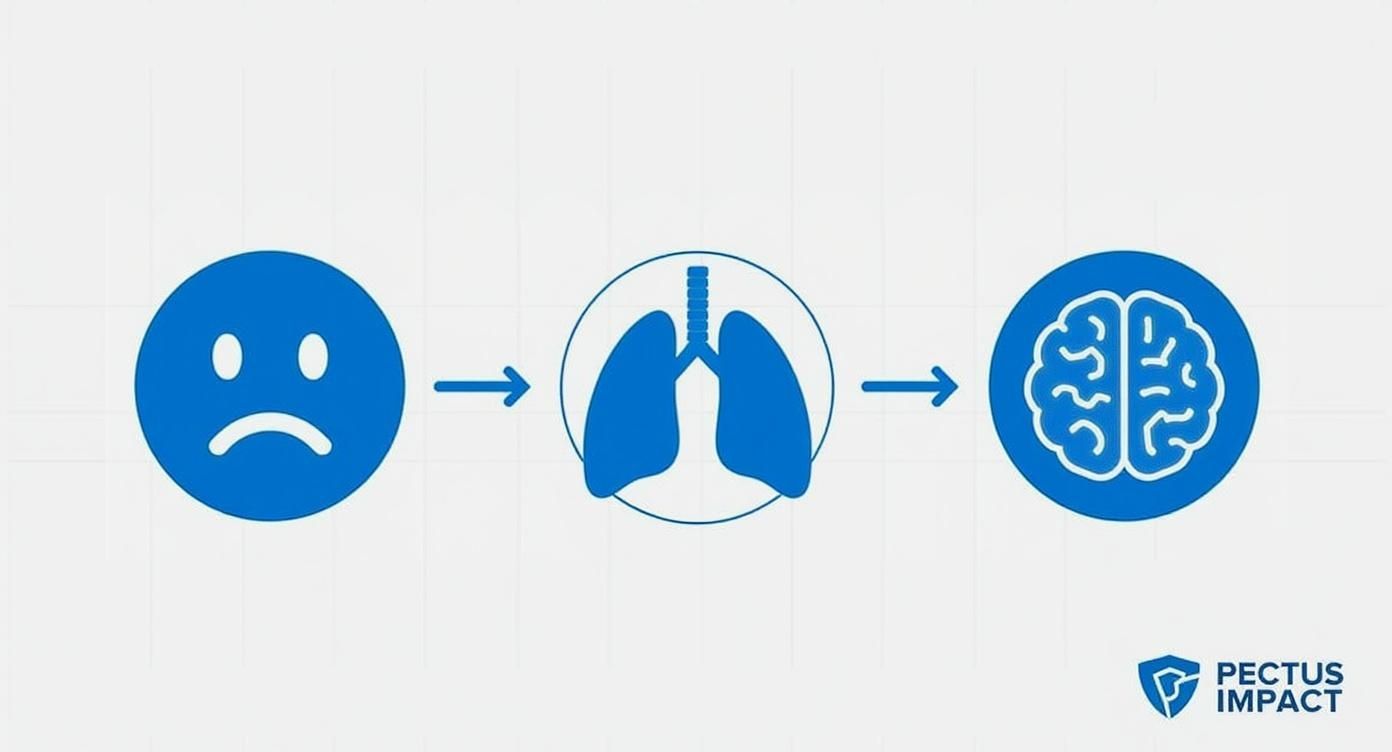
As you can see, the condition’s impact often starts with how it looks but can ripple outwards, affecting physical health and psychological well-being.
Assessing Heart and Lung Function
Getting a clear picture isn't just about images. Your specialist will also want to understand how the condition is affecting your body's performance. Functional tests are essential for seeing whether the indented sternum is physically getting in the way of your heart and lungs doing their jobs.
Two of the most common assessments are:
- Echocardiogram: Think of this as an ultrasound for your heart. It lets doctors see if the sternum is pressing on or shifting the heart out of its normal position. More importantly, it shows how well the heart is pumping blood.
- Pulmonary Function Tests (PFTs): This involves a series of breathing exercises using a machine called a spirometer. PFTs measure your lung capacity and how efficiently you can breathe air in and out, which can quickly show if the chest deformity is restricting your lungs.
By pulling all this information together—the imaging, the Haller Index, and the functional test results—your specialist gets a complete, 360-degree view. It provides the solid evidence needed to discuss your unique situation and recommend the best course of action for you.
Exploring Your Treatment Options in the UK
So, you’ve had a thorough assessment and know you’re dealing with pectus excavatum. The big question now is, what can you do about it? In the UK, the path forward isn't always a straight line. Your options range from proactive, non-surgical management to state-of-the-art surgical correction.
The best choice for you isn’t one-size-fits-all. It really hinges on the physical severity of the dip, whether it's causing any breathing or heart-related symptoms, and, just as importantly, how it's affecting you psychologically. Let's walk through the options, starting with the approaches that don't involve surgery.
Starting With Conservative Management
For many people, especially those with milder cases, surgery isn't the immediate or necessary answer. Non-surgical methods can be surprisingly effective, focusing on improving posture and building strength to minimise the visual impact of the sternal dip.
There are two main non-surgical routes:
- Targeted Physiotherapy: This isn't just about general exercise. A specialist physiotherapist can design a programme to strengthen your chest and back muscles. Better posture and muscle development can do a lot to lessen the appearance of the indentation and support better breathing mechanics.
- Vacuum Bell Therapy: Think of this as a non-invasive way to lift the sternum. A silicone cup is placed over the chest, and a hand pump creates a vacuum, gently pulling the breastbone forward. It's a long-term commitment, requiring consistent daily use over several years, and it tends to work best for younger patients whose chest walls are more pliable.
It's important to be realistic about these options. They demand real dedication. Success is tied directly to how consistently you follow the plan, making them a fantastic choice for motivated individuals with less severe cases.
Navigating Treatment on the NHS and Privately
Understanding the treatment landscape in the UK means being aware of some significant policy changes. Back in 2019, NHS England decommissioned routine surgical correction for pectus excavatum, putting procedures like the Nuss and Ravitch on hold. The official reason was a need for more evidence of their long-term benefits.
Before this change, the NHS performed around 380 of these operations a year. Now, access is restricted to exceptional cases, which must go through a difficult individual funding request process that is rarely successful. This has, understandably, left many families feeling stuck. More information on this policy can be found via the British Association of Paediatric Surgeons.
As a result, many now turn to the private sector, where surgery costs can range from £10,000 to £20,000. Private healthcare provides a vital alternative, offering fast access to specialists, diagnostics, and the full range of surgical procedures without the restrictive criteria. To get a clearer sense of the differences, our NHS and private sectors comparison guide can be a useful resource.
A Closer Look at Surgical Correction
When conservative methods aren’t enough, or when the condition is causing significant physical or psychological distress, surgery is the most definitive way to correct the problem. The aim is to physically reposition the sternum, relieving any pressure on the heart and lungs while creating a more typical chest shape.
The two gold-standard surgical techniques are the Nuss procedure and the Ravitch procedure. They work in different ways and are suited to different types of patients.
Let's break down the two main surgical approaches to help you understand how they differ.
Comparing Pectus Excavatum Surgical Procedures
| Feature | Nuss Procedure (Minimally Invasive) | Ravitch Procedure (Open Surgery) |
|---|---|---|
| Technique | Small incisions on the side of the chest; a curved bar is placed under the sternum to push it out. | A single incision over the chest; abnormal cartilages are removed to reposition the sternum. |
| Invasiveness | Minimally invasive; avoids large incisions and cartilage removal. | More invasive open surgery, providing direct visibility. |
| Ideal Patient | Children and teenagers with flexible chest walls. | Older adults with rigid chests or complex, asymmetrical cases. |
| Implant | A metal bar remains in place for 2-3 years to reshape the chest. | No internal bar is left behind; the sternum is fixed in its new position. |
| Number of Surgeries | Two stages: one to insert the bar, and a minor one to remove it later. | A single, one-stage corrective procedure. |
| Scarring | Two small scars on the sides of the chest. | A single, more prominent vertical or horizontal scar on the chest. |
Deciding between the Nuss and Ravitch procedures isn’t a choice you make alone. It’s a detailed conversation you’ll have with your thoracic surgeon, who will assess your specific anatomy, age, and the rigidity of your chest to recommend the approach that promises the best and most lasting outcome for you.
Life After Treatment: Recovery and Your Long-Term Outlook
Deciding to go ahead with treatment for pectus excavatum is a big step, so knowing what to expect afterwards is key. The good news is that the recovery process and long-term outlook are overwhelmingly positive, leading to better physical function and a real boost in self-esteem.
If you opt for surgery, the first part of your recovery happens in the hospital. After a Nuss or Ravitch procedure, you can typically expect to stay for about 3 to 5 days. Our main focus here is on getting your pain under control. Good pain management is what allows you to start moving, breathing deeply, and coughing properly – all crucial first steps.
A Phased Return to Normal Life
Recovery doesn't happen overnight; it’s a gradual process. Following your surgeon's advice to the letter is the best way to ensure your chest heals perfectly. We structure your recovery in phases, giving your body the time it needs to adapt and get stronger.
Here’s a rough timeline of what you can expect:
- Weeks 1-4: This is a time for rest and gentle activity. Daily walks are great, but you must avoid any lifting, pushing, or pulling. Bending and twisting are also off-limits for now.
- Weeks 4-12: You’ll start to slowly introduce more activities. Most people are cleared to go back to school or a desk job. Low-impact exercises like swimming or cycling are often okayed at this point, but contact sports are still on hold.
- After 3 Months: This is a big milestone. The majority of patients get the green light to return to all their normal activities, including sports. You’ll likely find you can do more now than you could before the surgery.
If there’s one piece of advice I give every patient, it’s this: listen to your body and listen to your surgical team. Pushing yourself too hard, too soon can undo all the good work. Patience is your most valuable tool for a successful recovery.
Living with the Nuss Bar
If you have the minimally invasive Nuss procedure, you’ll have an internal support bar. Think of it like scaffolding for a building – it holds your breastbone in its new, corrected position while your cartilage and bones remodel around it. It’s not permanent, just a temporary support doing a very important job.
The bar usually stays in for 2 to 3 years. During that time, you can live a completely normal life. Once your surgeon confirms that your chest wall is stable in its new shape, you'll come in for a much smaller day-case procedure to have it removed. The removal is very straightforward, and the recovery is quick.
The Big Picture: Long-Term Success
The long-term results from pectus excavatum surgery are excellent. Once your chest has fully healed and any support bars are removed, the correction is considered permanent. The chance of the indentation returning is extremely low, particularly when the surgery is performed by a specialist thoracic surgeon with plenty of experience.
But really, this journey is about more than just the physical fix. Time and time again, patients tell us about the profound impact it has on their quality of life. They can breathe easier and exercise without trouble, but just as importantly, they feel a huge surge in confidence. The goal is to help you live a full, active life without the physical or emotional limitations the condition once caused.
Frequently Asked Questions About Pectus Excavatum
When you’re first learning about pectus excavatum, it’s natural to have a lot of questions. We’ve put together some straightforward answers to the queries we hear most often, helping you get the clear information you need.
Can Pectus Excavatum Get Worse Over Time?
Yes, it often does. While pectus excavatum is a condition you’re born with, the dip in the chest can become much more noticeable during the teenage growth spurt.
Even if the chest's appearance stays the same in adulthood, some people find that symptoms like getting out of breath easily or struggling with exercise start to creep in. This is exactly why we recommend keeping an eye on it with a specialist, especially through the adolescent years.
Are There Exercises That Can Fix Pectus Excavatum?
Exercise is a fantastic tool, but it can’t actually fix the bone and cartilage causing the indentation. Think of it as a powerful supporting player, not the lead actor. A well-designed physiotherapy programme can absolutely make a difference.
By strengthening your chest and back muscles and improving your posture, you can sometimes lessen how visible the dip is. It’s also brilliant for boosting your lung capacity. But for moderate to severe cases, exercise isn’t a cure on its own; it’s best used as part of a conservative approach or alongside treatments like the vacuum bell or surgery.
Is Surgery for Pectus Excavatum Purely Cosmetic?
This is a very common misconception. While improving the chest’s appearance is a major benefit that can do wonders for self-confidence, surgery is very often performed for clear medical reasons.
In many moderate to severe cases, the sunken breastbone is physically compressing the heart and lungs. This can cause real-world symptoms like shortness of breath, chest pain, and an inability to keep up with physical activity.
The goal of surgery is to lift that pressure, allowing the heart and lungs to function properly again. The decision to operate is always based on a full picture: physical symptoms, the psychological impact, and detailed scans that measure the severity of the compression.
What Is the Best Age for Pectus Excavatum Surgery?
The sweet spot for surgery is generally during the mid to late teens, usually somewhere between 14 and 18 years old. At this age, the chest wall is still flexible enough to be reshaped effectively, but the patient is old enough to understand and cope with the recovery.
Timing it this way also allows us to work with the body's natural growth, helping the chest to settle and heal nicely in its new position. That said, successful surgery is absolutely possible for younger children and adults, too. The right time is always unique to the individual and decided after a careful assessment with a thoracic surgeon.
If these questions have sparked more of your own, or if you have any concerns about pectus excavatum, the best thing you can do is speak to an expert. Marco Scarci Thoracic Surgery provides fast-track access to specialist consultations and personalised treatment plans in London. To learn more or to book an appointment, please visit marcoscarci.co.uk.

