
Lung cancer remains the leading cause of cancer death both in the UK and worldwide, claiming more lives than breast, colon, and prostate cancers combined. Yet the statistics tell a dramatically different story depending on when the disease is found. Early stage lung cancer (stage I) treated with surgery can achieve five year survival rates of around 70% or higher, compared with only about 21% when similar tumours go untreated.
Clinical innovations and the ongoing development of advanced diagnostic and surgical technologies—such as liquid biopsies, minimally invasive techniques, and AI-driven tools—are transforming early detection and treatment outcomes for lung cancer.
As a consultant thoracic surgeon in London, Mr Marco Scarci focuses on minimally invasive, lung-sparing procedures that maximise cure rates while reducing pain and recovery time. Radiology and oncology specialists play a crucial role in advancing early detection and treatment approaches, integrating high-tech imaging and cancer research to improve patient outcomes. This article explains how early detection—particularly through low dose ct screening—directly feeds into higher lung cancer surgery success rates, and what that means in practical terms for patients and their families. Data from long-running programmes at Mayo Clinic, Johns Hopkins, Memorial Sloan Kettering, and the International Early Lung Cancer Action Program (I-ELCAP), alongside NHS initiatives, all point to the same conclusion: when lung cancer is found early and operated on promptly, survival improves dramatically. The five-year survival rate for lung cancer is around 56% when it is detected while the cancer is still localized, and low-dose CT scans are effective in catching lung cancer in its most treatable stages.
Understanding Lung Cancer Stages and Why Stage Matters for Surgery
“Stage” describes how far cancer has spread throughout the body, and this single factor strongly influences whether surgery is possible and how successful it is likely to be. The presence and size of the tumor are key factors in determining the stage and surgical outlook.
Here is a brief overview of the key stages:
| Stage | What It Means | Surgical Outlook |
|---|---|---|
| Stage I | Small tumour confined to the lung, no lymph node spread | Often ideal for surgery with curative intent; highest success rates |
| Stage II | Larger tumour and/or spread to nearby lymph nodes within the lung | Still frequently operable with good outcomes |
| Stage III | Spread to more distant or multiple lymph nodes in the chest | Surgery sometimes combined with chemotherapy/radiotherapy; outcomes more variable |
| Stage IV | Spread to other organs (brain, liver, bone) | Usually not treated with surgery aimed at cure; managed with systemic therapies |
Research dating back to the 1970s and 1980s from Mayo Clinic, Johns Hopkins, and Memorial Sloan Kettering already demonstrated that stage I NSCLC patients who underwent lung surgery lived far longer than those who did not. This pattern remains consistent in modern data.
One critical point for patients to understand: early stage (I–II) cancers are often completely asymptomatic. Clinical guidelines have suggested the use of advanced screening methods to detect tumors before symptoms appear. Waiting for symptoms like persistent cough, breathlessness, or blood in the sputum usually means the disease has already advanced beyond the optimal window for curative surgery. The most important message is simple—the earlier the stage at diagnosis, the more likely surgery is to be feasible and curative. For example, the survival rate for participants with Stage 1A cancers that measured 10 mm or less was 92 percent.
Lung Cancer Surgery Success Rates: What the Evidence Shows
“Success” in lung surgery is typically measured by the five year survival rate and longer-term survival, alongside quality of life after the operation. The five year survival rate is a key metric for assessing the effectiveness of lung cancer surgery and early detection strategies. The evidence accumulated over decades consistently shows that early lung cancer detection and prompt surgical treatment yield dramatically better outcomes. Patients diagnosed with lung cancer at an early stage via screening have a much higher survival rate compared to those diagnosed at a later stage.
Historic Evidence from X-Ray Screening Trials
Analyses published in Chest (1984, 1986) and the American Review of Respiratory Disease (1984) examined patients diagnosed through chest X-ray screening programmes. For the first time, these studies demonstrated the impact of early detection on survival:
- Around 63–76% five year survival for stage I NSCLC patients treated surgically
- Only 0–19% five year survival for similar stage I patients left untreated, with most dying of lung cancer within five years
A 1992 analysis reported in Biometrics, supported by an American Cancer Society grant (RD306), reinforced that surgical resection of screen-detected, early stage tumours dramatically reduced lung cancer deaths.
Building on these early findings, the U.S. Preventive Services Task Force now recommends annual lung cancer screening for high-risk adults.
Modern Data from I-ELCAP
More recent evidence from the International Early Lung Cancer Action Program, which followed 1,285 participants with lung cancer detected by low dose CT, shows even more encouraging results:
- Early stage lung cancers found by LDCT and treated promptly achieved approximately 80% twenty-year survival
- This is long-term, not just five year, survival—especially meaningful for patients and families
Contemporary Surgical Outcomes
A large National Cancer Database analysis from Duke University (2004–2020, covering 76,466 cases) provides further insight into modern outcomes:
| Procedure | Five Year Overall Survival |
|---|---|
| Lobectomy | 83.6% |
| Segmentectomy | 80.6% |
| Wedge resection (2016–2019) | 79.9% |
These figures reflect how advances in minimally invasive techniques (VATS and robotic surgery), improved anaesthesia, and enhanced recovery pathways have reduced operative risk and hospital stay without compromising oncological outcomes. These surgical approaches are specifically designed to preserve as much healthy lung tissue as possible, improving outcomes for patients’ lungs. Minimally invasive lung cancer surgery techniques are also associated with lower complication rates compared to traditional open surgeries.
It is worth noting that individual prognosis depends on tumour type, size, lymph node involvement, overall fitness, and co-existing conditions. These percentages are guides rather than guarantees, but they demonstrate what is achievable when disease is caught early.

The Impact of Early Detection: From CT Screening to Lung MOTs
Lung cancer is frequently diagnosed late. Globally, only about 15–30% of people diagnosed with lung cancer are identified at an early stage, and most lung cancer deaths occur within a year when disease is advanced. Ongoing efforts by healthcare systems and researchers are focused on improving early detection and increasing screening uptake to enhance outcomes for patients. This is precisely why screening programmes have become so important. Mobile lung cancer screening programs have also been effective in increasing early diagnosis rates in deprived communities.
How Low-Dose CT Screening Works
Radiology plays a central role in low-dose CT screening for lung cancer. Low dose CT screening targets high risk individuals—typically long-term smokers or ex-smokers aged 55–74—using very low radiation doses (around 1–1.5 mSv per scan, compared with 7–8 mSv for a full diagnostic chest CT). The goal is to detect small nodules long before symptoms appear. The U.S. Preventive Services Task Force recommends annual lung cancer screening for adults aged 50 to 80 years with a significant smoking history.
Key evidence from programmes like I-ELCAP and major national trials demonstrates that routine LDCT screening:
- Significantly increases early stage cancer detection rates
- Reduces lung cancer mortality by up to 20–24% compared with no screening or chest X-ray alone
NHS England Lung Health Checks
The NHS “lung trucks” or mobile unit lung MOT programmes have brought screening directly to communities across England. Between 2019 and 2022:
- More than 300,000 people were scanned in deprived communities
- 1,779 lung cancers were diagnosed
- 76% of these were identified at an early stage (stage I or II)
- The proportion of lung cancers diagnosed at stage I or II in participating areas rose from 30% in 2019 to 34.5% in 2022
This measurable improvement in early lung cancer diagnosis directly connects to surgery success: more early stage diagnoses mean more patients are eligible for curative operations, which translates into higher population-level survival.
For patients, early detection also means gentler treatment options—less lung tissue removed, smaller incisions, and faster return to normal activities.

Modern Surgical Techniques: Keyhole and Minimally Invasive Lung Cancer Surgery
Clinical advancements have driven the evolution of modern surgical techniques in lung cancer surgery, moving from large open thoracotomies to keyhole (minimally invasive) approaches. These modern clinical methods aim to maintain or improve cancer outcomes while substantially reducing surgical trauma.
Training programs for minimally invasive surgical techniques are being established to improve proficiency among surgeons.
Video-Assisted Thoracoscopic Surgery (VATS)
VATS involves making 2–4 small incisions between the ribs. A thoracoscope (camera) provides a magnified view on a monitor, while long instruments perform the dissection and resection. Common VATS procedures include:
- Lobectomy (removal of a lung lobe)
- Segmentectomy (removal of specific lung segments)
- Wedge resection (removal of a small wedge of tissue around the tumour)
The benefits are significant:
- Less post-operative pain
- Shorter hospital stay (often 3–5 days versus 7–10 for open surgery)
- Fewer complications such as pneumonia
- Quicker recovery and return to normal activities
Advanced Minimally Invasive Approaches
Ongoing efforts to develop new surgical techniques have led to the adoption of single-port (uniportal) VATS, which uses just one small incision of 3–4 cm. This approach reduces trauma and post-surgery pain compared to traditional multi-port VATS, providing significant benefits for lung cancer patients. The Shanghai Pulmonary Hospital has performed over 75,000 single-port VATS procedures, making it a leader in this surgical technique and demonstrating that minimally invasive surgery can be safely used for the majority of early stage cases.
Robotic-assisted thoracic surgery offers high-definition 3D vision and wristed instruments with greater dexterity, which can be advantageous for complex resections.
Precision Planning with Modern Technology
Contemporary thoracic surgery leverages the clinical application of advanced tools for precise tumour localisation and surgical planning:
- 3D CT reconstructions to visualise segmental anatomy
- Intraoperative imaging techniques (CT-guided markers, fluorescence, cone-beam CT)
- In some centres, 3D-printed models of patient-specific lung anatomy
- AI-assisted nodule detection and risk stratification
Liquid biopsies can detect lung cancer markers in blood samples, and the miDER technology identifies long non-coding RNA from extracellular vesicles to improve lung cancer detection.
Mr Marco Scarci’s practice emphasises these minimally invasive, keyhole approaches—including VATS and, where appropriate, robotic techniques. Each procedure is tailored to the patient’s tumour characteristics, lung function, and overall health, ensuring the best balance between complete cancer clearance and preservation of healthy lung tissue.
Types of Lung Cancer Operations and Their Typical Outcomes
Understanding the main surgical options helps patients make informed decisions about their care. Oncology expertise guides the selection of both surgical and non-surgical treatment options, ensuring that each patient receives the most appropriate and effective care plan.
Lobectomy Removal of an entire lung lobe remains the gold standard for many stage I–II NSCLCs. Long-term survival data consistently shows strong outcomes, with five year survival rates often exceeding 60–70% for stage I disease.
Segmentectomy and Wedge Resection These lung-sparing options are increasingly used for very small tumours or patients with limited lung function. Thanks to better imaging and minimally invasive techniques, researchers have demonstrated that carefully selected patients can achieve survival comparable to lobectomy while preserving more lung capacity.
Pneumonectomy Removal of an entire lung is now far less common due to its profound impact on breathing and higher risk. It is reserved for selected cases where lesser resections cannot achieve adequate cancer clearance.
Recent advances in targeted therapy and immunotherapy have also significantly improved treatment options and outcomes for lung cancer patients, complementing surgical approaches.
Quality of Life After Surgery
Most patients can return to active, independent living after recovery, particularly when keyhole approaches are used. Studies show that persistent pain (post-thoracotomy pain syndrome) is substantially less common after VATS compared with open surgery. Lung function typically remains adequate for daily activities, especially after lung-sparing resections. You can learn more in the article An Overview of Lung Cancer Surgery: Types and What to Expect.
Beyond the Operation: Adjuvant Therapy, Follow-Up, and Recurrence Prevention
Surgery is often the cornerstone of treatment for early stage NSCLC, but it may not be the entire plan. Clinical decision-making is essential in determining the need for adjuvant therapies after surgery, as these additional treatments can further reduce recurrence risk and improve long-term outcomes. Regular imaging and surveillance are suggested by clinical guidelines to detect recurrence early and ensure the best possible prognosis.
Post-Surgical Treatment Options
Oncologists may recommend:
- Chemotherapy or immunotherapy after surgery for certain stage II–III cancers
- Targeted therapies if specific genetic changes (such as EGFR or ALK mutations) are found in the tumor, allowing treatment to be tailored to the tumor’s unique genetic profile
- Close CT-based surveillance to detect any recurrence or new primary tumors early
Research by colleagues such as Dr Kellie Smith at Johns Hopkins has shown that even in early stage disease, the immune system’s anti-tumor response can be monitored through blood tests. This opens future possibilities for:
- Personalised decisions about who needs extra treatment after surgery
- Earlier detection of microscopic recurrence, potentially months before it becomes visible on imaging
Structured Follow-Up in Practice
In Mr Marco Scarci’s practice, follow-up is structured and personalised, typically including:
- Scheduled imaging at defined intervals
- Symptom review and lung function monitoring
- Lifestyle and smoking-cessation support to protect long-term lung health
The message here is clear: early detection does not end with the first operation. Ongoing surveillance enables earlier identification of any problems, maintaining the survival advantage over time.
Who Should Consider Lung Cancer Screening and Surgical Consultation?
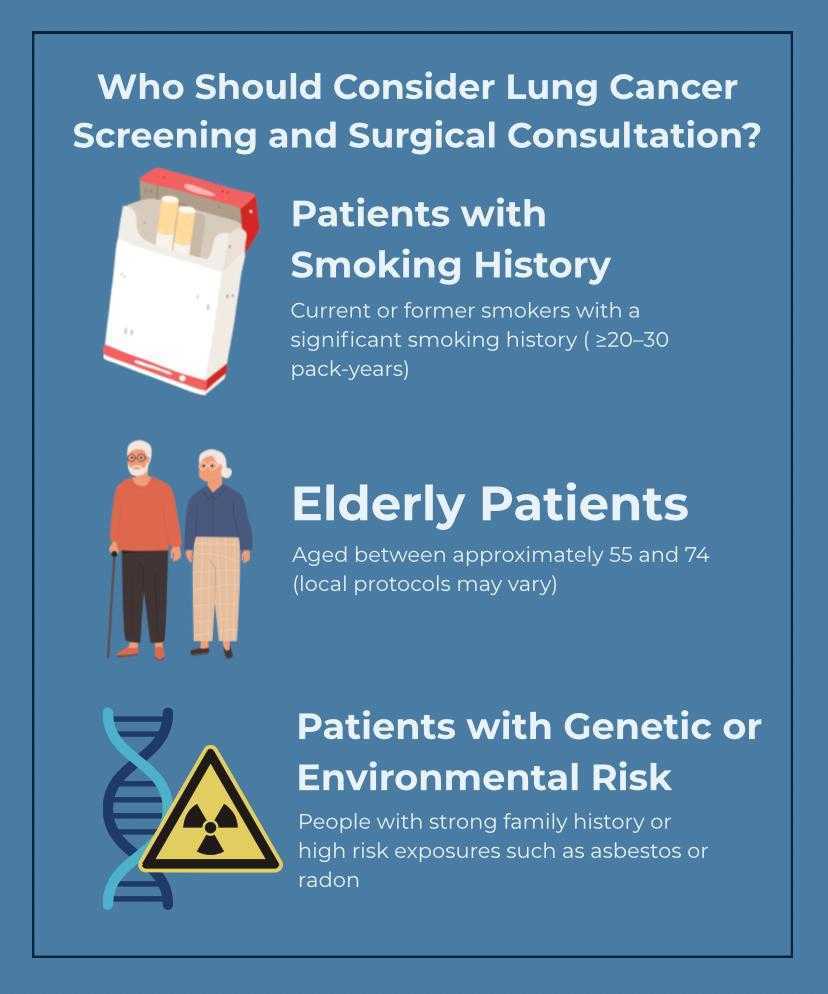
Lung cancer screening eligibility criteria used internationally and in UK/NHS programmes typically include:
- Current or former smokers with a significant smoking history (usually ≥20–30 pack-years)
- Aged between approximately 55 and 74 (local protocols may vary)
- Sometimes extended to people with strong family history or high risk exposures such as asbestos or radon
Screening is suggested for individuals meeting these risk factors according to clinical guidelines, as early detection can significantly improve outcomes.
People who meet these criteria benefit most from discussing low dose CT screening—either via NHS lung health checks or private pathways. According to the American Lung Association, only about 18% of eligible high risk individuals currently receive screening, despite robust evidence of benefit.
When to Seek Specialist Consultation
Individuals with suspicious findings on imaging—such as lung nodules—or a new confirmed diagnosis of early stage lung cancer should seek prompt opinion from a specialist thoracic surgeon experienced in minimally invasive techniques.
Mr Marco Scarci can support patients through:
- Rapid access face-to-face or virtual consultations for UK and international patients
- Coordination of imaging, biopsy, and staging investigations
- Detailed discussion of surgical options, risks, and likely outcomes tailored to each patient’s situation
The key behavioural point: do not wait for severe symptoms. If you fit a high risk profile or are concerned about scan results, an early specialist review can make the difference between a small, curable operation and more complex, less successful treatment later.
Taking the Next Step: Practical Advice for Patients and Families
Receiving news about a potential lung cancer diagnosis is understandably frightening. But the evidence is clear: early action can be lifesaving, and outcomes today are substantially better than they were even a decade ago. Patients and families are encouraged to take part in ongoing efforts to improve early detection and outcomes, such as participating in screening programmes and supporting awareness initiatives.

A Practical Checklist
If you are concerned about lung cancer, consider these steps:
- If you are in a high risk group (e.g. 20+ pack-years of smoking, age over 50–55), ask your GP or respiratory medicine specialist about low dose CT screening or NHS lung health checks
- If you have been told you have a lung nodule or early stage cancer, request referral to a consultant thoracic surgeon—ideally one with expertise in minimally invasive lung surgery
- Prepare questions about surgical approach (open vs keyhole), expected recovery time, and long-term outlook
- Don’t delay—timing matters for outcomes
Accessing Mr Marco Scarci’s Services
Patients can access Mr Marco Scarci’s London-based practice through:
- Self-referral or referral from GPs and other specialists
- Both private and NHS pathways available
- Initial virtual consultation option for those living outside London or overseas
The Bottom Line
When lung cancer is caught early and treated promptly with expert, minimally invasive surgery, long-term survival can be dramatically better. The data from decades of research—from historic screening trials to the latest NHS lung MOT programmes—consistently shows that early cancer detection saves lives.
Screening plus awareness are the tools that make early diagnosis possible. If you fit a high risk profile, or if you have already received concerning scan results, take the next step. Speak to your doctor about screening, or contact a specialist thoracic surgeon for an accurate diagnosis and personalised treatment plan. Early action is the single most powerful thing you can do to improve your chances of a successful outcome.

