

This article is intended for lung cancer patients, survivors, and their families who are concerned about the risk of recurrence after surgery. Understanding your risk can help you make informed decisions about follow-up care and lifestyle choices. The risk of lung cancer recurrence is influenced by the type and stage of cancer at the time of diagnosis. Even after successful lung cancer surgery, many patients understandably wonder whether their cancer might return. This is one of the most common questions asked in clinic, and the honest answer is that there is a measurable risk of recurrence, particularly in the first two to five years after the operation.
As a consultant thoracic surgeon in London, I focus on meticulous staging, minimally invasive techniques and tailored follow-up to minimise this risk and detect any problems early. In this article, I’ll explain what the statistics actually mean for different types and stages of lung cancer, what factors influence your individual risk, and what you can do to give yourself the best possible chance of remaining cancer-free.
Quick answer: How likely is lung cancer to come back after surgery?
The chance of lung cancer coming back depends mainly on the type of cancer (non small cell lung cancer versus small cell lung cancer), the stage at the time of surgery, whether lymph nodes were involved, and whether you continue to smoke. If lung cancer returns, the risk and prognosis depend on several factors including stage, type, and treatment received.
The risk of lung cancer recurrence can be influenced by the type of lung cancer and the stage at which it was diagnosed.
Summary of Recurrence Rates by Stage and Type
Below is a summary of recurrence rates for the major lung cancer types and stages, based on published studies:
| Lung Cancer Type & Stage | Approximate Recurrence Rate & Time Frame |
|---|---|
| NSCLC Stage I (very early) | 20%–30% of patients experience recurrence within 5 years ([1]) |
| NSCLC Stage II | 40%–50% recurrence rate ([4]) |
| NSCLC Stage III | Often exceeds 50%–60% ([5]) |
| NSCLC (all stages, general) | 30%–55% of patients experience recurrence after surgery ([2]); 30%–75% chance of recurrence in one study ([3]) |
| Early-stage NSCLC (with chemotherapy) | Approximately half experience recurrence after surgery, even with chemotherapy ([7]) |
| SCLC (Small Cell Lung Cancer) | Approximately 70% recurrence within one to two years after treatment ([6]) |
References:
- Approximately 20% to 30% of Stage I patients experience lung cancer recurrence.
- 30% to 55% of patients with non-small cell lung cancer (NSCLC) experience recurrence after surgical resection despite curative intent.
- NSCLC was found to have a 30-75% chance of recurrence in one study.
- Recurrence rates for Stage II lung cancer rise to approximately 40% to 50%.
- For Stage III lung cancer, recurrence rates often exceed 50% to 60%.
- SCLC has a recurrence rate of approximately 70% within one to two years after treatment.
- Approximately half of people with early-stage NSCLC experience their cancer coming back after surgery, despite also receiving chemotherapy.
Key points to remember:
- Most recurrences (50%–90%) occur within the first two years after surgery, and 90%–95% appear within five years.
- Most recurrences happen within the first two to five years after the operation.
- Follow-up is most intensive during this period for exactly this reason.
- Many factors influence your individual risk, including tumour size, lymph node spread and whether the cancer was completely removed.
- Quitting smoking after surgery significantly reduces the chance of both recurrence and a new tumor.
One large study found that NSCLC has a 30-75% chance of recurrence after surgery, and 30% to 55% of patients with NSCLC experience recurrence after surgical resection despite curative intent.
These figures are averages drawn from large studies and help with planning your follow-up. They do not predict what will happen to any single person.
Current smokers have a significantly higher hazard ratio of 1.63 for lung cancer recurrence. Visceral pleural invasion (VPI) and the presence of lymphovascular invasion (LVI) significantly increase the risk of recurrence following lung cancer surgery. Larger tumor size and higher metabolic activity (PET SUVmax >5) are associated with increased lung cancer recurrence rates. Patients with Stage II or higher lung cancer who do not receive adjuvant therapy have an increased risk of recurrence.
Want a specialist opinion on your condition?
Get a clear answer from a surgeon who will be with you throughout.
What do doctors mean by “lung cancer recurrence” after surgery?

Lung cancer recurrence happens when your cancer returns after you’ve been in remission for at least one year. Recurrence means the same lung cancer comes back after a period when scans and tests showed no evidence of disease. This is usually defined as at least 12 months after the initial treatment. When lung cancer recurs, it is usually of the same type as the original tumor, which helps distinguish it from a new, unrelated cancer.
It is different from a “second primary” lung cancer, which is a completely new tumour unrelated to the original diagnosis. Second primaries often develop in a different part of the lung and have distinct features under the microscope or on genetic tests.
Understanding the terminology:
- Recurrence: The original lung cancer cells return after a disease-free interval, usually of the same type as the initial tumor
- Second primary: A new, unrelated lung cancer
- Progression: The original cancer never fully went away or grew back within the first year of treatment
In practice, pathologists distinguish recurrence from a new primary by examining the cancer cells and, where needed, using molecular or genomic testing.
Having had lung cancer once does not mean every new symptom is a recurrence. However, any new or persistent cough, chest pain or unexplained symptoms should prompt an assessment at a specialist chest clinic rather than being ignored.
"I was diagnosed in March with a rare condition. My local hospital said it was inoperable due to the size of the mass. Mr Scarci reassured me the thymoma was resectable. I was booked for surgery the following week where he successfully removed the entire tumour."
How common is lung cancer recurrence after surgery?
Recurrence rates by stage and type
Recurrence rates vary widely based on stage, tumour size, lymph node spread and cancer subtype. The statistics below are averages rather than guarantees for any individual.
For lung cancer patients treated with surgery, the likelihood of the cancer returning depends heavily on how advanced it was at diagnosis. While these figures can sound daunting, it is important to remember that many patients remain cancer-free long term after surgery, especially when the tumour was found early and completely removed.
The prognosis for lung cancer recurrence is generally poor, with a 3-year survival rate of approximately 24%. The median survival time after recurrence varies depending on the extent and location of the disease, but is often limited.
Modern keyhole (VATS and robotic thoracic surgery) and precise staging have improved both disease free survival and quality of life compared with older techniques.
Non-small cell lung cancer (NSCLC)
Cell lung cancer NSCLC is the most common type, accounting for around 80–85% of cases. When caught at an early stage, surgery is the main curative treatment.
After complete surgical removal (lobectomy, segmentectomy or pneumonectomy), recurrence is still possible. It can occur:
- Locally: Near the original tumor or at the surgical margin
- Regionally: In nearby lymph nodes in the chest
- Distantly: In organs such as the brain, bones, liver, adrenal glands or the other lung
Research shows that around 60–80% of NSCLC recurrences are distant (metastatic) rather than only at the original site. This is why some patients are advised to undergo treatment with adjuvant chemotherapy, targeted and immunotherapy-based lung cancer treatments after surgery, depending on tumour features and molecular markers, to reduce the risk of recurrence.
Typical NSCLC recurrence figures:
- Stage I: roughly 20–30% recurrence within 5 years
- Stage II: recurrence risk often in the 30–50% range
- Stage III: recurrence can approach 60–70%, even with additional treatments
Small-cell lung cancer (SCLC)
Small cell lung cancer is less common (about 10–15% of lung cancers) and usually treated with chemotherapy and radiation therapy rather than surgery. Surgery is only considered in very early, limited cases.
Even when surgery is possible, SCLC tends to recur more often and more quickly than NSCLC. Most recurrences happen within one to two years of diagnosis.
SCLC recurrences commonly involve widespread disease in the chest, bones, liver or brain, reflecting its aggressive, fast-growing nature. Close follow-up, timely chemotherapy and, in some cases, preventive brain radiotherapy are used to reduce and manage recurrence risk.
Have a question about your diagnosis?
A consultation gives you a personalised plan — not a generic estimate.
Where can lung cancer come back after surgery?
Recurrence is usually described by where the cancer has returned in relation to the localized tumor that was originally removed.
The three main patterns:
- Local recurrence: In the same lung area or at the surgical margin where the original tumour was removed. This type may sometimes be treated with further surgery or radiotherapy.
- Regional recurrence: In nearby lymph nodes in the chest. The extent of nodal spread influences treatment options.
- Distant recurrence: In distant parts of the body, such as the brain, liver, bones, and adrenal glands. Under the microscope, these metastatic tumor deposits still look like lung cancer cells; they are not a new cancer arising from that organ.
Local and regional recurrences may be amenable to further surgery or radiotherapy in selected patients. Distant recurrence is usually treated with systemic (whole-body) treatments such as chemotherapy, targeted therapy or immunotherapy.
What are the risk factors for lung cancer coming back?

Tumour-related factors
Some risk factors are fixed, such as the stage at diagnosis or certain genetic features.
- Higher clinical stage at diagnosis (larger isolated tumors, lymph node spread)
- Certain aggressive histological subtypes (e.g. poorly differentiated tumours)
- Positive surgical margins (lingering cells close to where the tumour was cut out)
- Presence of vascular invasion or spread through air spaces
Patient and lifestyle factors
Others are modifiable, meaning you can take action to reduce your risk.
- Continued smoking after surgery (this can raise the risk of recurrence and new lung cancers several-fold compared with stopping)
- Underlying lung disease, such as severe emphysema or pulmonary fibrosis
- Weaker immune system from other illnesses or long-term medications
Molecular and genetic markers
- Specific gene mutations (e.g. EGFR, ALK, KRAS) can influence recurrence patterns and guide targeted therapy
- PD-L1 expression may influence suitability for immunotherapy to lower recurrence risk
- Certain mutated strains respond differently to treatment approaches
What you can do
Smoking cessation is one of the most important steps you can take. Pulmonary rehabilitation, exercise within your limits, good nutrition and close follow-up with your surgical and oncology team can all help reduce risk or allow earlier intervention if the cancer recurs.
Timing of surgery and quality of treatment
When early stage lung cancer is diagnosed, unnecessary delay in surgery can allow the tumour more time to grow or spread, potentially increasing recurrence risk.
Large studies have shown that cancer patients who underwent lobectomy and other thoracic surgery within about 12 weeks of diagnosis tended to live longer and had lower postoperative recurrence rates than those operated on later.
Careful pre-operative staging (CT, PET-CT, bronchoscopy, endobronchial ultrasound and, where needed, mediastinoscopy) helps ensure surgery is appropriate and complete. This reduces the likelihood of hidden disease being left behind, and choosing private thoracic surgery in London can also minimise delays to treatment.
Having surgery performed by an experienced thoracic surgeon, using modern minimally invasive approaches where suitable, is associated with fewer complications and can facilitate timely access to further treatments if required.
Not sure about your treatment options?
Mr Scarci provides expert consultations typically within one week of contact.
How will I know if my lung cancer has come back?
Follow-up after lung cancer surgery is structured precisely to monitor for recurrence. Even if you feel well, attending your scheduled appointments and scans is important.
Typical follow-up schedule for early-stage NSCLC:
| Time After Surgery | Appointment Frequency |
|---|---|
| First 2 years | Every 3–6 months |
| Years 2–5 | Every 6–12 months |
| Imaging (CT scans) | At least annually for first few years |
Symptoms that could suggest recurrence
- New or worsening persistent cough, coughing up blood, or chest pain
- Increasing shortness of breath compared with the months after surgery
- Unexplained weight loss, fatigue, fevers or night sweats
- Headaches, confusion or weakness in limbs (if cancer has spread to the brain)
- Bone pain, especially in the back, ribs, hips or shoulders
Many of these symptoms can also be caused by scarring from surgery, infections or other lung conditions. They should prompt assessment rather than panic.
In my practice, patients receive structured post-operative follow-up and can request a thoracic surgery consultation in London if they develop new or worrying symptoms between scheduled appointments.
"Dr. Marco Scarci is a deeply knowledgeable, open-minded, and empathetic surgeon. He listens to details and solves problems to truly deliver the most optimal results. As a medical professional myself, I can tell you that finding a specialist like Dr. Scarci is very rare, and it is a privilege to have him in my corner."
What treatments are available if lung cancer comes back after surgery?
Treatment for recurrent lung cancer depends on where the cancer has returned, how extensive it is, what treatments were given previously, and your overall health and lung function.
Main treatment approaches:
| Treatment | When Used | Goals |
|---|---|---|
| Surgery | Small, isolated recurrences in lung, chest wall, brain or liver | Potential cure or long term control |
| Radiation therapy | Local or regional recurrence; symptom control for brain, bone or liver metastases | Kill cancer cells in specific areas |
| Chemotherapy | More widespread distant recurrence | Systemic control of recurring lung cancer |
| Targeted therapy | Specific gene changes (e.g. EGFR, ALK) | Often effective for months or years with manageable side effects |
| Immunotherapy | Recurrent NSCLC, particularly PD-L1 positive | Help immune system recognise and attack cancer cells |
| The goals of treatment may be cure in some local or limited recurrences, or control of the disease and symptoms in advanced recurrences. The aim is always to prolong survival time and improve quality of life. | ||
| Clinical trials and new therapies continue to expand treatment options. Specialist centres in London can offer access to modern treatment protocols, including translational lung cancer research studies. |
Want a specialist opinion on your condition?
Get a clear answer from a surgeon who will be with you throughout.
Coping with disease recurrence
Facing lung cancer recurrence can be an overwhelming and emotional experience for both patients and their loved ones. It’s completely normal to feel a mix of disappointment, anxiety, or even frustration after having undergone initial treatment and achieved a period of disease free survival. Many lung cancer survivors find it helpful to seek support through counseling, patient support groups, or stress management techniques to help process these feelings and maintain emotional well-being. Open and honest communication with your healthcare team is also essential, as it allows you to express concerns, ask questions, and work together to develop a plan for moving forward.
When lung cancer recurs, it may do so locally, regionally, or at distant sites in the body. The type of recurrence and the treatments you received previously will influence the most appropriate treatment options for recurrent lung cancer. Advances in lung cancer treatment mean that many patients can safely receive further therapies, including surgery, radiation therapy, chemotherapy, targeted therapy, or immunotherapy, depending on the specific characteristics of the cancer cells and your overall health.
Targeted therapy, for example, uses drugs designed to attack certain mutated strains or gene changes found in lung cancer cells, often identified through genetic tests, in much the same way that pneumothorax surgery is tailored to the underlying cause and severity of a collapsed lung. This approach can be particularly effective for patients whose cancer has specific mutations, offering the potential for long term control with fewer side effects. Immunotherapy is another promising option, helping the immune system recognize and attack lung cancer cells, and has shown encouraging results in some patients with recurrent lung cancer.
Lifestyle choices remain important even after recurrence. Quitting smoking is one of the most effective ways to reduce the risk of further recurrence or the development of a new lung cancer, and it also lowers the risk of other lung conditions such as collapsed lung (pneumothorax). The American Cancer Society strongly recommends smoking cessation and minimizing exposure to secondhand smoke as key steps for all lung cancer patients. Addressing other risk factors, such as maintaining a healthy weight and staying active within your limits, can also support your overall health during and after treatment.
For some patients, participating in clinical trials can provide access to innovative treatment approaches that are not yet widely available. Translational lung cancer research continues to drive progress, offering hope for new therapies that may improve survival time and quality of life for those with recurrent cancers. Leading organizations, including the American College of Surgeons and the Society of Thoracic Surgery, emphasize the importance of timely and appropriate treatment for all stages of lung cancer, including early stage lung cancer and locally advanced disease.
Ultimately, coping with lung cancer recurrence requires a comprehensive approach that addresses not only the physical aspects of the disease, but also the emotional and psychological challenges. Working closely with your healthcare team to develop a personalized care plan, seeking support when needed, and staying informed about new treatment options can help you navigate this difficult time. By taking proactive steps and accessing available resources, patients and their families can find hope, improve quality of life, and focus on what matters most during their cancer journey.
What can I do to lower my chance of lung cancer coming back?
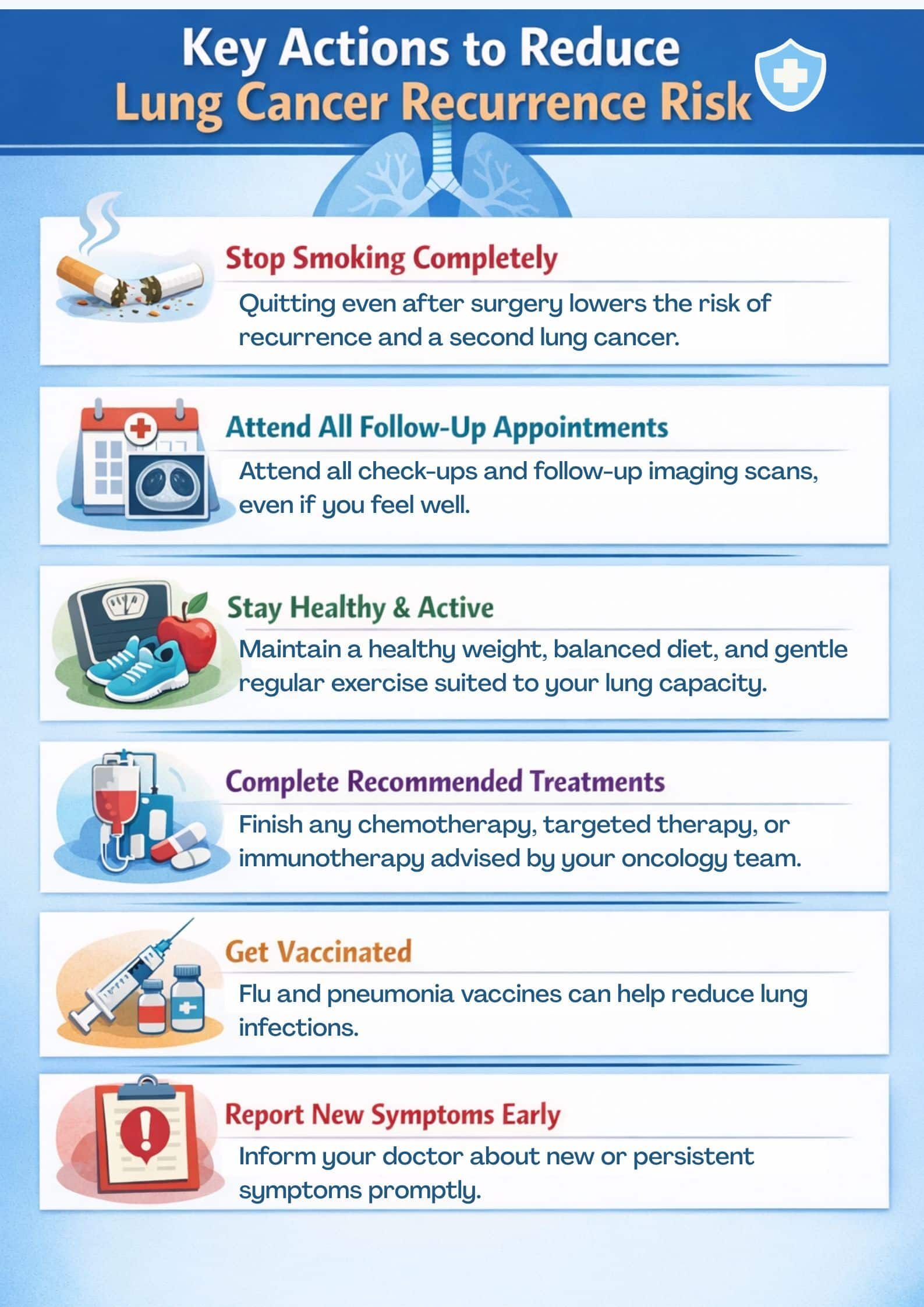
Key actions to reduce recurrence risk
- Stop smoking completely. Quitting even after surgery significantly reduces the risk of recurrence and a second lung cancer.
- Attend all follow-up appointments and imaging scans, even if feeling well.
- Maintain a healthy weight, balanced diet and gentle regular exercise tailored to your lung capacity.
- Complete any recommended adjuvant treatments (chemotherapy, targeted therapy, immunotherapy) if advised by your oncology team as appropriate treatment.
- Get vaccinated against flu and pneumonia as recommended to reduce lung infections.
- Report new or persistent symptoms early rather than waiting for the next scheduled appointment.
Psychological support, counselling and support groups can help manage anxiety about recurrence, which is extremely common after major cancer surgery.
In my practice, patients receive individualised advice on risk reduction, smoking cessation resources and ongoing support throughout recovery.
Seeing a thoracic surgeon in London about lung cancer surgery or recurrence
As a consultant thoracic surgeon based in London, I offer both private and NHS services for lung cancer treatment and other thoracic conditions, and work closely with some of the best private hospitals in London for thoracic care.
My particular expertise is in minimally invasive, keyhole and robotic techniques (such as VATS lobectomy). These approaches aim for faster recovery, less pain and the opportunity to start additional treatments promptly when needed.
Patients can be referred for:
- Assessment of a new lung cancer diagnosis and discussion of surgical options
- Second opinions on complex cases or concerns about recurrence
- Ongoing post-operative follow-up and management of long-term effects of lung surgery
Both face-to-face and virtual consultations are available, including for international patients seeking expert opinion in London.
If you are worried about your risk of lung cancer returning after surgery, or if you have developed new symptoms, seeking timely specialist advice is the most important step. Early detection and appropriate treatment give the best chance of long term control.
