
Slipping Rib Syndrome: Symptoms, Causes, Diagnosis and Treatment
Key Takeaways
- Slipping rib syndrome is a painful condition affecting the 8th, 9th, and 10th ribs (false ribs), causing sharp pain and a clicking or popping sensation in the lower chest or upper abdomen when cartilage attachments become loose.
- The condition is frequently underdiagnosed and often mistaken for heart, lung, or abdominal problems, leading to frustrating delays in appropriate treatment.
- Diagnosis relies primarily on clinical assessment, including the hooking manoeuvre during physical examination, with dynamic ultrasound supporting rather than replacing clinical findings.
- Most patients begin with conservative treatment including rest, activity modification, pain relief, and physical therapy, but persistent severe cases may benefit from intercostal nerve block injections or surgery.
- Mr Marco Scarci, consultant thoracic surgeon in London, provides specialist assessment and minimally invasive surgical options for complex and long-standing cases of this challenging condition.
What Is Slipping Rib Syndrome?
Slipping rib syndrome, also known as rib subluxation, clicking rib syndrome, or rib tip syndrome, is a painful rib syndrome where the lower ribs move excessively because their cartilage attachments have become weakened or torn.
- This abnormal movement causes the rib tip or rib cartilage to irritate nearby intercostal nerves and soft tissues, producing sharp, stabbing chest pain and sometimes an audible or palpable click
- The medical condition is a mechanical problem of the rib–cartilage–ligament complex, not a heart or lung issue, though symptoms can convincingly mimic those conditions
- Slipping rib syndrome is benign and not life-threatening, but it can significantly disrupt daily activities, sports, sleep, and work when left unrecognised
- Alternative names include Cyriax syndrome, painful rib syndrome, and interchondral subluxation
Which Ribs Are Affected and How Does It Feel?
Slipping rib syndrome most commonly involves the 8th, 9th, and 10th ribs – the false ribs – which attach to the rib above via flexible cartilage rather than directly to the breastbone.
- When ligaments and cartilage of these interchondral joints weaken or tear, the lower rib tips can partially dislocate (sublux) and slip under the rib above, irritating the intercostal nerve running along each rib’s underside
- The pain can often be reproduced by certain movements involving twisting, bending, or applying pressure to the affected area
Common pain triggers include:
- Coughing, sneezing, or laughing
- Deep breathing
- Reaching overhead or heavy lifting
- Sports involving rotation (golf, tennis, swimming, rowing)
- Simply rolling over in bed
Pain may radiate to the side, upper back, or flank along the course of the irritated nerve. Floating ribs (11 and 12) typically cause different soft-tissue issues rather than true slipping rib syndrome, sometimes labeled “twelfth rib syndrome”.

What Causes Slipping Rib Syndrome?
Slipping rib syndrome occurs when the fibrous and cartilaginous connections between the false ribs weaken, stretch, or tear, resulting in displaced ribs and hypermobility. Physical trauma, overuse, joint hypermobility, and congenital weakness are common causes of Slipping rib syndrome. Slipping rib syndrome may also result from congenital conditions, such as an unstable bifid rib, which can predispose individuals to the syndrome.
This can develop through several pathways:
| Cause Category | Examples |
|---|---|
| Acute trauma | Direct blow to the chest, falls, sports collisions, motor vehicle accidents, forceful coughing |
| Repetitive strain | Sports (swimming, rowing, tennis, gymnastics), manual labor with repeated lifting and twisting |
| Post-surgical | Thoracotomy, keyhole lung surgery (VATS), gallbladder operations altering local support |
| Congenital | Innate cartilage weakness present from birth |
| Connective tissue disorders | Joint laxity, hypermobility syndromes like Ehlers-Danlos |
| Idiopathic | No clear cause; may relate to subtle anatomical variation or chronic microtrauma |
| A previous rib injury or minor injury to the chest wall can also predispose to later instability as damaged ligaments heal inadequately. |
Epidemiology and Who Is at Risk?
Slipping rib syndrome is considered relatively uncommon but is almost certainly underdiagnosed because it mimics more familiar causes of chest pain or upper abdominal pain.
- The condition can affect younger patients through to older adults, with some studies in sports medicine noting slight female predominance among athletic individuals
- Published cases appear in journals including the British Medical Journal, American Journal of medical sciences, Current Sports Medicine Reports, and Pediatric Respiratory Reviews
Recognised risk factors include:
- Blunt trauma to the lower chest or upper abdomen
- Repetitive upper-body movements in sports or manual work
- Generalised joint laxity or connective tissue disease
- Prior thoracic or upper abdominal operations
- Rib flare or pectus deformities
Children and adolescents may present after activity aggravating pain from minor trauma, while adults may develop symptoms after years of low-grade strain. Pediatric surgery and pediatric anesthesia literature have documented cases initially dismissed as growing pains.
Physical Examination and Diagnosis
Slipping rib syndrome is primarily a clinical diagnosis based on detailed history and focused physical examination by an experienced clinician, typically after excluding more serious causes. Diagnosis of SRS is typically made through physical exams and dynamic ultrasound rather than static imaging like X-rays.
The key examination maneuver:
- Hooking maneuver: The examiner hooks fingers under the lower costal margin and gently pulls upwards and inwards. Reproduction of typical pain and/or a palpable click strongly supports the diagnosis and may demonstrate excessive movement of the affected ribs.
Additional examination includes checking rib mobility, local tenderness, muscle spasm, and conducting cardiorespiratory and abdominal assessments.
Role of investigations:
| Investigation | Purpose |
|---|---|
| Dynamic ultrasound | Can demonstrate abnormal rib movement during breathing or provoked manoeuvres |
| Standard X-rays | Usually normal; used to exclude fractures (findings often reported in Skeletal Radiology) |
| CT/MRI scans | Exclude other chest wall problems or thoracic disease rather than confirm diagnosis |
| Intercostal nerve block | Both therapeutic and diagnostic; pain relief supports diagnosis |
| Many patients have consulted multiple specialists before recognition. Awareness among GPs, physiotherapists, and surgeons about this differential diagnosis is crucial. | |
Differential Diagnosis: Conditions That Can Mimic Slipping Rib Syndrome
Because pain occurs in the lower chest or upper abdomen, slipping rib syndrome must be distinguished from more serious conditions.
Musculoskeletal differentials:
- Costochondritis and Tietze syndrome (more central chest wall pain)
- Rib fractures or stress fractures after trauma or severe coughing
- Twelfth rib syndrome (floating ribs causing flank rather than costal margin pain)
Visceral and other differentials:
- Cardiac causes: angina, myocardial infarction (especially with risk factors like high blood pressure)
- Pulmonary: pneumonia, pleurisy
- Abdominal: gastric ulcer, cholecystitis, pancreatitis, liver or spleen pathology
- Nerve conditions: entrapment syndromes, shingles (dermatomal pain band)
Life-threatening causes must always be excluded first, particularly when pain is new, severe, or associated with breathlessness, sweating, or collapse. Conditions such as pneumothorax and collapsed lung may require urgent assessment and sometimes specialist pneumothorax surgery. Publications in the Clinical Journal of thoracic disease and related literature emphasise this approach (Spear C et al.).
Management and Treatment Options
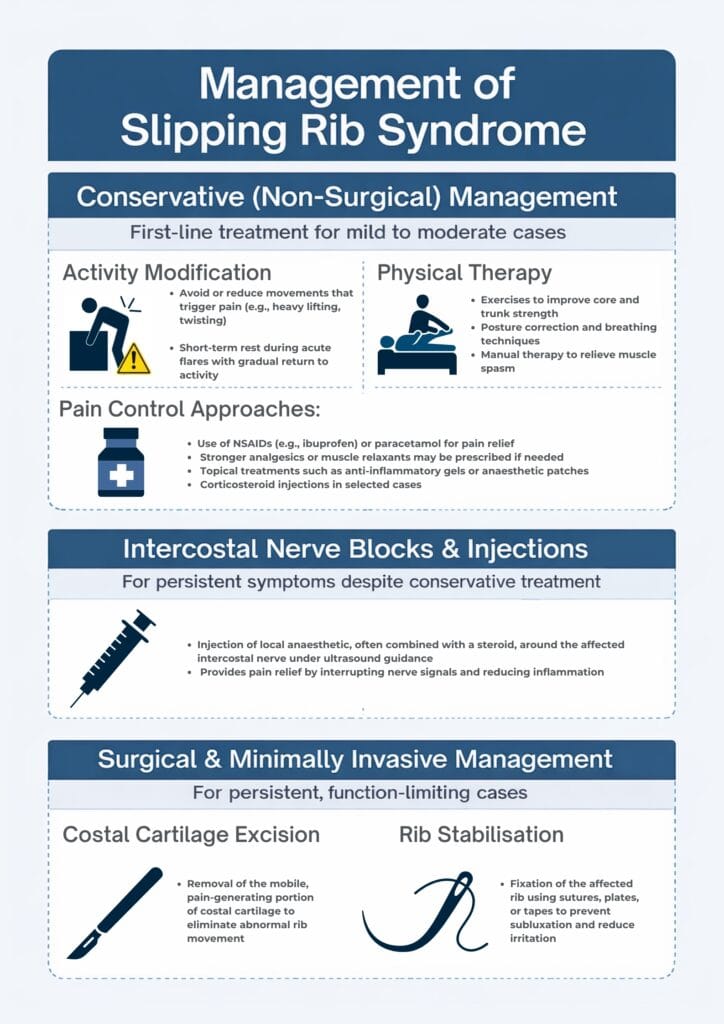
Treatment is tailored to symptom severity, duration, and impact on quality of life, progressing from conservative measures to procedures and surgery when needed.
Some mild cases improve over weeks to months with activity modification and simple pain management. For a fuller overview of slipping rib syndrome diagnosis and treatment options, structured conservative pathways are usually tried first. Long-standing or severe symptoms may require structured therapy or surgical stabilisation, as outlined in comprehensive slipping rib syndrome treatment guides.
Mr Marco Scarci’s approach typically begins with careful assessment, optimisation of non-operative care, and consideration of procedures such as intercostal nerve blocks or surgery for patients whose daily life is significantly restricted.
Conservative (Non-Surgical) Management
Initial management is usually non-operative, particularly for relatively recent or mild-to-moderate symptoms. Conservative treatment remains the foundation of symptom management. Conservative treatment for slipping rib syndrome includes rest, activity modification, and the use of ice or heat packs to reduce pain and inflammation. Pain management for slipping rib syndrome may involve over-the-counter pain relievers such as ibuprofen or acetaminophen, and in some cases, stronger medications or muscle relaxants may be prescribed. Minimally invasive procedures, such as nerve blocking injections, are commonly reported as a treatment for moderate slipping rib syndrome to avoid surgical intervention.
Activity modification:
- Avoid or reduce movements that trigger pain (heavy lifting, sports involving twisting)
- Short-term rest during acute flares with gradual return to activity
Pain control approaches:
- Over-the-counter NSAIDs (ibuprofen) for pain relief if medically suitable
- Paracetamol; occasionally stronger prescription analgesics for severe pain
- Topical treatments: anti-inflammatory gels, local anaesthetic patches
- Corticosteroid injection in selected cases
Physical therapy role:
- Targeted exercises improving core and trunk strength
- Posture correction and breathing techniques
- Manual therapy addressing muscle spasm
Some patients explore complementary therapies (osteopathy, chiropractic, acupuncture). Evidence remains limited, but these may offer temporary relief when integrated sensibly. Those with tenderness higher up the chest wall may in fact be experiencing pain related to floating ribs, which shares overlapping features but often has distinct causes. Conservative management typically continues for several weeks to months before considering more invasive options.
Intercostal Nerve Blocks and Injections
For patients whose pain persists despite conservative measures, targeted injections can provide significant, sometimes prolonged, relief.
Intercostal nerve block involves:
- Injection of local anaesthetic, often with steroids, around the affected intercostal nerve under ultrasound guidance
- Aim: interrupt pain signals, reduce inflammation, enable participation in rehabilitation
Pain relief may be temporary, but blocks can be repeated if effective. Some patients experience long-term improvement after a short series. The procedure also serves diagnostically – marked improvement after correctly placed block supports the diagnosis.
Surgical Treatment and Minimally Invasive Options
Surgery is reserved for patients with persistent, function-limiting pain who have not improved with appropriate conservative treatment and nerve blocks. Thoracic surgery offers definitive solutions for refractory cases.
Main surgical strategies:
- Costal cartilage excision: Partial rib resection removing the mobile, pain-generating cartilage portion
- Rib stabilisation: Suturing to adjacent structures or using plates/tapes to prevent further rib subluxation
In modern practice, minimally invasive or keyhole techniques reduce postoperative pain, scarring, and recovery time. This surgical procedure aims to eliminate abnormal rib tip movement, decompress the irritated intercostal nerve, and restore chest wall function.
Recovery typically involves:
- Short hospital stay
- Gradual return to activity under guidance
- Follow-up monitoring of pain relief and stability
Surgical intervention should be undertaken by an experienced thoracic surgeon such as Mr Marco Scarci, who discusses benefits, risks, and outcomes based on each patient’s history and imaging. His broader thoracic surgery practice in London encompasses minimally invasive procedures for a range of chest and lung conditions, which informs a tailored approach to complex rib problems.
Living With Slipping Rib Syndrome and When to Seek Help
While slipping rib syndrome is not dangerous, chronic pain and diagnostic uncertainty can be distressing, limiting work, exercise, sleep, and social activities. What begins as a minor nuisance can become significantly disabling.
Practical advice:
- Keep a symptom diary noting triggers and relief measures to share with clinicians
- Maintain fitness with low-impact activities that don’t provoke pain (gentle walking, stationary cycling)
- Use supportive measures during flares (heat or cold packs as advised)
Seek urgent medical attention (A&E or emergency services) for:
- New, severe chest pain with breathlessness, sweating, nausea, or pain spreading to jaw or arm
- Sudden breathlessness, coughing blood, or signs of serious illness
Arrange a planned consultation for:
- Ongoing or recurrent lower chest or upper abdominal pain with clicking or popping
- Pain labelled “non-specific” but continuing to interfere with life despite basic measures

Patients who suspect slipping rib syndrome or have received this diagnosis can arrange a private consultation with Mr Marco Scarci in London, in person or virtually, to discuss tailored management options. Dedicated clinics offer straightforward private thoracic surgery appointments in London, and many individuals share their experience of care in detailed patient testimonials for Mr Scarci.
FAQ
Can slipping rib syndrome show up on X-ray or MRI scans?
Standard chest X-rays typically appear normal because they capture bones well but cannot demonstrate the subtle movement or laxity of cartilage and ligaments causing the problem. MRI and CT scans may also look unremarkable, making them more useful for excluding other causes (tumours, fractures, lung disease) than confirming slipping rib syndrome. Dynamic ultrasound, performed while the patient moves or breathes deeply, can sometimes visualise the slipping, but diagnosis remains primarily clinical based on symptoms and physical examination.
Does slipping rib syndrome go away on its own?
In some patients, particularly those with mild symptoms following a clear triggering event, pain gradually improves over weeks to months with rest, activity modification, and physiotherapy. However, when significant structural instability exists in the costal cartilage, symptoms may persist or recur, requiring interventions such as nerve blocks or surgery. Early recognition and appropriate management improve chances of avoiding chronic pain cycles.
Is exercise safe if I have slipping rib syndrome?
Gentle, non-provocative exercise is usually safe and beneficial for overall health and core strength, provided it doesn’t trigger or worsen pain. Temporarily avoiding or reducing activities involving heavy lifting, rapid twisting, or high-impact contact is advisable until symptoms improve. An individualised exercise plan developed with a physiotherapist familiar with chest wall conditions helps patients remain active while protecting affected ribs.
Can children or teenagers develop slipping rib syndrome?
Yes, slipping rib syndrome can affect younger patients, often following minor trauma or sports injuries to the lower chest. Because serious heart and lung conditions are uncommon in this age group, chest pain may be attributed to growing pains or muscle strain, and slipping rib syndrome can be overlooked. Persistent, localised rib pain with clicking or popping warrants assessment, with referral to a thoracic specialist if symptoms don’t settle.
Do I need a referral to see Mr Marco Scarci about slipping rib syndrome?
Many private patients can self-refer to see Mr Scarci for specialist assessment, either at London clinics or via virtual consultation, depending on insurance arrangements. Bringing previous imaging reports, clinic letters, and a list of treatments already tried helps streamline the consultation. NHS pathways may require GP or hospital referral; contact the practice team for current booking advice.

