
Slipping Rib Syndrome Treatment London
Years of pain. Normal test results. Being told nothing is wrong.
If this sounds like your story, you may have slipping rib syndrome — one of the most consistently misdiagnosed conditions in medicine. It is real, it has a name, and there is a treatment path. You just need a specialist who knows what they’re looking for.

For patients who have been told nothing is wrong
You are not imagining it. And you are not alone.
The most common thing patients with slipping rib syndrome say at their first appointment is: “I thought I was going mad.”
Years of sharp, unpredictable pain under the lower ribs. Dozens of appointments. Blood tests, X-rays, CT scans, MRI scans — all reported as normal. Referrals to cardiologists, gastroenterologists, physiotherapists, pain clinics. Perhaps, at some point, a gentle suggestion that anxiety might be a factor.
And through all of it, the pain continued. Because slipping rib syndrome does not show up on standard imaging. It is diagnosed clinically — by a physical examination performed by a clinician who knows exactly what to look for. When someone who knows finally examines you, the diagnosis is usually made in under five minutes.
“The tragedy of slipping rib syndrome is not the condition itself — it is the years patients spend being investigated for everything else before someone finally performs a proper rib examination. A single clinical test, the Hooking Maneuver, often makes the diagnosis that five years of imaging could not.”
This guide explains what slipping rib syndrome actually is, why it is so frequently missed, how the diagnosis is made, and what the treatment options are — from physiotherapy and nerve blocks to costal cartilage resection surgery.
Book a Specialist Consultation
Seen within days. No referral needed. Mr Scarci specialises in slipping rib syndrome and can perform the Hooking Maneuver at your first appointment.
 Call 020 8090 5119
Why slipping rib is missed
“I had seen five specialists over three years. Every scan was normal. I’d been told it was stress, then a pulled muscle, then ‘unexplained chest wall pain.’ Mr Scarci did the hooking test in the first five minutes and said ‘I know exactly what this is.’ I cried with relief.”
“I’d stopped going to yoga, avoided hugging my children, and couldn’t sleep on my left side. Every time it slipped, I felt sick with the pain. After surgery I could take a full breath without bracing for something to go wrong. It changed everything.”
Who develops slipping rib syndrome
Risk groups — and who benefits most from specialist care
Anyone can develop SRS, but certain people are significantly more prone — and for all of them, early specialist diagnosis dramatically shortens the journey.
Athletes in rotational sports
Swimmers, rowers, golfers, tennis and racket sport players, gymnasts — sports with repetitive trunk rotation are consistently associated with SRS through cumulative microtrauma to the interchondral ligaments.
Hypermobility & Ehlers-Danlos Syndrome
Generalised ligamentous laxity from connective tissue disorders dramatically increases rib instability. SRS in hypermobile patients may affect multiple ribs and often requires more complex repair techniques to prevent recurrence.
Postpartum patients
Pregnancy-related changes in relaxin hormone and connective tissue mechanics — combined with the physical demands of carrying and lifting a baby — can precipitate or worsen rib instability, sometimes for months after delivery.
Trauma survivors
Road accidents, falls, direct blows to the lower chest, or even vigorous coughing can tear the interchondral ligaments that keep the false ribs stable. SRS may develop weeks or months after the original injury.
Manual workers
Jobs requiring repetitive lifting, twisting, or overhead reaching place sustained mechanical stress on the lower costal margin, gradually loosening the interchondral attachments over time.
Post-surgical patients
Some patients develop SRS immediately following abdominal laparoscopic surgery — including cholecystectomy, appendicectomy, or gynaecological procedures. The mechanism may relate to port placement, retraction, or post-operative positioning.
What is slipping rib syndrome?
The anatomy in plain English
Also called Cyriax syndrome, clicking rib syndrome, rib tip syndrome, or painful rib syndrome. The name changes but the anatomy is the same.
Your upper ribs are securely attached to the breastbone. But your lower ribs — the 8th, 9th, and 10th — are “false ribs” that connect through softer cartilage and interchondral ligaments rather than directly to the sternum. In most people, these ligaments are strong enough to keep the ribs stable.
In slipping rib syndrome, those ligaments have become lax — through injury, repetitive strain, hypermobility, or sometimes with no obvious cause. The loose rib tip moves abnormally, hooking over the rib above it and irritating the intercostal nerve that runs between them.
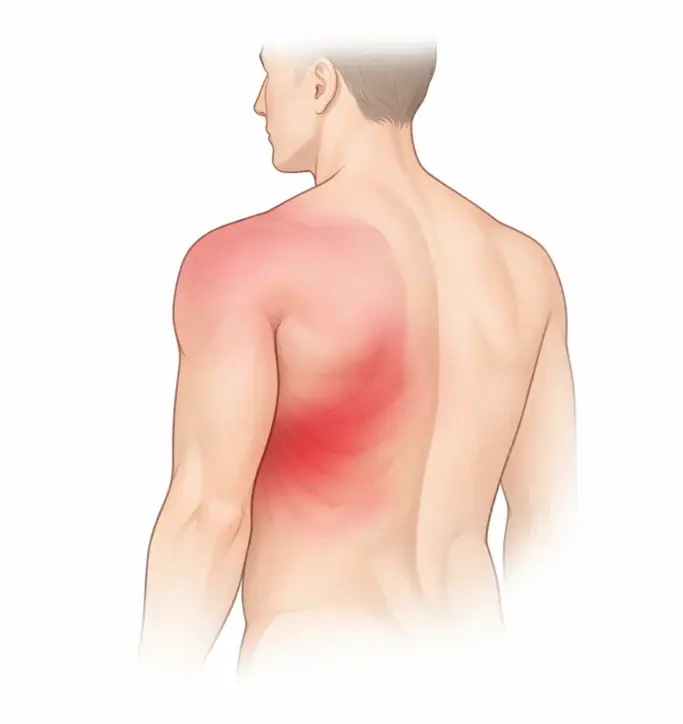
The result is a sharp, stabbing pain — sometimes with a perceptible click or pop — that happens when the rib slips and the nerve is compressed. Because the rib returns to position, standard imaging shows nothing abnormal. The problem is dynamic: it only appears when you move.
Key statistics
Why doctors keep missing it — and why that isn’t your fault
The journey most SRS patients describe before finding a correct diagnosis follows a painfully familiar pattern.
A&E or GP — chest pain, all tests normal
Sharp chest pain triggers urgent investigation. ECG, blood tests, chest X-ray — all normal. Discharged with analgesia and reassurance that the heart is fine.
Gastroenterology — suspected gallbladder, IBS, or GORD
Upper abdominal pain is investigated. Endoscopy, ultrasound, breath tests. Some patients undergo cholecystectomy — and are surprised when their pain continues or worsens after surgery.
Musculoskeletal — costochondritis, muscle strain, “nothing wrong”
Physiotherapy, osteopathy, chiropractic. Some provide temporary relief; none address the underlying instability. The pain keeps returning unpredictably.
Pain clinic — referred pain, neuralgia, “functional pain”
Nerve pain medications, injections with partial relief, psychological assessment. Some patients are given a functional pain diagnosis. Many begin to doubt themselves.
Chest wall specialist — Hooking Maneuver positive. Diagnosis made.
A clinical examination by someone who knows what to look for. The test takes minutes. Patients typically describe the moment of diagnosis as the greatest relief of the entire ordeal.
In one published series, 19% of slipping rib syndrome patients had already undergone laparoscopic cholecystectomy (gallbladder removal) for their pain — and experienced persistent or worsened symptoms afterwards. SRS is regularly mistaken for gallbladder disease, and surgery for the wrong diagnosis solves nothing.
X-rays, CT scans, MRI, and standard ultrasound cannot visualise the subtle cartilage laxity of slipping rib syndrome. In one major study, 76% of patients had prior imaging — none confirmed the diagnosis. The rib looks normal at rest. The problem only appears when it moves.
🩺 Who actually knows to look for it
Slipping rib syndrome is not covered in most medical school curricula. Chest wall specialists and experienced thoracic surgeons who routinely see lower chest pain are the clinicians most likely to consider it.
Symptoms of slipping rib syndrome
The symptoms are distinctive once you know what to look for — but they overlap significantly with many other conditions, which is why diagnosis is so often delayed.
Sharp, stabbing pain under the lower ribs
Typically one-sided, along the lower costal margin. Often described as a knife or stabbing sensation.
Clicking, popping, or slipping sensation
A palpable or audible click when the rib moves. Many patients describe actually feeling the rib “move” under their hand.
Pain triggered by twisting, bending, or reaching
Specific movements provoke the rib to slip. Reaching overhead, rolling over in bed, getting in and out of a car.
Radiating pain to the back, flank, or upper abdomen
Intercostal nerve irritation refers pain along the nerve’s distribution — into the back, side, or upper abdomen.
Unpredictable, fear-inducing episodes
Many patients develop anxiety about movement, avoiding activities, positions, and even clothing that might trigger an episode.
Pain with deep breathing, coughing, or sneezing
Activities that expand the lower chest and move the ribs can trigger slipping and acute pain.
🔀 What it gets mistaken for
- →Gallbladder disease — pain location and trigger pattern is almost identical
- →Costochondritis — rib cartilage inflammation also causes chest wall tenderness
- →Gastro-oesophageal reflux (GORD) / IBS — abdominal referral misleads gastroenterologists
- →Intercostal neuralgia or nerve entrapment — nerve irritation is real, but the cause is mechanical
- →Muscle strain or thoracic facet joint pain — normal after exercise or trauma
- →Cardiac chest pain — triggers urgent cardiac investigation that returns normal
- →Functional/psychosomatic pain — when everything else is excluded, some clinicians wrongly attribute it to anxiety
Note: SRS can coexist with some of these — particularly costochondritis and hypermobility conditions. A full chest wall assessment is essential.
The Hooking Maneuver — the most important test you’ve probably never had
This simple clinical examination test, performed correctly, diagnoses slipping rib syndrome with high sensitivity. If no one has ever done this to you, the diagnosis has never been properly assessed.
Diagnostic tools — what works, and what doesn’t
Understanding why your previous investigations came back normal — and what actually confirms the diagnosis.
Clinical Examination — Hooking Maneuver
The gold standard. History of characteristic pain plus a positive Hooking Maneuver is sufficient to diagnose SRS. Correlates with operative findings in 100% of cases in published series. No imaging can substitute for a skilled physical examination.
Dynamic Ultrasound
Standard ultrasound is unhelpful — but dynamic ultrasound, performed during active movement of the rib, can directly visualise the abnormal rib motion and confirm the diagnosis. Requires an experienced sonographer familiar with this specific application.
Intercostal Nerve Block (Diagnostic)
A local anaesthetic injection alongside the affected intercostal nerve(s) can confirm the diagnosis by temporarily abolishing the pain. It also identifies precisely which nerve(s) and rib(s) are responsible — essential information for surgical planning.
X-Ray, CT Scan, Standard MRI
These do not show the cartilage laxity or dynamic rib movement responsible for SRS. They are useful only to exclude other diagnoses — not to confirm SRS. A normal CT does not mean there is nothing wrong.
Treatment — from conservative care to definitive surgery
Treatment is not one-size-fits-all. Most patients begin with conservative approaches, with surgery reserved for those whose quality of life remains severely affected despite other management.
Activity modification, physiotherapy & pain management
Once the diagnosis is confirmed, targeted physiotherapy addresses the muscle imbalances and postural compensation that allow the rib to slip. Breathing mechanics, core stability, and neuromuscular control are all addressed. Oral analgesia, topical lidocaine patches, and anti-inflammatory medications support this phase.
Intercostal nerve block — targeted relief and diagnostic confirmation
A local anaesthetic injection alongside the affected intercostal nerve(s) can provide days to weeks of significant pain relief — and simultaneously confirms which nerve is responsible. Corticosteroid added to the injection reduces local inflammation and can extend the relief period for several months in some patients.
Prolotherapy — regenerative ligament injection
Prolotherapy involves injecting a dextrose-based solution into the affected ligaments and cartilage attachment points to stimulate the body’s own repair response. Evidence is limited but some patients report sustained improvement. Appropriate for patients who are keen to avoid surgery and have responded partially to nerve blocks.
Costal cartilage resection surgery — when quality of life demands a permanent solution
Surgery is recommended for patients whose quality of life remains severely affected despite adequate conservative management. Costal cartilage resection removes the structural source of the slipping, eliminating the mechanical stimulus for nerve irritation. For appropriately selected patients, the improvement in pain and function can be transformative.
Costal cartilage resection — what the surgery involves
Surgery for slipping rib syndrome involves removing the abnormally mobile cartilage tip that is causing the rib to slip and irritating the nerve. Performed under general anaesthetic through a small incision (typically 4–6 cm) at the lower costal margin. The affected cartilage is resected to the costochondral junction. Intercostal nerve ablation may be performed simultaneously if chronic nerve sensitisation is a significant component of the pain.
Costal Cartilage Excision (CCE)
The established technique: the affected cartilage tip(s) — most commonly ribs 8, 9, or 10 — are resected to the costochondral junction. Highly effective for pain relief, with most patients reporting significant improvement.
CCE + Vertical Rib Plating
Addition of bioabsorbable vertical rib plates provides costal margin stability during healing, addressing the recurrence weakness of isolated cartilage excision and lowering reoperation rates.
Minimally Invasive Sutured Repair
A rib-preserving technique that stabilises the slipped rib tip by suturing it back to the costal margin without excising the cartilage. Suitable for carefully selected patients where the cartilage is anatomically normal but simply detached.
Intercostal Nerve Cryoablation
Freezing of the affected intercostal nerve under direct vision during the operation, providing prolonged post-operative pain relief and addressing the chronic nerve sensitisation that may have developed over years of mechanical irritation.
Living with slipping rib syndrome — what actually helps
These are practical, evidence-informed strategies that reduce the frequency and severity of episodes — not a substitute for treatment, but meaningful tools for daily life.
Sleep positioning
Lie on your unaffected side with a pillow between your knees. Avoid deep trunk rotation during rolling over. A body pillow can support the lower ribs through the night.
Movement awareness
Identify your specific triggers — reaching overhead, twisting to the affected side, getting in and out of cars. Modify these movements consciously until core stability improves.
Ice during flares
Apply ice wrapped in a cloth to the lower costal margin for 15–20 minutes during acute episodes. Ice reduces local inflammation and nerve irritation more effectively than heat in the acute phase.
Core stabilisation
Targeted exercises strengthening the obliques, transversus abdominis, and paraspinal muscles provide a muscular splint for the unstable rib. Avoid high-rotation exercises until stable.
Compression support
Some patients find a light rib brace or compressive garment worn during activity reduces the amplitude of rib movement and lowers episode frequency.
Pain diary
Logging what triggers episodes, what positions relieve them, and how pain changes with time helps your clinician refine diagnosis, assess treatment response, and plan intervention precisely.
Mental health support
Chronic pain — especially chronic pain that was dismissed for years — causes real psychological damage. Anxiety, depression, and social withdrawal are common. Addressing these alongside the physical condition improves overall outcomes.
Chiropractic — use caution
Some patients find temporary relief; others report significant worsening after spinal manipulation in the thoracic area. Proceed cautiously and only with a practitioner aware of your SRS diagnosis.
Slipping rib syndrome — everything you need to know
You’ve been looking for this diagnosis for long enough.
A single consultation with a specialist who understands chest wall mechanics can provide the clarity that years of normal scans could not. You will leave knowing whether this is what you have — and what can be done about it.
