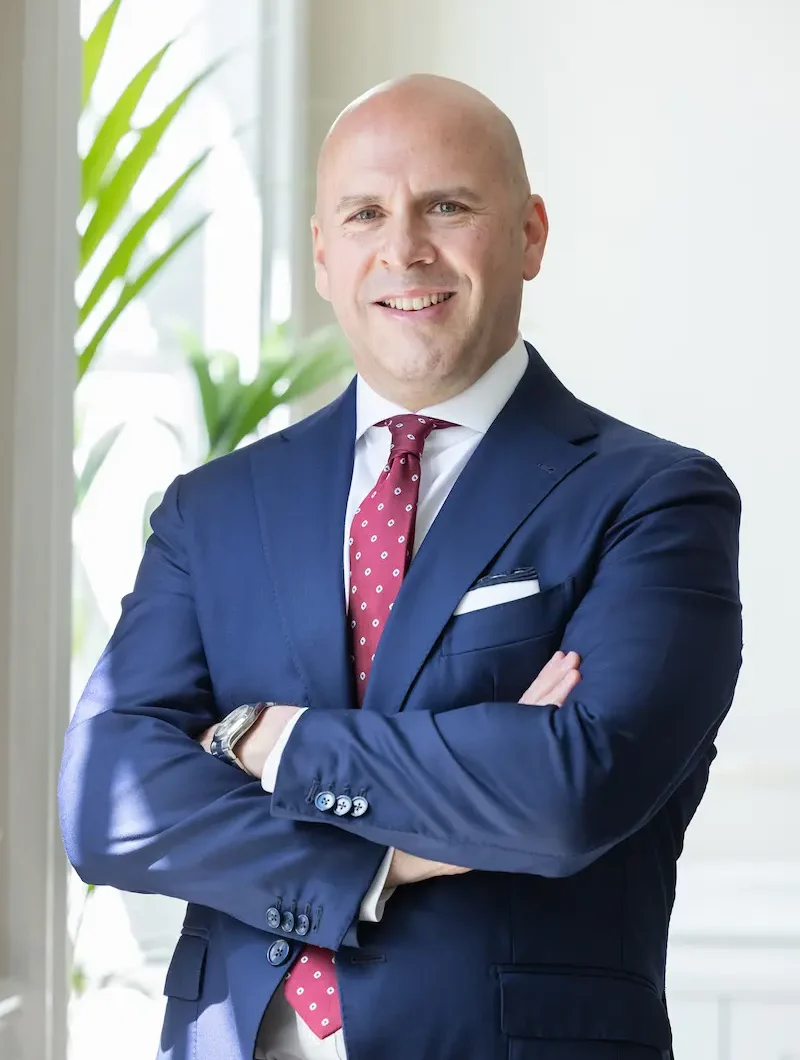
The surgeon you choose matters as much as the surgery itself.
Choosing a thoracic surgeon is not like choosing a physiotherapist or a GP. You are entrusting your chest, your lungs, and your recovery to one person. This page tells you who Mr Marco Scarci is — his training, his values, his record, and what it's actually like to be his patient.

I grew up in central Italy. My uncle was a cardiothoracic anaesthetist — the person in our family who everyone turned to when something went wrong medically. When I broke my leg as a child and needed an operation, it was him who put me to sleep, and I watched him do it with a calm authority I never forgot.
A few years later, a surgeon came to give a talk at my school. When he began showing photographs of his work — chests opened, repaired, closed — I felt something shift. I realised I could make people better. I could see them smiling again. That was the day I decided to become a thoracic surgeon.
Twenty-five years on, that moment still informs how I approach every consultation. Surgery is not just a technical act — it is an intervention in someone's life at one of their most vulnerable moments. The training can be taught. The care for the person on the table has to come from somewhere else.
"Choosing the right surgeon for you is essential — after all, you are entrusting your life to them. I take that trust seriously in every operating theatre, every consultation, and every conversation."
I am Italian by origin, British-trained, and internationally experienced. My career has taken me from Cambridge to London to Toronto to Milan and back. What I have kept constant through all of it is a commitment to offering each patient the most accurate diagnosis, the least invasive operation that achieves the goal, and a recovery supported by someone who knows their name.
What shaped my understanding of what patients actually need
When my mother was diagnosed with melanoma, I sat in every oncology appointment with her. I watched her navigate a system that was medically excellent but not always emotionally supportive. I saw her uncertainty when a doctor left the room without fully answering a question. I felt the weight of waiting for results.
That experience changed how I practise. It is not enough to perform the correct operation. The patient must understand what is happening, feel that their questions are welcome, and know that someone — a specific, named person — is responsible for their care from the first consultation to the final follow-up.
That is what I aim to provide. Not just surgical excellence — though that comes first — but a relationship with a surgeon who sees the whole person, not just the scan.
No referral needed. Seen within days. Mr Scarci sees patients at Imperial College NHS and privately across London.
In one consultation, he offered clarity on conditions I have been trying to get help for for two years. I am completely stunned and so happy to have found him.
Verified patient reviewI grew up in central Italy. My uncle was a cardiothoracic anaesthetist — the person in our family who everyone turned to when something went wrong medically. When I broke my leg as a child and needed an operation, it was him who put me to sleep, and I watched him do it with a calm authority I never forgot.
A few years later, a surgeon came to give a talk at my school. When he began showing photographs of his work — chests opened, repaired, closed — I felt something shift. I realised I could make people better. I could see them smiling again. That was the day I decided to become a thoracic surgeon.
Twenty-five years on, that moment still informs how I approach every consultation. Surgery is not just a technical act — it is an intervention in someone's life at one of their most vulnerable moments. The training can be taught. The care for the person on the table has to come from somewhere else.
"Choosing the right surgeon for you is essential — after all, you are entrusting your life to them. I take that trust seriously in every operating theatre, every consultation, and every conversation."
I am Italian by origin, British-trained, and internationally experienced. My career has taken me from Cambridge to London to Toronto to Milan and back. What I have kept constant through all of it is a commitment to offering each patient the most accurate diagnosis, the least invasive operation that achieves the goal, and a recovery supported by someone who knows their name.
What shaped my understanding of what patients actually need
When my mother was diagnosed with melanoma, I sat in every oncology appointment with her. I watched her navigate a system that was medically excellent but not always emotionally supportive. I saw her uncertainty when a doctor left the room without fully answering a question. I felt the weight of waiting for results.
That experience changed how I practise. It is not enough to perform the correct operation. The patient must understand what is happening, feel that their questions are welcome, and know that someone — a specific, named person — is responsible for their care from the first consultation to the final follow-up.
That is what I aim to provide. Not just surgical excellence — though that comes first — but a relationship with a surgeon who sees the whole person, not just the scan.
No referral needed. Seen within days. Mr Scarci sees patients at Imperial College NHS and privately across London.
In one consultation, he offered clarity on conditions I have been trying to get help for for two years. I am completely stunned and so happy to have found him.
Verified patient reviewChoosing a thoracic surgeon is not like choosing a physiotherapist or a GP. You are entrusting your chest, your lungs, and your recovery to one person. This page tells you who Mr Marco Scarci is — his training, his values, his record, and what it's actually like to be his patient.
I grew up in central Italy. My uncle was a cardiothoracic anaesthetist — the person in our family who everyone turned to when something went wrong medically. When I broke my leg as a child and needed an operation, it was him who put me to sleep, and I watched him do it with a calm authority I never forgot.
A few years later, a surgeon came to give a talk at my school. When he began showing photographs of his work — chests opened, repaired, closed — I felt something shift. I realised I could make people better. I could see them smiling again. That was the day I decided to become a thoracic surgeon.
Twenty-five years on, that moment still informs how I approach every consultation. Surgery is not just a technical act — it is an intervention in someone's life at one of their most vulnerable moments. The training can be taught. The care for the person on the table has to come from somewhere else.
"Choosing the right surgeon for you is essential — after all, you are entrusting your life to them. I take that trust seriously in every operating theatre, every consultation, and every conversation."
I am Italian by origin, British-trained, and internationally experienced. My career has taken me from Cambridge to London to Toronto to Milan and back. What I have kept constant through all of it is a commitment to offering each patient the most accurate diagnosis, the least invasive operation that achieves the goal, and a recovery supported by someone who knows their name.
When my mother was diagnosed with melanoma, I sat in every oncology appointment with her. I watched her navigate a system that was medically excellent but not always emotionally supportive. I saw her uncertainty when a doctor left the room without fully answering a question. I felt the weight of waiting for results.
That experience changed how I practise. It is not enough to perform the correct operation. The patient must understand what is happening, feel that their questions are welcome, and know that someone — a specific, named person — is responsible for their care from the first consultation to the final follow-up.
That is what I aim to provide. Not just surgical excellence — though that comes first — but a relationship with a surgeon who sees the whole person, not just the scan.
Mr Scarci's training pathway took him through some of the most respected thoracic surgery programmes in Europe and North America before his consultant appointment in 2011.
Graduated with honours in Medicine and Surgery. Began cardiothoracic surgical residency at the same institution.
Foundation in surgical anatomy, pathophysiology, and operative techniqueThree years of broad cardiothoracic surgical training in a high-volume centre, developing core operative skills across the full range of thoracic and cardiac procedures.
Diploma of Specialisation in Cardiothoracic Surgery, 2007Entry into the UK thoracic surgery training pathway. Exposure to high-volume NHS thoracic surgery and introduction to minimally invasive approaches.
Senior fellowship at one of the UK's premier thoracic surgery programmes. Extensive exposure to lung cancer surgery, pleural disease, chest wall procedures, and complex thoracic oncology.
FRCS(Eng) awarded 2010Fellowship in minimally invasive thoracic surgery at one of North America's leading centres. The University of Toronto programme is internationally recognised as a world-class VATS and advanced thoracic surgery training environment. This fellowship forged the minimally invasive philosophy that defines Mr Scarci's practice today.
Specialism in VATS and robotic approaches — the cornerstone of his surgical practicePapworth is the UK's largest cardiothoracic centre. Appointed consultant at 35, Mr Scarci built his independent practice here, establishing expertise in complex lung cancer surgery, chest wall reconstruction, and minimally invasive procedures.
NHS Clinical Excellence Award 2013 · NHS Change Leaders Programme 2012–13UCLH is consistently ranked among the top NHS trusts in England. Mr Scarci continued developing his thoracic surgery programme, with particular focus on robotic surgery and complex lung cancer cases.
Led the thoracic surgery department at a major Italian teaching hospital. Directorial responsibility for programme development, teaching, and surgical outcomes. This international leadership role broadened his perspective on thoracic surgery practice across European healthcare systems.
Department director — strategic and clinical leadershipCurrently based at Imperial College NHS Healthcare, one of London's most prestigious academic medical centres. Private practice at OneWelbeck, Harley Street Clinic, Bupa Cromwell Hospital, and Imperial Private Healthcare.
Honorary Clinical Senior Lecturer, Imperial College London · Senior Clinical Tutor, University of CambridgeThese are not honorary titles. Each fellowship represents a formal examination by a professional body, assessing surgical competence, clinical knowledge, and professional standards.
Fellow of the Royal College of Surgeons of England. The UK's most rigorous surgical qualification — requiring written and clinical examinations and peer assessment of surgical competence.
Fellow of the American College of Chest Physicians. Recognises advanced clinical and academic expertise in thoracic medicine and surgery — awarded by international peer review.
Fellow of the American College of Surgeons. Peer-elected fellowship recognising adherence to high standards of surgical practice, education, and ethics across international borders.
Fellow of the European Board of Thoracic Surgery. European certification confirming competence in the full scope of thoracic surgery to the standards of the European Society of Thoracic Surgeons.
Awarded by the NHS for outstanding contribution to clinical excellence, patient care, and service development — assessed by an independent committee of senior clinicians.
Registered with the General Medical Council — the regulator of all doctors practising in the UK. Full registration with a licence to practise. Verifiable at gmc-uk.org.
A surgeon who publishes research, teaches the next generation, and shapes the guidelines that define best practice is a surgeon who is always at the leading edge — not one who stopped learning in 2011.
Published in the world's leading thoracic surgery journals. Research spanning lung cancer surgery, VATS techniques, chest wall reconstruction, and outcome measurement. All indexed on PubMed.
Author and editor of four published books on minimally invasive and open thoracic surgery — used as reference texts by thoracic surgeons in training around the world.
Co-specialty Chief Editor for Thoracic Surgery, Frontiers in Surgery. Associate Editor, Journal of Thoracic Disease and Journal of Thoracic and Cardiovascular Surgery — the most prestigious in the specialty.
Former Council Member and Director of the Annual Conference of the European Society of Thoracic Surgeons — the largest thoracic surgery conference in the world. Led ESTS working groups on chest wall database management and pleural malignancies.
Member of National Institute for Health and Care Excellence (NICE) working groups — contributing to the clinical guidelines that define best practice in thoracic surgery across the UK.
Honorary Clinical Senior Lecturer, Imperial College London (National Heart and Lung Institute). Senior Clinical Tutor, University of Cambridge. Teaching the next generation of thoracic surgeons.
Research and teaching are not separate from clinical practice — they are how best practice is defined.A surgeon involved in producing the evidence and the guidelines is one whose patients benefit from that knowledge first.
View Publications on PubMed →Mr Scarci is a thoracic surgeon — meaning his surgical practice is entirely confined to the chest. He does not divide his attention between multiple organ systems. Every week, he performs lung cancer resections, chest wall repairs, and keyhole procedures that other surgeons might see once a year.
His surgical philosophy centres on minimally invasive technique wherever it can be performed safely — VATS (video-assisted thoracoscopic surgery) and robotic-assisted approaches that offer smaller incisions, less post-operative pain, faster recovery, and better cosmetic results. Open surgery remains available when the case demands it, but minimally invasive is the default, not the exception.
Every patient's case is reviewed in multidisciplinary context — with respiratory physicians, oncologists, radiologists, and specialist nurses — so that the surgical decision is never made in isolation from the broader clinical picture.
Many patients arrive having been through a confusing series of appointments where they left with more questions than they arrived with. This is what a consultation with Mr Scarci is like.
Mr Scarci reviews all CT scans, MRI, blood tests, and clinical letters before you arrive. You are not meeting a surgeon who is seeing your case for the first time. You are meeting someone who has already thought about it.
The consultation typically runs 30–45 minutes. Every question is welcome. You receive a clear explanation of your diagnosis, the treatment options available, what each involves, and what happens next. You leave with a plan, not more uncertainty.
Mr Scarci performs every operation personally. There is no delegation to a trainee, no different team on the day. The relationship you built in clinic follows you to the operating theatre.
Pathology results are reviewed by Mr Scarci and discussed with you directly. You receive a call, not a letter forwarded to your GP. Results and their implications are explained in language that makes sense.
If something changes, if you have a question, or if you are concerned about a symptom, you can reach Mr Scarci directly. You are not passed to a phone triage system or asked to wait for a scheduled review.
Pre-authorisation, claims, and insurer communication are managed by Mr Scarci's team on your behalf. You do not need to navigate the insurance process alone while also managing a medical condition.
These are selected from verified reviews across Doctify, Google, and Top Doctors.
"As a doctor myself, I can say with utmost confidence that you will simply not find a cardiothoracic surgeon with the same depth and breadth of knowledge as Mr Marco Scarci. He is the most brilliant and compassionate thoracic surgeon I have encountered. I am travelling to him from the United States despite being affiliated with Johns Hopkins and my husband being a pulmonary and critical care physician at Brown. He deserves to be in the surgical hall of fame."
"I have just had a first, remote consultation with Mr Scarci. I am completely stunned and so happy to have found him. In one consultation, he offered clarity on conditions I have been trying to speak to doctors about and get help for for some two years. A positive plan forward. I cannot recommend him highly enough."
"Clear and concise communication during the initial consultation, with excellent follow-up. Subsequent surgery was stress-free due to his professional and empathetic approach. Highly recommended."
"Mr Scarci is excellent and I can't recommend him highly enough. He and his colleagues are professional, friendly and exceptionally efficient. He is rectifying a broken rib caused by a surgeon at a major US hospital that has caused me severe pain for months. The contrast in care is remarkable."
100+ five-star reviews across verified platformsDoctify · Google · Top Doctors · Trustpilot · independent patient feedback
Read All Testimonials →Mr Scarci practises at four London hospitals, allowing patients to choose the most convenient location. Surgery is performed at the most appropriate site for each individual procedure.
1 Welbeck Street, W1G 0AR. One of London's newest and most advanced private hospitals, adjacent to Harley Street.
Consultations · Minor procedures35 Weymouth Street, W1G 8BJ. Premier central London private hospital with full surgical facilities.
Consultations · SurgeryCromwell Road, SW5 0TU. One of London's leading private hospitals, with a dedicated thoracic surgery programme.
Consultations · SurgerySainsbury Wing, Hammersmith Hospital, W12 0HS. Part of Imperial College NHS Healthcare Trust — academic centre of excellence.
Consultations · SurgeryOnline and telephone consultations are available for initial consultations, second opinions, and international patients. Mr Scarci sees patients from across the UK and internationally — with many travelling from Europe, the Middle East, and the United States for complex chest surgery.
Mr Scarci reviews your scans before you arrive. He explains everything clearly. He operates personally. He calls you with results. A consultation is the beginning of that relationship.