Catamenial Pneumothorax · Thoracic Endometriosis · VATS Surgery · London

Your lung keeps collapsing around your period. This is not a coincidence.

Catamenial pneumothorax is a specific, diagnosable, and treatable condition — a form of thoracic endometriosis where endometrial tissue causes cyclical lung collapses timed to menstruation. It is consistently missed until someone asks the right question. This page is for women who have finally found the right words for what keeps happening to them.

Mr Marco Scarci — Consultant Thoracic Surgeon London
Mr Marco Scarci FRCS · FCCP · FACS · FEBTS
~90% Cases are right-sided
3+ A&E visits before diagnosis
VATS Gold standard — diagnostic & curative
MDT Thoracic + gynaecology combined care
Lung collapse within 72 hours of period Multiple A&E visits — "spontaneous" pneumothorax Right-sided chest pain around menstruation Known endometriosis — never linked to chest Right shoulder tip pain before or during period Recurrence after previous VATS surgery
FRCS(Eng) · FCCP · FACS · FEBTS
Catamenial pneumothorax specialist, London
Multidisciplinary thoracic + gynaecology team
All major insurers accepted
For women who already know something is wrong — but haven't yet been believed

You've been to A&E three times. Each time: a chest drain, pain, recovery — and then it happens again.

Same side. Same time of month. Something connects these events that nobody has named yet.

The pattern is not subtle, but the medical system tends to process each episode in isolation. A collapsed lung is treated, the drain is removed, you go home. A month later it happens again. Another drain. The word "spontaneous" is used — implying random, unpredictable, unconnected. But you have noticed. It is not random. It is your period.

Catamenial pneumothorax is a recognised medical entity where endometrial tissue — the same tissue that causes endometriosis in the pelvis — migrates into the thoracic cavity. It deposits on the diaphragm, the pleura, and sometimes the lung surface. At menstruation it responds to hormonal cycling, breaks down, bleeds, and creates holes through which air escapes into the pleural space — collapsing the lung.

"Most patients I see with catamenial pneumothorax have already had three or more chest drain insertions before someone connects the timing to their cycle. The diagnosis is not difficult once you ask the question — but in a busy emergency department, the question is almost never asked. The patient has to bring the information."

This page is for you if you've had recurrent pneumothorax timed to your menstrual cycle. It explains what is happening, how it is confirmed, and what treatment involves — both the surgical component (VATS, thoracic surgeon) and the hormonal component (gynaecology), because treating only one is not enough.

This guide covers: Catamenial pneumothorax treatment London Thoracic endometriosis surgery Lung collapse around period treatment VATS catamenial pneumothorax Diaphragmatic endometriosis repair Thoracic endometriosis syndrome (TES) Catamenial pneumothorax recurrence prevention Hormonal therapy after pneumothorax surgery Right shoulder tip pain endometriosis period Pleurodesis catamenial pneumothorax

Book a Specialist Consultation

Seen within days. No referral needed. Mr Scarci specialises in catamenial pneumothorax and works with a dedicated gynaecology MDT team.

ic baseline phone Call 020 7459 4367
Seen within one week
All major insurers accepted
Bring existing scans & records
No GP referral required

Why diagnosis is so often delayed

3+ Average number of A&E admissions before catamenial connection is identified
~90% Cases are right-sided — a key diagnostic clue
72h Collapse typically occurs within 72 hours of menstruation onset
MDT Thoracic surgery alone is insufficient — hormonal suppression is essential
A story too many patients recognise

The journey to diagnosis — what most catamenial pneumothorax patients go through

Studies show an average of three or more pneumothorax episodes before the catamenial pattern is recognised. Here is what that journey typically looks like.

1
Episode One

Right-sided chest pain and breathlessness — A&E admission

Sudden sharp chest pain on the right, breathlessness. X-ray shows a right-sided pneumothorax. Chest drain inserted. After 2–3 days you're discharged, told it was a "spontaneous pneumothorax." You may be slim and young, which apparently explains it. Nobody asks where you are in your menstrual cycle.

→ Diagnosis: "Primary spontaneous pneumothorax" — underlying cause unaddressed
2
One Month Later

Same side. Same symptoms. Another chest drain — and this time surgery is discussed.

It happens again. Same right side. You notice it's around your period again — but it isn't acted on. VATS bullectomy and pleurodesis may be performed for "recurrent spontaneous pneumothorax." The histology from the lab may actually say "endometriosis" — but nobody links this to the treatment plan.

→ Surgery for "recurrent PSP" — underlying thoracic endometriosis not addressed
3
Months After Surgery

It comes back. Even after a procedure that should have prevented it.

Recurrence after VATS that should have been preventive is the most common trigger for catamenial pneumothorax finally being suspected. An experienced thoracic surgeon asks about menstrual timing. You confirm the pattern. The pieces come together for the first time.

→ Recurrence post-VATS: first strong signal that something specific is being missed
4
Specialist Consultation

The diagnosis is made — often in the first appointment with the right specialist

A thoracic surgeon familiar with catamenial pneumothorax asks the right questions: timing relative to menstruation, right-sided predominance, history of pelvic endometriosis. Targeted VATS — this time looking specifically for diaphragmatic fenestrations and thoracic endometriosis implants — is planned alongside gynaecological input for post-operative hormonal management.

→ Diagnosis: catamenial pneumothorax — thoracic endometriosis syndrome confirmed
5
After Treatment

Surgery + hormonal management — the monthly pattern is finally broken

VATS addresses the structural thoracic pathology: endometrial implants excised, diaphragmatic fenestrations repaired, pleurodesis performed. Post-operatively, hormonal suppression eliminates the cyclical hormonal stimulus that drives recurrence. For the first time, your period arrives without a lung collapse.

→ No further pneumothorax — cycle broken with combined surgical and hormonal treatment
Recognise this pattern? A specialist consultation focused on catamenial pneumothorax reviews your history differently — and can reach a diagnosis that earlier assessments missed.
Book a Consultation →
What is actually happening

How thoracic endometriosis causes catamenial pneumothorax

Endometriosis occurs when endometrial-like tissue grows outside the uterus. The thoracic cavity is the most common site of extra-pelvic endometriosis — deposits form on the diaphragm, the pleural surfaces, and occasionally within the lung parenchyma. This ectopic tissue responds to the same hormonal signals that drive menstruation.

Diaphragmatic fenestrations (holes)

~87% of cases

Endometriosis erodes perforations through the diaphragm, allowing air to pass from the abdominal cavity into the pleural space at menstruation. The most important finding the surgeon must look for at VATS.

Pleural implants

~30% of cases

Deposits on the visceral pleura weaken the lung surface, creating areas of fragility that rupture at menstruation, releasing air directly into the pleural space.

The result in both cases is identical: a cyclical, predictable, right-sided pneumothorax occurring within 72 hours of menstruation onset — and recurring every month without definitive treatment.

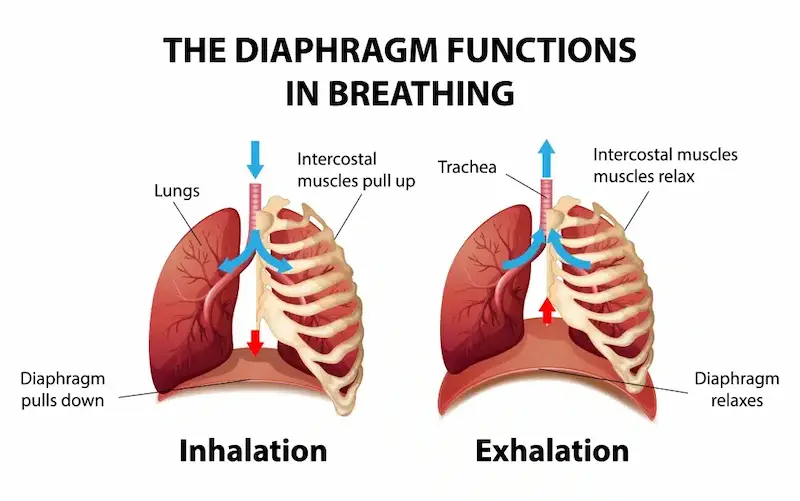
Diaphragm anatomy — catamenial pneumothorax mechanism
Diaphragmatic fenestrations allow air to pass from the abdominal cavity into the pleural space during menstruation
Beyond the pneumothorax

Thoracic endometriosis syndrome — the full clinical spectrum

Catamenial pneumothorax is the most common manifestation of thoracic endometriosis syndrome (TES) — but it exists alongside other presentations that can occur separately or together.

Most common 73%

Catamenial Pneumothorax

Recurrent lung collapse within 72 hours of menstruation onset. Almost exclusively right-sided (~90%). The most frequently diagnosed and most surgically treatable form of TES. Recognition requires asking about timing with the menstrual cycle.

Haemothorax 14%

Catamenial Haemothorax

Blood in the pleural cavity occurring cyclically with menstruation — endometrial tissue bleeding into the pleural space rather than causing air leaks. May co-exist with pneumothorax. Diagnosed and treated at VATS.

Haemoptysis 7%

Catamenial Haemoptysis

Coughing up blood occurring cyclically at menstruation — caused by endometrial tissue within the lung parenchyma that bleeds with each cycle. A striking symptom that should immediately raise suspicion of thoracic endometriosis.

Lung nodules ~6%

Pulmonary Nodules

Endometrial implants within the lung parenchyma appearing as nodules on CT. May be discovered incidentally during workup for a suspected malignancy. VATS resection is both diagnostic and therapeutic.

Catamenial chest pain and right shoulder tip pain — the overlooked signals

Up to 80% of women with thoracic endometriosis report catamenial chest pain that does not reach the threshold of a full pneumothorax. Right shoulder tip pain around the period — referred from diaphragmatic irritation via the phrenic nerve — is a classic but frequently unrecognised symptom of diaphragmatic endometriosis. These symptoms in a woman with known pelvic endometriosis should prompt investigation for thoracic involvement even without a documented collapse.

Could your recurrent pneumothorax be catamenial?

If several of these describe your experience, a specialist consultation for catamenial pneumothorax is warranted — regardless of what previous doctors have told you.

Timing within 72 hours of period Your collapsed lung happened on or just before/after your period started
Right-sided pneumothorax Your collapses are always or almost always on the right side
Recurrent episodes You've had two or more pneumothorax events
Known pelvic endometriosis You've been diagnosed with endometriosis affecting the pelvis
Right shoulder tip pain with period Right shoulder pain around your cycle even without a full pneumothorax
Recurrence after previous VATS Surgery that should have prevented recurrence — and it happened again
Cyclic chest pain without collapse Right-sided chest pain following a monthly pattern, even without documented collapse
Catamenial haemoptysis You have coughed up blood at the time of your period
Book a Specialist Consultation →

Two or more of these features in a woman of reproductive age is sufficient to justify specialist assessment — even if no previous doctor has mentioned this diagnosis.

Confirming the diagnosis

How catamenial pneumothorax is properly diagnosed

The diagnosis is primarily clinical — built from the pattern of symptoms. Imaging plays a supporting role. VATS provides definitive confirmation and simultaneous treatment.

Foundation

Clinical History — the pattern is the diagnosis

A detailed menstrual history is the single most important diagnostic tool. Recurrent right-sided pneumothorax within 72 hours of menstruation onset in a woman of reproductive age is sufficient clinical basis to diagnose catamenial pneumothorax. Has anyone ever asked you where you were in your cycle when each collapse occurred?

→ The diagnosis is made by asking the question that nobody has asked
Gold standard

VATS — Diagnostic AND Therapeutic

VATS is both the definitive diagnostic tool and the primary treatment. The surgeon directly visualises the thoracic cavity — identifying diaphragmatic fenestrations (found in 87% of cases), pleural implants, apical blebs, and endometrial deposits. Tissue is sent for histological confirmation. Treatment proceeds in the same operation.

→ VATS confirms thoracic endometriosis in ~52% of catamenial pneumothorax cases at surgery
Imaging

Chest X-Ray and CT

X-ray confirms the pneumothorax. CT may reveal small diaphragmatic defects — a characteristic finding. CT may also show pleural-based nodules. However, a normal CT does NOT exclude catamenial pneumothorax — many diaphragmatic fenestrations are invisible on pre-operative imaging.

→ Normal CT does not exclude the diagnosis
MRI

MRI of Chest and Pelvis

Pelvic MRI confirms concurrent pelvic endometriosis and guides gynaecological planning. Chest MRI can identify larger pleural-based endometrial deposits. More useful for soft tissue characterisation than for detecting small diaphragmatic fenestrations, for which VATS remains essential.

→ Pelvic MRI guides gynaecological treatment planning
Combined surgery

Combined VATS + Gynaecological Laparoscopy

For women with significant pelvic endometriosis, combined VATS and laparoscopy may be performed at the same operating session. Concurrent pelvic endometriosis is found in 50–80% of catamenial pneumothorax patients. The most thorough approach when both thoracic and pelvic disease are present.

→ VATS typically performed first, followed by laparoscopy at the same anaesthetic
Diagnostic trial

Hormonal Response Test

When diagnosis remains uncertain, a trial of hormonal suppression (OCP or GnRH agonist) that eliminates menstrual cycling can serve a diagnostic function. Abolition of episodes during suppression strongly supports the catamenial diagnosis.

→ Confirms diagnosis but delays definitive surgery; not a substitute for VATS

Why catamenial pneumothorax requires a multidisciplinary team

Catamenial pneumothorax sits at the intersection of thoracic surgery and gynaecology — and treating only one dimension reliably leads to recurrence. Surgery alone, without post-operative hormonal suppression, carries a recurrence rate of up to 32%. Hormonal therapy alone does not repair diaphragmatic fenestrations or remove pleural deposits.

The evidence consistently shows that surgery plus hormonal management produces significantly lower recurrence than either alone. This requires coordination between a thoracic surgeon experienced in catamenial pneumothorax and a gynaecologist experienced in endometriosis.

🔬

Thoracic Surgeon (Mr Marco Scarci)

VATS surgery: diaphragmatic repair, implant resection, pleurodesis, apicectomy. Surgical planning and post-operative thoracic follow-up.

👩‍⚕️

Gynaecologist / Endometriosis Specialist

Pelvic endometriosis assessment, laparoscopy when indicated, post-operative hormonal management prescribing and monitoring.

🧬

Histopathologist

Confirms diagnosis of thoracic endometriosis on VATS tissue samples using immunohistochemistry for oestrogen/progesterone receptors.

🫁

Respiratory Physician

Pre-operative respiratory assessment and pulmonary function testing. Consulted as needed for ongoing respiratory management.

The surgical treatment

VATS surgery for catamenial pneumothorax — what the operation involves

The goal is diagnostic, therapeutic, and structural — finding and treating every source of thoracic endometriosis while preventing future pneumothorax through pleurodesis. This is not the same operation as VATS for standard spontaneous pneumothorax.

What happens during VATS for catamenial pneumothorax

Unlike standard VATS for spontaneous pneumothorax — which focuses primarily on apical blebs — VATS for catamenial pneumothorax requires a systematic survey of the entire thoracic cavity: the diaphragm, all pleural surfaces, the lung apex, and the visceral pleura. Performed under general anaesthetic, typically 2–3 hours. In most cases the patient goes home within 3–5 days.

Most important finding

Diaphragmatic Repair

Holes in the diaphragm — found in ~87% of thoracic endometriosis cases — are the primary source of catamenial pneumothorax. Depending on size and number, they are repaired by direct suture closure, selective diaphragmatic plication, or partial diaphragmatic resection with mesh reconstruction.

→ Found in 87.5% of cases at VATS in published series
Endometriosis excision

Implant Excision & Biopsy

All visible endometrial deposits on the visceral pleura, parietal pleura, and diaphragm are excised or ablated. Tissue is sent for histological confirmation with immunohistochemistry. Systematic exploration is essential — small deposits are easily missed by a surgeon not specifically looking for them.

→ Diaphragmatic lesions 38.8%; visceral pleura 29.6% in published series
Lung apex

Apicectomy

When dystrophic lung tissue, blebs, or bullae are present at the lung apex — found in ~62% of catamenial pneumothorax cases at VATS — surgical removal is performed. These may contribute to air leaks independently of the endometriosis.

→ Performed in ~62% of cases alongside diaphragmatic repair
Recurrence prevention

Combined Pleurodesis

Both mechanical pleurodesis (abrading pleural surfaces) and chemical pleurodesis (sterile talc powder) are performed in all cases to maximise recurrence prevention. This dual approach provides an additional layer of protection beyond the structural repairs and endometriosis excision.

→ Combined mechanical + chemical pleurodesis in all cases
2–3 hrs Typical operating time
3–5 days Typical hospital stay
87% Diaphragmatic holes found at VATS in TES
Low Recurrence with surgery + hormones
The essential second component

Hormonal therapy — why surgery alone is not enough

⚠️

The recurrence problem — why hormonal therapy after surgery is mandatory

Published data show recurrence rates of 20–32% after VATS alone for catamenial pneumothorax — even with excellent surgical technique. The reason: surgery removes existing lesions but cannot prevent new endometrial deposits forming if the hormonal driver (the menstrual cycle) continues. Post-operative hormonal suppression is not optional.

Surgery removes existing thoracic endometriosis and repairs structural defects
Hormonal therapy suppresses oestrogen-dependent growth of any residual or new endometrial tissue
Together, they produce significantly lower recurrence than either alone
Never discontinue hormonal therapy without specialist review — premature discontinuation is a common cause of recurrence

Hormonal treatment options

All approaches aim to suppress ovarian oestrogen production, eliminate cyclical hormonal fluctuations, and prevent the hormonal stimulus that drives endometrial tissue activity. Choice depends on other medical needs, fertility intentions, and tolerance.

Combined Oral Contraceptive Pill

Continuous (no pill-free breaks) OCP eliminates menstrual cycling and significantly reduces endometrial tissue activity. Well-tolerated, widely available, usually first post-operative choice.

GnRH Agonists (Zoladex, Prostap)

Powerful suppression of ovarian oestrogen creating a temporary menopausal state. Highly effective for severe cases. Used for 6 months post-operatively with bone-protecting HRT add-back.

Progestogens

Progestogen-only therapy suppresses endometrial activity without oestrogen. Various formulations — oral, injected, or via Mirena IUS. Preferred when oestrogen-containing preparations are contraindicated.

Danazol

An androgenic steroid suppressing both oestrogen and progesterone. Effective but associated with androgenic side effects. Less commonly first-line; appropriate for selected cases.

Aromatase Inhibitors

Letrozole and anastrozole target local oestrogen production in endometrial tissue. Used in specialist centres for cases refractory to standard hormonal approaches.

Fertility considerations

Women wishing to conceive need a tailored approach — all hormonal options are contraceptive. Careful planning between thoracic surgeon and gynaecologist is essential to balance recurrence risk with fertility goals.

Important: Hormonal therapy is managed by your gynaecologist in coordination with thoracic follow-up. Never discontinue hormonal therapy without discussing with your treating team first — premature withdrawal is the most common cause of late recurrence.

What patients say
★★★★★

"I had four chest drains in eighteen months. Every time: 'spontaneous pneumothorax.' I was 32 and otherwise healthy — it made no sense. I'd told three different doctors it always happened around my period and that I had endometriosis. Nobody connected it. It was only when I found Mr Scarci that someone actually took that information seriously. VATS found holes in my diaphragm. I'd never heard of catamenial pneumothorax before that appointment. Two years later, not a single episode."

Private patient, London — verified review
Why specialist care matters for this specific condition

What a catamenial pneumothorax specialist provides that standard care does not

This condition requires specific surgical knowledge, a specific operative approach, and coordinated gynaecological care. This is not a standard pneumothorax referral.

Asks the right question

The single most important diagnostic step — asking whether each collapse coincides with the menstrual cycle — is almost never asked in A&E. A specialist consultation puts this at the centre of history-taking.

🔬

VATS with a specialist eye

VATS for catamenial pneumothorax requires systematic survey of the entire diaphragm and all pleural surfaces — not just the lung apex. Only a surgeon who knows to look finds the fenestrations that are present in 87% of cases.

👩‍⚕️

Coordinated gynaecological care

Post-operative hormonal management prescribed by a gynaecologist experienced in endometriosis is the component most often absent when women are treated as if this is standard spontaneous pneumothorax.

🔄

Understanding of recurrence

Surgery alone carries a 20–32% recurrence rate. Understanding why this happens and how combined treatment reduces it requires specific knowledge of thoracic endometriosis — not just pneumothorax management.

Seen within days

Most patients are seen within one week of contact. For a condition that recurs monthly, a waiting list measured in months is a waiting list measured in collapses.

🛡️

All major insurers accepted

Catamenial pneumothorax surgery is covered by all major UK private health insurers as a medically necessary procedure. Mr Scarci's team handles pre-authorisation from the outset.

Your questions answered

Everything you need to know about catamenial pneumothorax

  • How do I know if my pneumothorax is catamenial?
    The key features are: timing within 72 hours of the start of your period; right-sided predominance (~90% of cases); recurrent episodes; and in many cases a history of pelvic endometriosis. You do not need all of these features. Even two or three — particularly menstrual timing plus right-sided recurrence in a woman of reproductive age — is sufficient to warrant specialist assessment. A specialist consultation will review your full history, including the menstrual timing of every collapse you've had, which is often the definitive clinical picture that makes the diagnosis clear within the first appointment.
  • I've already had VATS for a "spontaneous" pneumothorax and it came back. What does this mean?
    Recurrence after VATS performed without specifically addressing thoracic endometriosis is one of the most important diagnostic clues for catamenial pneumothorax. If the original VATS was done for presumed spontaneous pneumothorax, the diaphragm was likely not systematically examined, thoracic endometriosis was not looked for, and no post-operative hormonal therapy was given. A revised VATS — specifically looking for and treating thoracic endometriosis, combined with hormonal management — is the appropriate next step. Many catamenial pneumothorax patients have had one or two previous VATS procedures before the correct diagnosis and treatment are provided.
  • I have endometriosis but was never told it might affect my chest. How common is this?
    Thoracic endometriosis is the most common site of extra-pelvic endometriosis — yet it is rarely screened for or discussed in the context of a pelvic endometriosis diagnosis. Studies estimate that diaphragmatic endometriosis is present in up to 20–40% of women with pelvic endometriosis who undergo laparoscopy. Most are completely asymptomatic from their thoracic deposits. However, in those who do develop symptoms — catamenial chest pain, shoulder tip pain, or pneumothorax — the connection to their known endometriosis is frequently not made. If you have endometriosis and experience any cyclic chest or shoulder symptoms, mention this to your gynaecologist and ask for thoracic review.
  • Can catamenial pneumothorax be treated with hormones alone without surgery?
    Hormonal therapy alone can suppress the menstrual cycling that triggers catamenial pneumothorax and may prevent episodes while on medication. For women who are not fit for surgery, this is a reasonable option. However, it does not repair diaphragmatic fenestrations, does not remove pleural implants, and provides no lasting structural protection. If hormonal therapy is stopped — including for pregnancy planning — episodes typically resume. Most specialists recommend surgery as the definitive treatment, with hormonal therapy as the essential post-operative adjunct to minimise recurrence risk.
  • How high is the chance of recurrence after treatment?
    Surgery alone: approximately 20–32% recurrence rate at medium-term follow-up. Surgery plus post-operative hormonal management: significantly lower — most series show recurrence rates well below 10%. The combination of thorough VATS (including diaphragmatic repair and pleurodesis) plus ongoing hormonal suppression is the most protective strategy currently available. Premature discontinuation of hormonal therapy is a common cause of late recurrence, which is why long-term gynaecological follow-up is an essential part of the treatment plan.
  • I want to have children in the future — can I still be treated?
    Yes — and it's important to discuss fertility plans at your consultation, as they influence the hormonal strategy. The surgical component (VATS) is not affected by fertility intentions. However, all post-operative hormonal options are contraceptive, creating a tension between controlling recurrence and allowing conception. A common approach: hormonal suppression for a defined period post-operatively, then carefully monitored attempts at conception. This requires coordinated planning between your thoracic surgeon and gynaecologist, taking account of the severity of your thoracic disease and your timeline.
  • Will my insurance cover treatment for catamenial pneumothorax?
    Yes — catamenial pneumothorax surgery is covered by all major UK private health insurers as a medically necessary procedure for a recognised condition. Mr Scarci's team will verify your policy and manage pre-authorisation from the outset. The gynaecological component is managed under your gynaecologist's own insurance relationship. Self-pay pricing with full transparency is also available. Given the cost and disruption of repeated A&E admissions and chest drains, definitive specialist treatment represents clear value for both patients and insurers.

You've been to A&E enough times.
This one appointment can change the pattern.

A specialist consultation reviews your full history with catamenial pneumothorax specifically in mind. For most patients the diagnosis is clear within the first appointment. The treatment — surgery plus hormonal management — can break the cycle that has defined far too many of your menstrual months.

No referral needed
All major insurers accepted
Typically seen within one week
Thoracic + gynaecology MDT care

Book Your Appointment

WhatsApp WhatsApp 020 7459 4367
WhatsApp 020 7459 4367