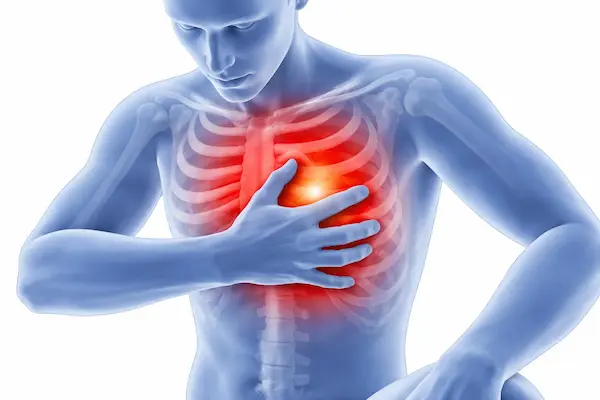
Sharp chest pain — but your heart is fine.
So what's actually going on?
Most chest and rib pain is not cardiac. It comes from the chest wall — the ribs, cartilage, nerves, and muscles that make up the structure of your chest. Finding the right diagnosis matters because the right treatment is completely different depending on the cause.

You went to A&E, or your GP, or perhaps directly to a cardiologist. An ECG was done. Blood tests. Maybe a chest X-ray. All normal. And you were told, correctly, that your heart isn't the problem. That's good news — but it left you with an unanswered question: then what is causing this?
The answer is almost always in the chest wall itself — the complex framework of ribs, cartilage, muscles, ligaments, and nerves that surrounds your heart and lungs. When something goes wrong here, it can produce pain that is every bit as sharp, severe, and frightening as cardiac pain. And it is frequently misdiagnosed, undertreated, or simply dismissed once the heart has been cleared.
"The chest wall is one of the most anatomically complex regions in the body — and one of the most commonly overlooked sources of chronic pain. Most patients I see with chest and rib pain have already had their heart investigated. What they haven't had is a proper chest wall examination. That's usually where the answer is."
This page explains the most common causes of chest and rib pain, how each is diagnosed, what treatment looks like, and — critically — when chest pain is a genuine emergency that cannot wait.
Seen within days. No referral needed. Mr Scarci specialises in chest wall pain — bring any existing scans, reports, or ECG results.
Call 999 — do not wait for a GP appointment
Chest and rib pain presents in many different ways. These are the most common patterns that bring patients to a chest wall specialist.
Cardiac investigations came back normal but you're still experiencing sharp or aching chest pain. You're relieved it isn't the heart, but frustrated and confused about what is actually causing it.
Taking a full breath, coughing, or sneezing triggers or dramatically worsens your chest or rib pain. You may be unconsciously breathing more shallowly to avoid triggering it.
There's a clear, reproducible spot of tenderness on the chest wall — pressing it triggers the pain. This pattern of localised tenderness often points to a specific, diagnosable cause.
You can feel — or even hear — something moving in your lower ribs when you bend or twist. The sensation of instability or "something shifting" is highly characteristic of certain chest wall conditions.
Your chest pain doesn't stay in one place — it radiates around your side, into your back, or down into the upper abdomen. This pattern of referred pain has confused both you and your previous doctors.
Weeks or months of chest and rib pain, multiple appointments, investigations that came back normal, and still no diagnosis. You know something is wrong, but haven't yet found someone who can name it.
"I spent eight months convinced something was seriously wrong with my heart, despite four normal ECGs. Every time I went to A&E, they sent me home. Mr Scarci examined my chest properly for the first time in fifteen minutes — pressed on the specific spot and reproduced the pain immediately. Costochondritis, with a cortisone injection the same week. The relief was immediate."
Your chest wall is not a static structure. It moves — expanding and contracting — with every single breath you take, around 20,000 times each day. It is made up of 12 pairs of ribs, the sternum, costal cartilage connecting the ribs to the breastbone, intercostal muscles between each rib, and an intricate network of nerves running along the underside of each rib.
Any of these structures — bone, cartilage, muscle, or nerve — can become a source of pain. Because they are all interconnected and constantly in motion, pain from one structure easily refers to another. A problem at the front of the chest can radiate to the back; a problem in the lower ribs can feel like abdominal pain.
This is why chest wall pain is so often misattributed — to the heart, to the stomach, to "stress" — and why a proper physical examination by someone who understands these structures is so important.

Here is a clear, plain-language breakdown of the most common conditions causing chest and rib pain — and what distinguishes each one.
Inflammation of the costal cartilage — the connective tissue linking the ribs to the sternum. Causes sharp, reproducible chest pain that worsens with deep breathing, coughing, or pressing on the affected area. Most common in the upper ribs (2nd–5th). Often mistaken for a heart attack in A&E. Usually self-limiting but can be chronic and debilitating.
Similar to costochondritis but with a key difference: visible and palpable swelling at the costochondral junction. This localised, tender swelling distinguishes it from costochondritis on examination. Usually affects a single joint, most often the second or third. More common in younger adults.
A pulled or torn intercostal muscle — the muscles between the ribs. Very common after sudden twisting movements, heavy lifting, or vigorous coughing. Produces sharp, localised pain that worsens with specific movements, breathing, or pressing the area. Distinguished from rib fractures by the absence of point tenderness directly on the bone.
Hypermobility of the 8th–10th ribs, causing them to slip and irritate intercostal nerves. Sharp, stabbing lower rib pain that often clicks or pops and worsens with specific movements. Frequently misdiagnosed as gallbladder disease or IBS. The Hooking Maneuver is diagnostic. Standard imaging is normal.
After a fall, accident, or even severe coughing. Sharp, point-specific tenderness directly on the rib bone. Pain worsens dramatically with deep breathing, coughing, or movement. Multiple rib fractures require specialist review to prevent pneumonia. X-rays can miss up to 50% of rib fractures — a CT scan is more reliable.
A previous rib fracture that has healed incorrectly (malunion) or failed to heal at all (nonunion). Causes persistent or worsening chest wall pain months after the original injury. Visible or palpable deformity may be present. Often requires surgical correction if causing significant functional impairment.
Irritation or compression of an intercostal nerve — the nerve running beneath each rib. Produces sharp, shooting, burning, or electric-shock pain that follows the path of the nerve, typically wrapping from the back around to the front. Can be caused by rib fractures, inflammation, post-herpetic scarring, or be idiopathic. Often worse at rest and at night.
Before the characteristic rash appears, shingles causes severe burning or stabbing chest pain that follows a dermatomal pattern. Patients — and doctors — often miss the diagnosis in the pre-rash "prodromal" phase. The pain can be incapacitating. Post-herpetic neuralgia (pain persisting after the rash clears) can become chronic.
Persistent chest and rib pain after thoracic surgery caused by intercostal nerve injury or scar tissue formation. Affects a significant proportion of patients after thoracic surgery. Treatment requires specialist pain management — general practitioners often have limited experience with this specific presentation.
Inflammation of the pleura causes sharp chest pain that is dramatically worse on inspiration. Often accompanied by a friction rub heard with a stethoscope. Can result from infection, autoimmune disease, pulmonary embolism, or malignancy. Requires urgent investigation to identify the cause.
Primary tumours of the chest wall (sarcoma, chondrosarcoma) or secondary spread from other cancers can cause localised bone pain, a palpable lump, or progressive worsening pain. Relatively rare but should not be dismissed in anyone with persistent, unexplained, progressive chest wall pain — especially over a specific bony point.
A blood clot in the pulmonary artery can cause sharp, pleuritic chest pain (worse on breathing), breathlessness, rapid heart rate, and sometimes coughing up blood. This is a medical emergency — not a musculoskeletal problem.
Musculoskeletal chest pain, however uncomfortable, is not life-threatening. But certain symptoms require immediate emergency attention. Call 999 or go directly to A&E if you experience any of the following:
Different patterns of chest and rib pain point strongly toward different diagnoses. Click any symptom to see what it most likely indicates.
One of the most frustrating aspects of chest wall pain is being referred to the wrong specialist — resulting in normal test results and no answers. Here's how to navigate this correctly.
The appropriate first contact — especially to rule out cardiac and respiratory causes. Once serious causes are excluded, they should refer to a specialist.
The specialist best placed to assess and treat pain arising from the chest wall — ribs, cartilage, pleura, and intercostal nerves.
Certain causes of chest pain require referral to other physicians depending on the underlying diagnosis.
No spam. One email with your download link. Unsubscribe any time.
Download the free guide →Good diagnosis follows a logical sequence — ruling out serious causes first, then using targeted tests to identify the specific musculoskeletal or structural problem.
Where exactly is the pain? What type — sharp, burning, aching, stabbing? What makes it worse — breathing, movement, pressing? When did it start and what triggered it? Does it radiate? These answers alone often point strongly to a diagnosis before any examination has been performed. A thorough clinical history takes time — and is where most brief GP appointments fall short.
Palpation of the chest wall identifies the precise location of tenderness and its character (bone, cartilage, muscle, joint). The Hooking Maneuver assesses rib hypermobility. Percussion and auscultation assess the lungs and pleura. Provocative movements reproduce the specific pain. For many chest wall conditions — particularly slipping rib syndrome and costochondritis — the diagnosis is made entirely on examination, with no imaging needed.
Chest X-ray: rules out pneumonia, pneumothorax, pleural effusion; misses up to 50% of rib fractures. CT scan: definitive for rib fractures, chest wall tumours, pleural disease. MRI: excellent for soft tissue — cartilage, muscle, nerve. Dynamic ultrasound: the key investigation for slipping rib syndrome — shows rib movement in real time. Bone scan: for suspected stress fractures or metastatic bone disease. The right imaging depends on the clinical suspicion — not a blanket approach.
Injecting local anaesthetic alongside a specific intercostal nerve both confirms that this nerve is responsible for the pain (if pain is abolished, the nerve is the source) and provides immediate, temporary relief. For conditions like slipping rib syndrome and intercostal neuralgia, a nerve block is both a diagnostic tool and a first-line treatment. It also guides surgical planning if intervention is ultimately needed.
Treatment is always directed at the underlying cause — there is no single solution. Here's a clear overview of the main approaches, from self-management through to specialist intervention.
For mild musculoskeletal chest wall pain: regular NSAIDs (ibuprofen, naproxen), ice in the first 48 hours then heat, avoiding the specific activities or postures that aggravate pain, breathing exercises to prevent secondary complications, and gentle graduated activity. Adequate for many simple cases of costochondritis, muscle strain, and minor rib injuries.
Targeted physiotherapy addresses the postural and movement abnormalities that contribute to chest wall pain. Breathing retraining, rib mobilisation, thoracic spine work, and neuromuscular exercises provide meaningful benefit for costochondritis, muscle strain, and post-fracture rehabilitation. Best delivered by a physiotherapist with specific chest wall experience.
Local anaesthetic and steroid injections into the costochondral joint, alongside the intercostal nerve, or under ultrasound guidance into specific structures. Can provide sustained relief lasting weeks to months. Also used diagnostically to confirm the source of pain before considering surgical options.
For intercostal neuralgia and post-thoracotomy pain: gabapentin, pregabalin, amitriptyline, and topical lidocaine patches address the nerve sensitisation that drives ongoing pain even after the initial cause has resolved. Require careful titration and monitoring — a pain specialist or neurologist input is often beneficial.
When conservative and injection-based treatment has failed and a structural cause is confirmed, surgery addresses the root problem directly. Costal cartilage resection for slipping rib syndrome, rib plating (ORIF) for complex fractures or nonunion, and chest wall resection for tumours all achieve what no amount of physiotherapy can: correction of the underlying anatomy.
For chronic chest wall pain with significant functional impact — particularly post-surgical pain and refractory intercostal neuralgia — a pain clinic approach combining medication management, psychological support, nerve modulation techniques (TENS, radiofrequency ablation), and physiotherapy achieves better outcomes than any single intervention alone.
Chest wall pain requires a physical examination by someone who does this every day — not a protocol designed to rule out cardiac causes and discharge.
The chest wall diagnosis is made by hands — palpating specific structures, performing provocation tests like the Hooking Maneuver, and systematically identifying the exact source of pain. This takes 20+ minutes, not 5.
Standard chest X-ray misses most rib fractures and all cartilage problems. A specialist knows which investigation answers the clinical question — dynamic ultrasound for slipping rib, CT for fractures, MRI for soft tissue.
A nerve block or cortisone injection done at consultation both confirms the diagnosis and provides relief. This is not something a GP can typically offer — it requires specialist training and equipment.
Most patients are seen within one week of contact. When chest pain is affecting your daily life — sleep, work, exercise — waiting months on an NHS waiting list is not the right answer.
If the problem isn't surgical, you'll leave with a clear conservative plan and the appropriate referrals. If it is surgical, you'll understand exactly what's involved and what the outcome looks like.
Questions between appointments are answered directly by Mr Scarci. You are not left wondering whether a change in symptoms matters until your next scheduled review.
A chest wall specialist consultation takes the time to examine every structure, identify the specific source of pain, and give you a clear plan. Not another referral. Not another set of normal tests. An actual answer.