
Thymoma · Thymectomy · Myasthenia Gravis · London · Private
A diagnosis that stops you cold. A condition that is among the most curable in thoracic surgery.
Hearing the word “tumour” is frightening. But if you have been diagnosed with a thymoma — or if you have myasthenia gravis and have been told you need thymectomy — there is something important to know immediately: with the right surgery, early-stage thymoma carries a cure rate exceeding 95%.

For Patients Who Have Just Received a Thymoma Diagnosis
You’ve just been told you have a mass in your chest. Here is what that actually means.
If you have just been told you have a thymoma, a thymic tumour, or a mass in your anterior mediastinum, the instinct is to catastrophise. But thymoma is not like most cancers you may have heard of. It is typically slow-growing, well-defined, and in the majority of patients — particularly those with early-stage disease — surgery is curative. Most patients live full, normal lives after treatment.
This page also covers a second, closely related group of patients: those with myasthenia gravis who have been told that thymectomy may help manage their condition. About 30–50% of thymoma patients also have myasthenia gravis — and thymectomy is an established treatment for MG even without a tumour present. Both conditions are covered here, in depth.
“The majority of my thymoma patients, when they finally understand what they have been diagnosed with and what surgery involves, tell me the anticipation was far worse than the reality. Thymoma is a condition where we genuinely have excellent treatments — and excellent outcomes. My job at the first consultation is to replace fear with a plan.”
This guide explains what a thymoma is, how it is classified and staged, how surgery works, what the options are, and what recovery looks like. Read it at your own pace — then reach out when you are ready.
Book a Specialist Consultation
Seen within days. No referral needed. Mr Scarci specialises in thymoma surgery and thymectomy for myasthenia gravis.
 Call 020 8051 7930
Key facts about thymoma
What is a thymoma — in plain English
The thymus: your immune system’s early training ground
The thymus sits directly behind your breastbone in the upper chest, just in front of the heart. In childhood, it trains T-cells — the white blood cells that protect you from infection and disease. By adulthood, it has largely done its work and gradually shrinks. It is part of the anterior mediastinum — the space in the centre of the chest between the lungs.
A thymoma develops when the epithelial cells of the thymus begin to grow abnormally. Unlike many other cancers, thymoma is typically slow-growing and tends to remain encapsulated rather than spreading aggressively. This is precisely what makes early surgical removal so often permanently curative.
Thymic carcinoma is a different, rarer, more aggressive tumour requiring a multimodal treatment approach. It is important to establish which you have — which requires specialist pathological review.
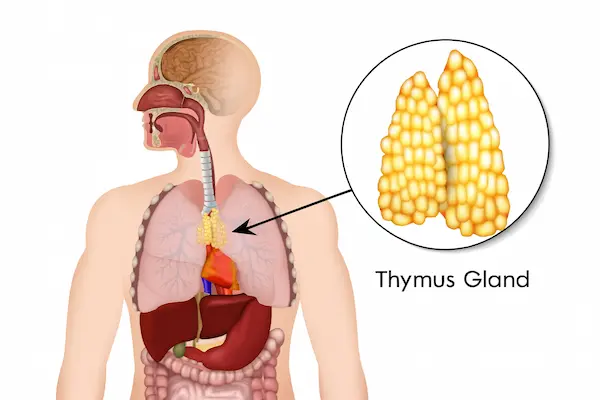
Thymus position in the anterior mediastinum — accessible by minimally invasive surgery
Thymoma staging and cure rates — what your stage means for your outlook
Thymoma is staged using the Masaoka-Koga system. The earlier the stage, the higher the cure rate — and most thymomas are discovered at early stages, often incidentally.
Fully encapsulated
Completely contained within the thymus capsule. Surgery alone is curative in the vast majority of cases.
Minimal invasion
Capsule or adjacent fat/pleura minimally involved. Surgery plus post-operative radiotherapy gives excellent results.
Local invasion
Invasion of neighbouring structures. Combined surgery, radiotherapy, and sometimes chemotherapy. Depends heavily on complete resection.
Spread present
Pleural, pericardial, or distant spread. Multimodal approach; outcomes vary. Full MDT review essential.
Most thymomas are discovered at Stage I or II, often found incidentally on imaging. This means most patients are in the highest cure rate categories. Early surgical removal before any invasion develops is the goal — and private referral avoids the wait that can allow disease to progress.
Types of thymoma — what your type means for treatment
Thymomas are classified from Type A (least aggressive) through B3 (more aggressive), plus the distinct and rarer thymic carcinoma. Your type influences recurrence risk and whether additional treatment is recommended after surgery.
Type A
Spindle-shaped epithelial cells, few lymphocytes. Typically encapsulated, slow-growing, rarely recurs after complete surgical removal.
Excellent — surgery alone usually curative
Type AB
Mixed cell population. Behaves similarly to Type A. Well-encapsulated and responds excellently to surgical resection.
Very good outcomes; low recurrence
Type B1
Resembles normal thymic tissue with abundant lymphocytes. Low-grade with small but real recurrence risk. Surgery highly effective.
Good — long-term surveillance needed
Type B2
More epithelial-dominant, fewer lymphocytes. Higher recurrence risk. Complete surgical excision with clear margins critical. Post-operative radiotherapy often recommended.
Complete resection + radiotherapy typical
Type B3
Predominantly epithelial with minimal lymphocytes. More aggressive behaviour; higher risk of local invasion. Surgery with radiotherapy and sometimes chemotherapy is standard.
Multimodal treatment usually required
Thymic Carcinoma
A true carcinoma — distinct histological features, more aggressive, higher risk of distant spread. Requires surgery plus chemotherapy and radiotherapy. MDT input essential throughout.
Specialist MDT management; outcomes vary by resectability
Thymoma Symptoms — from silent discovery to systemic effects
Many thymomas cause no symptoms at all. When they do, the presentation varies widely — which is one reason the diagnosis can be delayed or unexpected.
Incidental discovery — no symptoms
Up to half of thymomas are found on imaging done for another reason — a chest X-ray, pre-operative CT, or cardiac assessment. This is an ideal outcome: early discovery before any symptoms or invasion develop.
Chest pressure or breathlessness
As the tumour grows, it can compress nearby structures — trachea, great vessels, or lung — causing a sense of fullness, shortness of breath, or difficulty taking a full breath.
Persistent dry cough
A non-productive cough without an obvious infectious cause, particularly one that doesn’t respond to usual treatments, can reflect a mediastinal mass pressing on bronchial structures.
Chest pain or sternal discomfort
Dull aching discomfort or pressure behind the breastbone can result from the tumour pressing on surrounding structures. Often intermittent and easy to dismiss initially.
Unexplained fatigue or weight loss
Systemic symptoms without a clear cause, particularly combined with any of the above, should prompt investigation including chest imaging.
The myasthenia gravis connection
In 30–50% of thymoma patients, the tumour triggers an autoimmune response affecting the neuromuscular junction — causing myasthenia gravis. MG symptoms may actually appear before the thymoma is detected, and subsequent chest imaging reveals the underlying cause.
- Drooping eyelids (ptosis) often worse towards evening
- Double or blurred vision
- Difficulty swallowing certain foods
- Muscles that fatigue unusually quickly with repeated use
- Voice changes or difficulty speaking at length
- Generalised fluctuating muscle weakness
If you have myasthenia gravis, thymectomy may significantly reduce your symptoms — even if no thymoma is identified.
Thymectomy surgery — removing the thymus and the tumour
Surgery is the cornerstone of thymoma treatment. Complete resection with clear margins is the single most important determinant of long-term outcome. Minimally invasive approaches have transformed what recovery looks like.
Why complete surgical resection is everything
The single most important factor in thymoma outcomes is whether the tumour is completely removed with clear surgical margins. Incomplete resection dramatically increases recurrence risk. This is why thymectomy must be performed by a thoracic surgeon with specific experience in mediastinal and thymic surgery.
Robotic and VATS thymectomy have made complete resection achievable through very small incisions for the majority of early-stage cases, transforming the patient experience without compromising the oncological quality of the operation.
Discuss surgery with Mr Scarci →Surgery outcomes at a glance
Surgical approaches — which is right for you
Robotic-Assisted Thymectomy
Through 3–4 incisions of 8–12mm, the surgeon operates guided by a high-definition 3D camera with magnified visualisation. The robotic platform provides articulating instruments with greater dexterity near the great vessels, pericardium, and phrenic nerve.
✓ Maximum precision near critical structures · Minimal scarring · Fastest recovery
VATS Thymectomy (Keyhole)
Video-Assisted Thoracoscopic Surgery uses small incisions and a camera for the lateral chest wall approach. Well-established for appropriately selected early-stage thymomas. Shorter hospital stay, less pain, faster return to normal life.
Excellent for early-stage, encapsulated thymomas
Median Sternotomy (Open)
The traditional approach through the breastbone provides the widest exposure and remains appropriate for large, invasive, or complex tumours. For Stage III/IV cases or where cardiac or great vessel involvement is present, this approach delivers the surgical thoroughness required.
Gold standard for complex, invasive, or large tumours
Thymectomy for myasthenia gravis
Why removing the thymus helps myasthenia gravis
The thymus plays a central role in MG — it is involved in producing the autoantibodies that block signals between nerves and muscles. A landmark 2016 randomised controlled trial established thymectomy as first-line therapy for non-thymomatous generalised MG with AChR antibodies.
Who benefits most from thymectomy for MG?
Patients with AChR antibody-positive generalised MG, those with a confirmed thymoma, and those with early disease where medication has not produced satisfactory control. Age alone is not a contraindication — individual clinical assessment matters far more.
Pre-operative optimisation
Surgery can temporarily worsen MG symptoms. Pre-operative stabilisation with IVIG or plasmapheresis is used to optimise muscle strength and reduce the risk of post-operative myasthenic crisis — planned jointly between Mr Scarci and the treating neurologist.
The neurology–surgery partnership
Thymectomy for MG requires close coordination between thoracic surgeon and neurologist before, during, and after the operation. Medication management, anaesthetic planning, and post-operative monitoring are all informed by specialist neurological input throughout.
Realistic expectations — results take time
Thymectomy does not produce immediate remission. Most patients see the full benefit 1–2 years after surgery, as antibody levels gradually fall. Medication continues post-operatively and is reduced slowly by the neurologist as symptoms improve.
Recovery from thymectomy — week by week
Recovery from minimally invasive thymectomy is typically faster than patients expect. Most are back to normal life within 3–4 weeks.
Operation
Robotic or VATS under general anaesthetic. Walking encouraged the same evening.
In hospital
Chest drain (if used) removed before discharge. Pain well controlled with regular analgesia.
Early recovery
Light activity. Most patients describe less pain than expected. Driving typically cleared at week 2.
Return to life
Return to work (desk: week 3). Full activity and exercise by week 6. Regular surveillance begins.
For open sternotomy: hospital stay 3–5 days; return to desk work by 4–6 weeks; full activity by 8–12 weeks. Open surgery is used only when clinically necessary for complex or large tumours.
Further treatment — when and why it is recommended
For most early-stage thymomas, surgery alone is sufficient. Additional treatment is recommended based on stage, type, and completeness of resection.
Post-operative Radiotherapy
Targeted radiation to the mediastinum is often recommended after surgery for Stage II–III thymoma, when clear margins are uncertain, or when there are features suggesting higher recurrence risk. Modern radiotherapy is precisely targeted to minimise side effects.
Typically: Stage II–III or incomplete resection
Chemotherapy
Neoadjuvant chemotherapy (before surgery) can shrink larger tumours to improve resectability. Adjuvant chemotherapy may be used for Stage III/IV thymic carcinoma or highly invasive thymoma. Thymoma chemotherapy typically has fewer side effects than regimens for other cancers.
Typically: Advanced stages, thymic carcinoma, large pre-operative tumours
Immunotherapy & Clinical Trials
Checkpoint inhibitors are under investigation for thymic carcinoma and refractory thymoma. Clinical trial access through the private sector may be available for eligible patients. Mr Scarci’s MDT can advise on current opportunities.
For advanced, refractory, or recurrent disease
Long-term Surveillance
Thymoma can recur — sometimes years after initial treatment — making long-term CT surveillance essential. Annual imaging gradually reduced over time is the standard approach. Mr Scarci coordinates this directly with patients and communicates results personally.
Required for all patients after thymoma treatment
Why patients choose private specialist care
Expert thymoma care — without the wait that allows uncertainty to grow.
When a scan has found a mediastinal mass, the most damaging thing is not the tumour — it is weeks of not knowing what it means or what happens next.
Subspecialty mediastinal expertise
Thymectomy requires specific thoracic and mediastinal surgical experience. Mr Scarci performs this as a core part of his practice, not as an occasional unfamiliar procedure.
Seen within days, not months
A mediastinal mass requires prompt assessment. Most patients are seen within one week. Diagnosis, MDT review, and surgical planning are completed rapidly.
Full MDT review for every case
Every case is reviewed by a multidisciplinary team — thoracic surgeon, oncologist, radiologist, and pathologist — before a treatment recommendation is made.
Neurology coordination for MG
For myasthenia gravis patients, thymectomy planning involves close collaboration with a specialist MG neurologist at every stage — before, during, and after surgery.
Direct access to your surgeon
You speak to Mr Scarci — not a relay of messages through secretaries. Questions between appointments are answered promptly, personally, and honestly.
Insurance navigation built in
All major insurers are accepted. Pre-authorisation and claims are managed by the team, freeing you to focus on your health and recovery.
“When my CT showed a mass in my chest I spent a week convinced I was facing something terrible. Mr Scarci reviewed everything before my appointment, explained within the first ten minutes that this was almost certainly a Stage I thymoma and highly treatable, and I had robotic surgery three weeks later. I went home the next day. Back to work in two weeks. I genuinely wish I had been told sooner how good the prognosis for this actually is.”
Everything patients want to know about thymoma and thymectomy
A diagnosis you don’t have to face alone — or in uncertainty.
A consultation covers your imaging, your tumour type and stage, your surgical options, and your realistic prognosis. You leave with a clear picture and a plan — not more questions.
