

Persistent chest and rib pain can be deeply unsettling, especially when initial tests return normal. Many patients find themselves caught between relief that nothing immediately dangerous has been found and frustration that they still have no answers. This guide explains what unexplained chest pain might mean once emergency cardiac causes have been ruled out, when to worry, and how specialist assessment can finally provide clarity.
Quick answer: When chest or rib pain is an emergency
Any new, severe, or unexplained chest pain must be treated as urgent until a heart problem is excluded. If you experience chest pain, it is crucial to seek emergency medical attention to rule out life-threatening causes, such as a heart attack.

Call 999 immediately if you experience:
- Sudden crushing or tight central chest pain, especially if it spreads to the arm, jaw, neck, back, or shoulders
- Heavy pressure, squeezing, or burning sensations are typically felt in the centre of the chest
- Profuse sweating, nausea, dizziness, or feeling extremely unwell, alongside chest discomfort
- Severe breathlessness, collapse, or confusion
- Symptoms of a heart attack including shortness of breath and sweating
Heart attack symptoms can vary, but chest pain lasting more than 15 minutes that does not improve with rest may indicate a heart-related issue requiring immediate intervention.
Red flags for life-threatening non-cardiac causes include:
- Sudden sharp chest pain with breathlessness, which may suggest pulmonary embolism (a blood clot in the lung) or a collapsed lung
- Severe tearing pain in the chest or back, potentially indicating aortic dissection
- Coughing up blood, fever, or sudden unexplained shortness of breath
Less common but serious causes of chest pain include aortic dissection, pulmonary embolism, and spontaneous coronary artery dissection (SCAD), all requiring immediate medical attention.
If you are unsure whether the pain is serious enough, always seek immediate help rather than waiting. The rest of this article focuses on chest and rib pain where initial emergency cardiac causes have been excluded, including when scans and tests seem normal.
Not sure about your treatment options?
Mr Scarci provides expert consultations typically within one week of contact.
Overview: understanding chest and rib pain with no obvious cause
Many people experience persistent chest wall pain even after normal ECGs, blood tests, and X-rays. This can feel worrying and confusing, leaving patients uncertain about what is actually wrong.
When doctors say there is no obvious cause, this usually means no immediately life-threatening problem has been identified. However, there may still be a musculoskeletal, nerve, lung, or chest wall issue requiring specialist assessment. Chest pain can result from various conditions including musculoskeletal issues (like costochondritis or muscle strain), heart-related problems (such as heart attack or angina), lung-related issues (like pulmonary embolism or pneumonia), and digestive issues (such as acid reflux).
The chest wall structures (ribs, costal cartilage, muscles, nerves, and pleura) can generate pain that closely mimics heart pain. These structures share nerve pathways with the heart, which explains why musculoskeletal chest pain can feel alarmingly similar to cardiac symptoms.
A thoracic surgeon such as Mr Marco Scarci specialises in conditions of the lungs and chest wall. Using advanced imaging and minimally invasive techniques, including keyhole and robotic approaches, he can perform a full assessment and identify causes that standard emergency assessments may miss.
"After two years of being told my symptoms were anxiety, Mr Scarci identified the problem immediately. The surgery was straightforward and I was discharged after three days. I only wish I had found him sooner."
What chest and rib pain can feel like (when heart tests are normal)
Non-cardiac chest wall pain varies considerably and often changes with movement, breathing, or touch.
Common descriptions include:
- Sharp, stabbing pain on one side of the rib cage
- Dull ache along the ribs or breastbone
- Tenderness when pressing over a specific rib or the costochondral joints
- Pain that worsens with deep breathing, coughing, twisting, or heavy lifting
- A burning sensation or electric-like discomfort
Rib pain may radiate into the back, shoulder blade, or upper abdomen, making it difficult for patients to pinpoint the origin. Pain associated with muscle strain is typically localised, while heart-related pain often feels like vague heaviness or pressure in the chest.
Patterns suggesting chest wall rather than heart pain include:
- Reproducible by pressing on the affected area
- Clearly related to posture or certain movements
- Worse after severe coughing fits or physical activity
Anxiety and fear, especially after previous emergency assessments, can amplify the perception of pain. However, this does not mean the pain is imagined; it simply overlays genuine physical pathology.
Have a question about your diagnosis?
A consultation gives you a personalised plan — not a generic estimate.
Common non-cardiac chest and rib pain causes
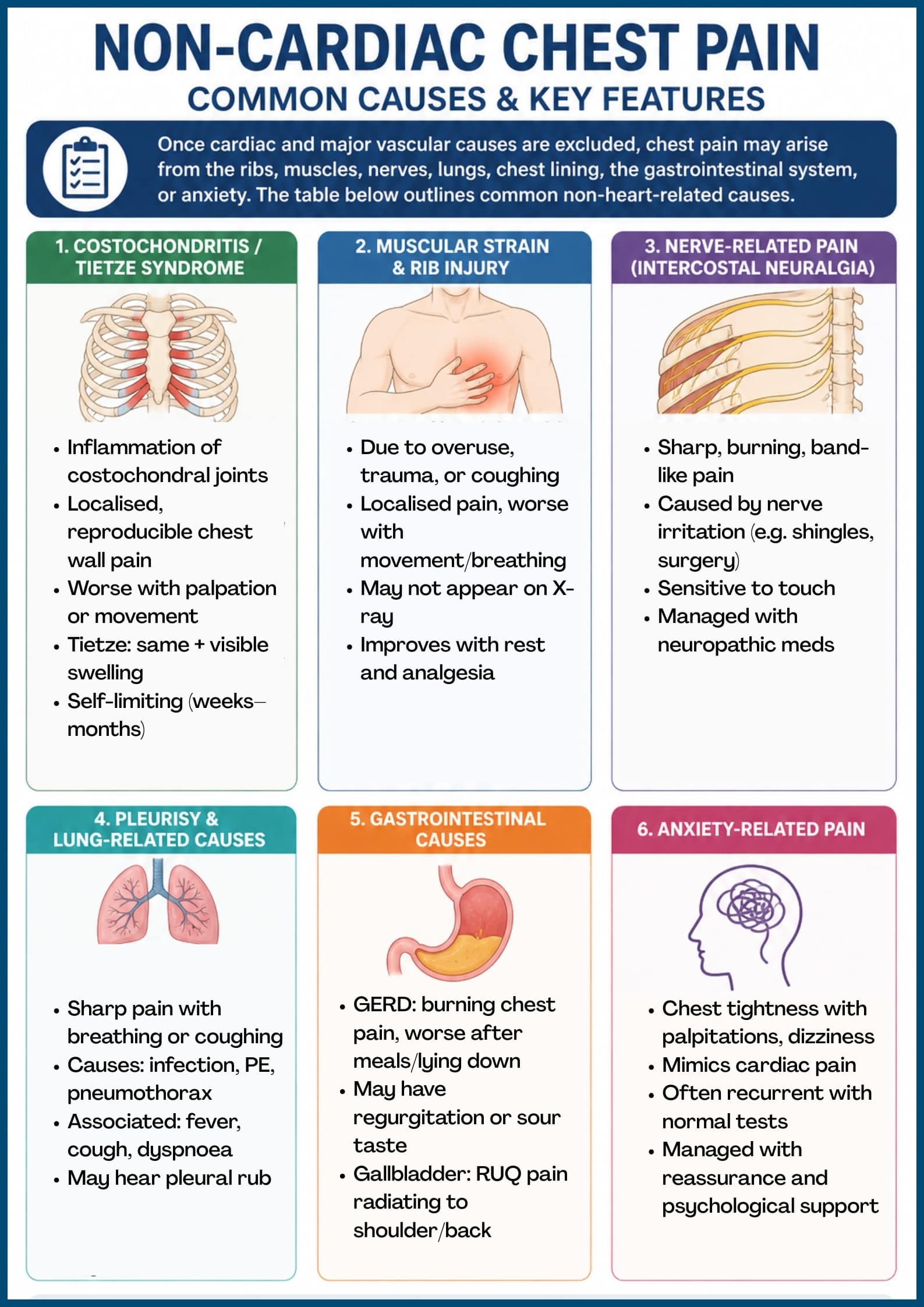
Once cardiac and major vascular causes are excluded, doctors investigate problems involving ribs, cartilage, muscles, nerves, lungs, and the lining of the chest. Common causes of non-heart-related chest pain include heartburn, chest infections, muscle pain, injuries, and inflammation.
Costochondritis and Tietze syndrome
Costochondritis is an inflammation of the cartilage that connects a rib to the breastbone, known as the sternum. The pain associated with costochondritis is often localised to the area where the rib cartilage attaches to the sternum and can mimic the pain of a heart attack.
The condition most commonly affects the upper ribs (2nd to 5th), often on the left-hand side, creating significant anxiety for patients who fear cardiac problems. A key distinguishing feature is that pressing on the tender joints typically reproduces the discomfort.
Tietze syndrome is a related condition where the same area is painful but also visibly or palpably swollen, more often seen in teenagers and young adults, affecting the 2nd or 3rd ribs.
Costochondritis can occur without a clear cause, but it may be associated with trauma, illness, or physical strain, such as severe coughing. Repetitive activities like overhead movements or intense sport can also trigger it.
Symptoms often improve gradually over a few weeks to a few months with simple pain relief, rest, and stretching. However, if symptoms persist beyond 12 weeks or present atypically, further evaluation is warranted to exclude conditions like fibromyalgia or infection.
Muscular strain and rib injuries
Muscle strains affecting the chest muscle groups, particularly the intercostal muscles between the ribs, are common causes of chest wall pain. Overuse, sudden twisting, weight training, or repetitive movements can cause localised soreness that worsens with movement and improves with rest.
The forces involved can be substantial. Severe bouts of coughing can generate loads equivalent to 50kg of pressure on the chest wall, sometimes causing rib contusions or undisplaced fractures that may not show clearly on basic X-rays. CT scanning has approximately 95% sensitivity for detecting such injuries compared with 50% for plain films.
Rib injuries typically take several weeks to settle and are managed with adequate pain control, breathing exercises, and avoidance of further strain. Incentive spirometry helps prevent lung collapse by maintaining chest expansion.
Persistent or worsening rib pain, particularly with fevers, trouble breathing, or feeling sick, should prompt reassessment for complications such as pneumonia, pleural effusion, or empyema.
Nerve-related chest pain (intercostal neuralgia and nerve irritation)
Sensory nerves run along each rib, and irritation or trapping of these nerves can cause sharp pain, a burning sensation, or electric shock-like discomfort in a band around the chest.
Causes include:
- Prior thoracic surgery with rib spreading
- Healed rib fractures causing neuromas
- Spinal disc problems affecting thoracic nerves
- Shingles (herpes zoster) affecting a chest nerve: post-herpetic neuralgia occurs in approximately 20% of those over 50
This nerve-related pain can be highly sensitive to light touch or even clothing, may persist after visible healing, and typically does not respond well to standard anti-inflammatory tablets alone.
Diagnosis relies on clinical examination, history of previous procedures or rashes, and sometimes imaging of the spine or chest wall. Treatment may involve nerve-specific medications such as pregabalin, physiotherapy, targeted nerve blocks, or, rarely, surgical intervention by a thoracic specialist.
Pleurisy and lung-related causes
Pleurisy involves inflammation of the lining of the lungs, causing sharp pain during breathing or coughing. The pleura (the thin lining around the lungs and inside the rib cage) contains nerve endings that respond to stretch and inflammation.
Common causes include:
- Viral or bacterial chest infection
- Pulmonary embolism (accounting for 10-30% of pleuritic presentations)
- Autoimmune diseases such as lupus
- Post-surgical inflammation
Key accompanying symptoms include fever, productive cough, breathlessness, or feeling generally unwell, which help distinguish pleurisy from simple muscular pain. A friction rub may be audible on examination in approximately 25% of cases.
Conditions like a collapsed lung (spontaneous pneumothorax) can cause sudden, one-sided pleuritic pain in otherwise healthy individuals, especially tall, slim young adults and smokers. Recurrence rates reach 30-50% without intervention, often requiring thoracic surgical input for pleurodesis or bullectomy.
Gastrointestinal and anxiety-related pain
Acid reflux and oesophageal spasm can mimic chest pain, often presenting as burning or pressure-like discomfort. Symptoms are typically worse after meals or when lying flat, sometimes accompanied by regurgitation or a sour taste.
Upper abdominal problems such as gallbladder disease can present with pain under the ribs on the right, radiating to the back or shoulders.
Chest pain can be caused by anxiety, which may feel similar to heart-related chest pain and can lead to symptoms such as a racing heart and dizziness. Panic attacks can cause intense chest tightness, a sensation where the chest feels tight, and shortness of breath, often leading to repeated emergency room visits despite normal cardiac tests.
While anxiety can worsen pain perception through central sensitisation, it frequently coexists with genuine musculoskeletal or nerve pain. Both physical and psychological aspects should be addressed through a multidisciplinary approach involving a GP, a gastroenterologist, a cardiologist, a thoracic surgeon, and a mental health professional when symptoms are complex.
"I was diagnosed in March with a rare condition. My local hospital said it was inoperable due to the size of the mass. Mr Scarci reassured me the thymoma was resectable. I was booked for surgery the following week where he successfully removed the entire tumour."
Less common but important chest wall and rib causes
Although rare, certain structural problems of the ribs and chest wall can cause persistent, unexplained pain requiring specialist assessment. These conditions often need advanced imaging and evaluation by a thoracic surgeon experienced in treating complex thoracic conditions.
Chest wall deformities (e.g. pectus excavatum and pectus carinatum)
Pectus excavatum (sunken chest) and pectus carinatum (protruding chest) are structural deformities of the sternum and costal cartilage that can cause chest discomfort and exercise intolerance. Many patients present in adolescence, though some adults seek assessment later when pain, breathlessness, or cosmetic concerns increase.
Pain often relates to altered chest wall mechanics, chest muscle fatigue, or pressure points where anatomy is abnormal. Severe pectus excavatum can compress the heart, reducing cardiac output by up to 20% during exercise.
Evaluation includes CT imaging with Haller index measurement, lung function tests, and cardiology input. Mr Marco Scarci offers minimally invasive surgical approaches such as the Nuss procedure for selected deformities, alongside conservative options like physiotherapy and bracing.
Rib tumours and chest wall lesions
Tumours of the chest wall can arise from bone, cartilage, or soft tissue of the ribs, presenting with localised persistent pain and sometimes a palpable lump.
| Type | Examples | Characteristics |
|---|---|---|
| Benign | Osteochondromas, fibromas, lipomas | Account for 50% of chest wall bone tumours |
| Malignant | Chondrosarcomas, sarcomas, metastases | Lung and breast primaries represent 80% of metastatic cases |
| Imaging with CT or MRI is typically required, with core needle biopsy achieving 95% diagnostic accuracy. Treatment depends on underlying pathology and may involve surgical removal, chest wall reconstruction, and oncology coordination. Most chest wall tumours are benign, but expert evaluation remains essential. |
Slipping rib and rib hypermobility syndromes
Slipping rib syndrome occurs when the lower ribs (often the 8th, 9th, or 10th, where ribs join only by cartilage) become overly mobile. This irritates nearby nerves, causing intermittent sharp or catching pain.
Patients often report:
- A clicking or popping sensation under the ribs
- Pain triggered by certain movements or positions
- Occasional relief when pressing on the affected area
Standard imaging is frequently normal, making diagnosis primarily clinical. The hook manoeuvre has approximately 80% diagnostic yield. Treatment ranges from physiotherapy and local injections to surgical stabilisation or partial rib resection when conservative measures fail.
Want a specialist opinion on your condition?
Get a clear answer from a surgeon who will be with you throughout.
How a thoracic specialist investigates unexplained chest and rib pain
After emergency causes are excluded, structured assessment becomes essential for finding the source of persistent symptoms.
A specialist consultation includes:
- Detailed history covering onset, triggers, past trauma or surgery, and associated symptoms
- Focused examination of the chest wall, spine, and breathing pattern
- Review of prior investigations
Typical investigations:
| Test | Purpose |
|---|---|
| ECG and blood tests | Usually completed in emergency care |
| Chest X-ray | Initial lung and rib assessment |
| High-resolution CT | Sub-millimetre imaging of cartilage and bone |
| MRI or ultrasound | Soft tissue and dynamic rib assessment |
| Lung function tests | When breathlessness is present |
| In London, private thoracic surgery appointments with Mr Marco Scarci can be arranged promptly in private settings while reviewing prior NHS imaging to avoid unnecessary duplication. Diagnostic procedures such as thoracoscopy—keyhole inspection of the chest cavity with 92% diagnostic yield for indeterminate lesions—may be recommended for uncertain findings. |
Treatment options: from simple measures to minimally invasive surgery
Most non-cardiac chest and rib pain responds to conservative management without major surgery.
Conservative measures include rest, physiotherapy with myofascial release (reducing pain by approximately 40%), posture correction, appropriate pain relief, and taking deep breaths through incentive spirometry. These approaches help most patients return to usual activities within a few weeks.
Targeted procedures such as nerve blocks, steroid injections, or radiofrequency ablation offer relief when conservative care proves insufficient. Hydrodissection achieves approximately 75% response rates for nerve-related pain.
Surgical solutions are considered when there is clear benefit:
- Recurrent pneumothorax requiring pleurodesis or VATS bullectomy
- Symptomatic chest wall deformities are amenable to Nuss bar or Ravitch procedures
- Slipping rib syndrome is not responding to other treatment options
- Confirmed chest wall tumours requiring resection and reconstruction
Minimally invasive approaches like video-assisted thoracoscopic surgery (VATS) and robotic thoracic surgery reduce pain, hospital stay (2-3 days versus 7-10 for open surgery), and recovery time. After any intervention, tailored rehabilitation and follow-up are essential to restore function and monitor for recurrence.
Not sure about your treatment options?
Mr Scarci provides expert consultations typically within one week of contact.
When to ask for a specialist thoracic opinion

Many patients feel stuck after normal heart tests and basic imaging. Seeking a thoracic expert is entirely appropriate when symptoms persist without explanation.
Consider referral when experiencing:
- Ongoing chest or rib pain for more than 6-8 weeks despite GP or physiotherapy input
- Recurrent unexplained pleuritic pain or repeated pneumothorax
- Visible or palpable chest wall deformity causing discomfort
- Imaging showing an unclear chest wall or lung lesion
- Risk factors for complications, such as previous trauma or surgery
Patients in the UK can be seen privately in London or via consultation at Elstree Outpatients Centre, including virtual appointments for international patients wishing to review scans and discuss options remotely before travelling.
Collaboration with your GP and cardiologist ensures all prior investigations are considered, avoiding unnecessary repeat tests. Understanding the underlying condition driving your symptoms is the first step toward effective treatment.
Mr Marco Scarci focuses on personalised, minimally invasive care for complex chest and rib conditions, backed by patient testimonials highlighting expert thoracic care. Whether the cause is costochondritis, slipping rib syndrome, a chest wall deformity, or something requiring surgical correction, specialist assessment can help you move from uncertainty toward a clear diagnosis and plan. Contact the practice to arrange a consultation.
