

For anyone facing surgery, the thought of a long, difficult recovery can be just as daunting as the procedure itself. Traditionally, the post-operative period meant days of bed rest, fasting, and a slow, passive return to normal life. But what if we could change that?
Enhanced Recovery After Surgery (ERAS) does exactly that. It’s a modern, common-sense approach that flips the old model on its head, using evidence-based methods to help you get back on your feet faster, with fewer bumps along the way.
Understanding Your Faster Surgical Recovery

Think of the old way of recovering from surgery as a winding country lane – you’ll get there eventually, but there might be a few unexpected delays. An enhanced recovery after surgery pathway, on the other hand, is more like a well-mapped motorway, designed from the start to get you back to your life as safely and smoothly as possible.
ERAS isn't just one single change; it's a complete rethink of the entire surgical journey. It begins well before you come to the hospital and continues long after you've gone home.
This modern approach challenges long-held traditions that we now know can slow down healing. For instance, instead of the old advice to fast for long periods, ERAS protocols often include a special carbohydrate-rich drink a couple of hours before surgery. This simple step gives your body the fuel it needs to handle the stress of the operation.
At its core, ERAS is about minimising the physical toll surgery takes on your body. Every step is carefully planned, involving a coordinated effort from your entire team—surgeons, anaesthetists, nurses, and physiotherapists—all working together to support your body’s natural ability to heal.
The Patient-First Philosophy of ERAS
The real power of ERAS lies in its patient-first philosophy. It brings you right to the centre of the care plan, transforming you from a passive recipient of care into an active, informed partner in your own recovery.
This simple shift has led to incredible results. Some hospitals now report that over 90% of patients undergoing certain procedures are well enough to go home within 24 hours.
This partnership involves a few key differences from traditional care:
Active Participation: You'll be encouraged to get up and walk within hours of your surgery, not days.
Empowerment Through Education: We give you clear, detailed information about what to expect and how you can play a part in a smoother recovery.
Optimised Pain Control: We use modern pain management strategies that keep you comfortable without the groggy side effects of older, heavy-duty medications.
Early Nutrition: You'll be encouraged to start eating and drinking soon after your operation to give your body the energy it needs to heal.
The goal of ERAS isn’t to rush you out of the hospital. It’s to help you get well enough to go home sooner. The focus is on the quality of your recovery, not just the speed.
By coordinating every aspect of your care, we can significantly reduce common post-operative problems like pain, nausea, and fatigue. The outcome is a more comfortable, predictable, and efficient recovery that helps you regain your strength and independence much more quickly.
Not sure about your treatment options?
Mr Scarci provides expert consultations typically within one week of contact.
The Core Principles of a Faster Recovery
An Enhanced Recovery After Surgery (ERAS) programme isn't one single thing; it’s a collection of many small, evidence-based steps that work together to dramatically reduce the stress of an operation on your body. Think of it less like a magic bullet and more like a high-performance pit crew in a race—every member has a specific job, and when they all work in harmony, the result is a much smoother and faster process.
When we combine these elements, the goal is to keep your body in its natural rhythm as much as possible, cut down on complications, and put you in the driver's seat of your own recovery. Let's break down the fundamental ideas that make this modern approach work so well.
Preparing Your Body for the Challenge Ahead
Any surgery, no matter how small, is a major physical event. The first step in a faster recovery is to get you in the best possible shape before you even arrive at the hospital. We call this 'preoperative optimisation', and it’s a lot like how an athlete trains for a big competition. The idea is to build up your resilience so you can handle the stress of the procedure and bounce back far more quickly.
This preparation phase involves a few key actions:
Nutritional Support: The old way involved long periods of fasting, which we now know can weaken the body. Instead, you'll likely be given a special carbohydrate-rich drink a couple of hours before your operation. This gives your system a crucial energy boost to manage the surgical stress, preventing the deep fatigue that can slow down healing.
Patient Education: Knowing what's coming is a powerful tool against anxiety. We make sure you have clear, straightforward information about every stage of your journey. When you understand the plan, you can participate in it with confidence.
Medication Review: We'll take a close look at any medications you're currently on, making small adjustments if needed to ensure you're in optimal health on the day.
By dialling in these details beforehand, we’re setting the stage for a much better outcome after the operation is over.
A Smarter Approach to Managing Pain
Good pain control is absolutely central to enhanced recovery, but we go about it very differently now. Rather than relying heavily on strong opioids that can leave you feeling drowsy and nauseous (and therefore stuck in bed), ERAS uses a strategy called multimodal analgesia.
It's a bit like building a house—you wouldn't just use a hammer for every single job. Multimodal pain relief uses a combination of different medications and techniques, each tackling pain from a different angle.
This layered approach is far more effective. A local anaesthetic can block pain signals right at the source, anti-inflammatory drugs work to reduce swelling, and other non-opioid medications help manage the rest. The result? You get excellent pain relief without the fuzzy head, which is key to getting you moving again.
This smarter strategy is critical because it breaks a vicious cycle. When your pain is properly managed, you'll feel more able and willing to get out of bed, which is one of the most important things you can do to speed up your recovery.
The Importance of Early Movement and Nutrition
Two of the biggest changes in surgical care over the last decade have been the focus on moving and eating much sooner after an operation. The old advice of strict bed rest and waiting to eat has been completely overturned by a proactive approach that gives your body what it needs to heal right away.
Early Mobilisation simply means getting you up and moving—often just sitting in a chair or taking a short walk—within hours of your procedure. This might sound daunting, but the benefits are huge:
It helps you hold on to your muscle strength.
It improves your lung function, reducing the risk of chest infections.
It dramatically lowers the risk of developing dangerous blood clots.
Early Nutrition is just as vital. Your body needs fuel to repair itself, plain and simple. As soon as it’s safe, we'll encourage you to drink and then eat. This gets your digestive system going again and provides the protein and nutrients your body is crying out for. The days of being kept "nil by mouth" for long periods are over because we now know it just weakens you.
Together, moving and eating soon after surgery send a powerful signal to your body: it's time to get on with healing.
"After two years of being told my symptoms were anxiety, Mr Scarci identified the problem immediately. The surgery was straightforward and I was discharged after three days. I only wish I had found him sooner."
Your ERAS Pathway for Thoracic Surgery Explained
It’s one thing to understand the theory behind enhanced recovery, but it’s another to see exactly how it will shape your own surgical journey. For thoracic surgery, the ERAS pathway is a detailed roadmap designed to minimise the physical stress of an operation and give you a clear, predictable path forward. Think of it less as a rigid set of rules and more as a collaborative plan we build together, turning surgical uncertainty into manageable, well-supported steps.
This simple guide breaks down the core ideas that will underpin your entire experience, from preparing at home to getting back on your feet.
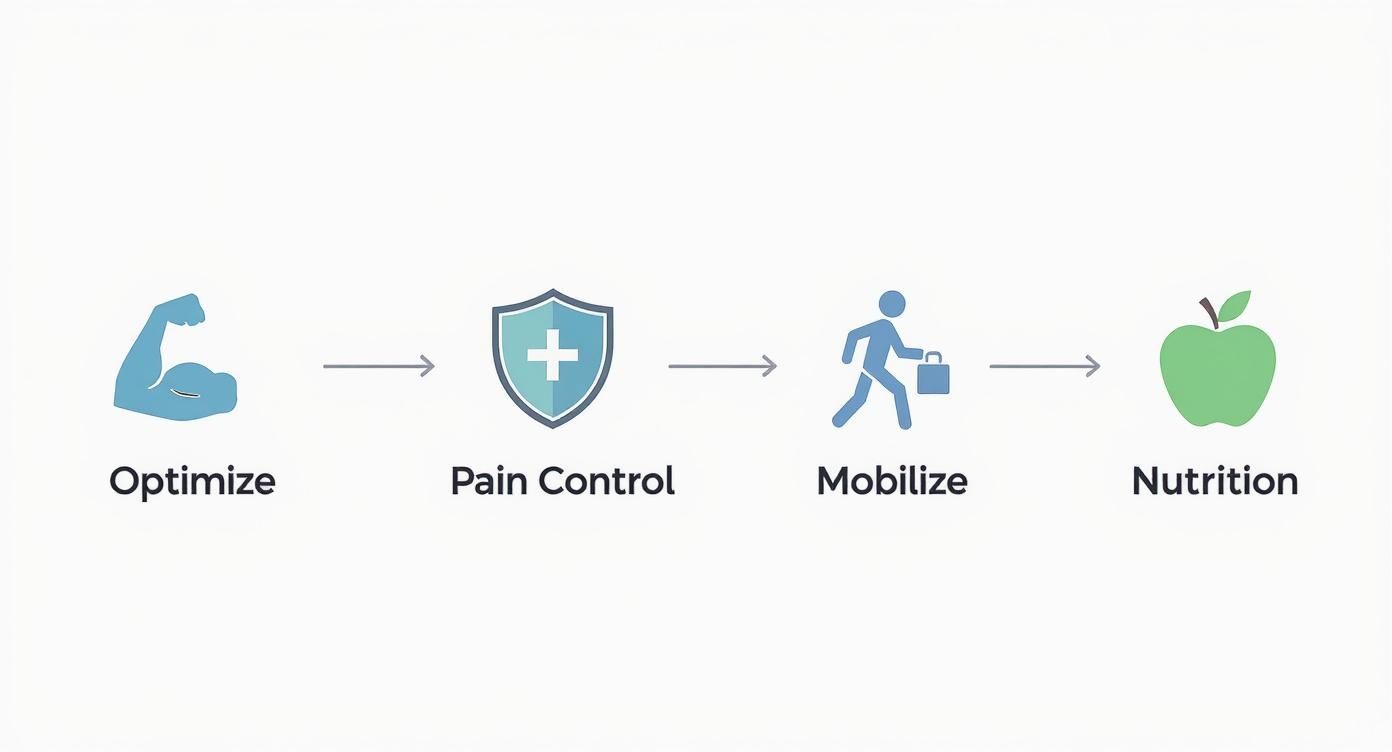
As you can see, we focus on optimising your health beforehand, keeping pain under control, getting you moving, and ensuring you have the right nutrition. These elements don’t work in isolation; they all weave together to create a smoother, faster healing process.
Getting Ready at Home Before Your Admission
Your recovery actually begins well before you even set foot in the hospital. This initial phase is all about getting you in the best possible shape, both physically and mentally, for the procedure ahead. It's a proactive approach that makes a real difference in how well your body handles the stress of surgery.
You are the most important member of the team here. We'll give you clear, practical guidance on a few key things you can do to prepare:
Breathing Exercises: Strengthening your lungs before surgery is crucial. A physiotherapist will show you some simple exercises to help maintain your lung capacity and significantly lower the risk of chest infections post-op.
Nutritional Boost: We’ll give you specific advice on your diet. This often includes special nutritional supplements or a carbohydrate-rich drink to have a few hours before your operation. It’s a bit like an athlete carb-loading before a big race – it gives your body the energy reserves it needs for healing.
Stopping Smoking: If you are a smoker, quitting is the single most powerful thing you can do for your recovery. It has an immediate positive effect on your lung function and circulation, which dramatically reduces your risk of complications.
By taking these steps, you are actively laying the groundwork for a successful outcome before the operation has even started.
The Day of Surgery and Your Immediate Recovery
On the day of your operation, the focus shifts to minimising your body's natural stress response. A cornerstone of this is our use of minimally invasive techniques like Video-Assisted Thoracoscopic Surgery (VATS). Instead of one large incision, VATS uses just a few small 'keyhole' cuts. The result? Far less pain, minimal scarring, and a much quicker return to your normal life.
After your surgery, our priority is to help you wake up gently and effectively. The anaesthetic drugs we use are modern and short-acting, meaning they wear off quickly so you can become alert and engaged sooner.
Your care right after surgery is designed to be proactive, not passive. The aim is to get your body’s systems back on track as safely and quickly as possible, breaking the old cycle of bed rest that can actually slow down healing.
We’ll manage any discomfort with a multi-layered approach, combining different types of pain relief to keep you comfortable without the heavy sedation of older methods. This is so important because feeling well and alert allows you to take an active part in the next steps of your recovery.
The First Few Days in Hospital
Those first couple of days after your operation are all about building positive momentum. Our team will be right there with you, helping you hit specific daily goals that are proven to speed up the healing process.
Getting you moving is a top priority. On the very first day, we’ll help you sit up in a chair and, when you’re ready, take your first short walk. This early mobilisation is absolutely vital. It helps prevent serious complications like blood clots and chest infections while also keeping your muscles strong.
Good nutrition is just as important. You’ll be encouraged to start drinking and eating a light diet as soon as you feel up to it, giving your body the fuel it needs to repair itself. We also manage any chest drains very carefully, removing them the moment it is safe to do so. This small step makes a big difference to your comfort and ability to move around.
If you’d like a more detailed look at this phase, have a read of our guide on what will happen after a keyhole lung operation.
Planning for a Safe and Confident Trip Home
The final piece of the puzzle is making sure you feel completely ready and confident to continue your recovery at home. We start planning for your discharge from the moment you’re admitted, setting clear and achievable goals that you need to meet before you can leave.
These goals are all centred on your safety and independence:
Your pain is well-managed with simple oral tablets.
You are eating and drinking normally.
You can walk around independently (and manage stairs if you have them at home).
Your chest drain has been removed and your wound is healing nicely.
Before you leave, we'll give you straightforward instructions on everything from managing pain at home to looking after your wounds and gradually getting more active. You’ll also have our team's contact details, providing a safety net of support for any questions that might pop up. This carefully planned discharge ensures your transition from hospital to home is as smooth and safe as possible.
Have a question about your diagnosis?
A consultation gives you a personalised plan — not a generic estimate.
The Real-World Benefits of ERAS in the UK
The theory behind an enhanced recovery pathway is one thing, but what does it actually mean for you? It’s not just about ideas on paper; the benefits are tangible improvements you can see and feel during your own recovery. Across the UK, the switch to enhanced recovery after surgery has consistently delivered remarkable results, completely changing the game for patients.
This isn't some new trend. It's an evidence-based framework backed by a mountain of data from right here within the NHS, establishing it as the proven gold standard for surgical care in the United Kingdom.
Perhaps the most striking benefit is a much shorter hospital stay. By dialling down the body's stress response to surgery and getting you actively involved in your recovery from day one, you’re simply ready to go home sooner.
Getting You Home Sooner and Safer
A shorter stay in hospital is a powerful sign of a smoother recovery, and UK-based research has proven just how effective ERAS is.
Take the Department of Health’s Enhanced Recovery Partnership Programme (ERPP), for example. This massive study tracked over 24,000 surgical patients across many NHS trusts. It found that hospitals using ERAS saw huge reductions in how long patients needed to stay. For colorectal surgery, which traditionally meant a long and difficult recovery, the average stay plummeted from 10–12 days down to just 5–7 days. That's a reduction of up to 50%. You can read more about this work on the official Enhanced Recovery Programme website.
This is crucial: it’s not about sending you home before you're ready. It's about helping you get well enough, faster. Returning to the comfort of your own home, your own bed, and your daily routine is one of the best medicines for your overall wellbeing.
The goal is simple: a quicker return to your normal life. By reducing the physical toll of surgery, ERAS pathways help you feel better faster, regain your independence, and move forward with fewer setbacks.
But it’s not just about the length of your stay; the quality of your recovery is where ERAS truly shines.
Reducing Complications and Improving Well-being
One of the biggest wins for the ERAS model is its proven ability to slash the rate of post-operative complications. The proactive steps we take at every stage directly tackle the most common risks head-on.
Lower Infection Rates: Simple things like early movement and targeted breathing exercises are incredibly effective at keeping your lungs clear and cutting the risk of chest infections.
Fewer Blood Clots: We get you up and walking within hours of your operation. This is one of the best ways to prevent dangerous blood clots (deep vein thrombosis).
Better Pain Management: Our modern, multi-pronged approach to pain relief means we rely less on strong opioids. This minimises nasty side effects like nausea, constipation, and that foggy-headed feeling.
These clinical wins translate directly into a much better experience for you. When you’re not held back by pain or nausea, you feel more able and willing to take an active role in your own recovery. You can eat a proper meal sooner, move around more freely, and get the most out of your physiotherapy.
It creates a positive cycle: feeling better helps you do more, and doing more helps you feel even better. The result isn't just a speedier physical recovery, but a real sense of being in control and well-supported, leading to far greater satisfaction with your entire experience.
"After multiple failed consultations elsewhere, Mr Scarci identified exactly what was wrong and operated within two weeks. Recovery was smooth and I'm back to normal life."
How We Measure a Successful Recovery Journey
When we talk about a successful recovery, we're looking at more than just the day you get to go home. A truly successful enhanced recovery after surgery pathway is gauged by a combination of hard clinical data and, just as crucially, your own personal experience.
Think of it like a car's dashboard. The speed is obviously important, but you also need to keep an eye on the engine temperature, fuel level, and oil pressure to know everything is running smoothly. It’s the same with recovery; we look at several key indicators together to get the full picture of your progress.
The Clinical Indicators of Success
First, let's talk about the hard data. These are the objective, clinical outcomes that give us a clear, evidence-based view of how the ERAS pathway is performing. They provide a vital baseline for safety and efficiency, helping us spot trends and continuously refine our approach.
Some of our key clinical metrics include:
Length of Stay: This is a big one. A shorter, safe hospital stay is a clear sign that you're recovering well and are medically ready to continue healing in the comfort of your own home.
Complication Rates: We meticulously track any post-operative issues, such as chest infections or blood clots. Low complication rates are a direct result of proactive measures like early mobilisation and breathing exercises paying off.
Hospital Readmission Rates: A successful discharge means you stay home for good. We monitor readmissions very closely, as a low rate tells us that patients are leaving the hospital feeling confident and well-prepared to manage their recovery.
Your Experience as a Key Metric
Clinical data tells one side of the story, but your experience tells the other. How you feel, the level of pain you're in, and your confidence in the process are just as important as any chart or statistic. The ultimate goal, after all, is for you to feel better, not just for us to hit a clinical target.
We measure this through several patient-focused metrics:
Pain Scores: We’ll regularly ask you to rate your pain on a simple scale. Keeping your pain scores consistently low and manageable shows our multi-pronged pain relief strategy is working, keeping you comfortable without relying on heavy sedation.
Mobility Goals: Hitting key milestones—like sitting in a chair on the first day or taking that first walk down the corridor—are huge achievements. We track these to make sure you're regaining your strength and independence right on schedule.
Patient Feedback: Your thoughts, shared through satisfaction surveys, give us priceless insight into what’s going well and where we can do even better.
This balanced approach ensures our definition of success is perfectly aligned with yours. It confirms that the enhanced recovery after surgery pathway is not only clinically effective but also a positive and empowering experience for you.
To see what this looks like for a specific procedure, you can read more about post-surgery recovery for lung cancer.
Want a specialist opinion on your condition?
Get a clear answer from a surgeon who will be with you throughout.
How We Bring Enhanced Recovery to Life for You
It’s one thing to read about the principles of an enhanced recovery pathway, but it’s another to see how they will directly shape your own surgical experience. With Marco Scarci and our thoracic surgery team, ERAS isn’t just a protocol we follow; it’s the very core of the personalised care you’ll receive from day one.
We take these proven concepts and turn them into real, tangible actions. For every person we treat, we aim to answer one simple question: ‘What does enhanced recovery after surgery actually mean for me?’ The answer is found in how we apply these modern principles at every stage, from your first meeting with us to your final follow-up appointment.
It all starts with making sure you feel informed and prepared. We give you clear, straightforward information that walks you through each step of your journey, helping you feel empowered and ready. This preparation is key to a smoother, less stressful experience.
Putting ERAS into Practice, Step-by-Step
Our approach weaves the ERAS philosophy into every part of your care plan. This isn't about ticking boxes on a checklist. It's about actively using smart, evidence-based strategies to reduce the physical stress of surgery and get you back on your feet faster.
You’ll see this commitment in several key areas:
Minimally Invasive Techniques: We are experts in techniques like Video-Assisted Thoracoscopic Surgery (VATS). By using keyhole incisions instead of large, traditional ones, we dramatically reduce post-operative pain. This is a game-changer for getting you moving again quickly.
Personalised Pain Management: Your comfort is our absolute priority. We design a pain relief plan just for you, often using a combination of methods. This keeps you comfortable without the heavy sedation common in older approaches, so you can be an active participant in your recovery.
Dedicated Specialist Support: You are never alone on this journey. Our specialist nurses are there to guide you through every milestone, from taking those first few steps after your operation to feeling confident about going home.
At its heart, our ERAS programme is a partnership. We bring the surgical expertise, the advanced techniques, and the supportive environment. Your active role, guided by our team, is the final ingredient that turns these principles into a faster, successful recovery.
And we know this collaborative approach works. For instance, our patients' average length of stay in hospital is around 25% shorter than the national average. This isn't about sending you home too early. It's the natural result of helping you get medically fit to leave sooner, safer, and with more confidence than ever before. Our commitment is to give you state-of-the-art care within a framework you can trust.
Your Questions About ERAS, Answered
Heading into surgery can feel overwhelming, and it's completely normal to have questions. An enhanced recovery after surgery pathway is designed to make your journey smoother and more predictable, but since it’s a modern approach, you might wonder how it differs from traditional care.
Let’s tackle some of the most common questions we hear from our patients. Our aim is to give you clear, honest answers so you can feel confident and prepared. Knowing the "why" behind each step makes you a central part of your own recovery team.
Will I Be Sent Home Before I’m Ready?
This is a big concern for many, and the answer is a firm no. The goal of ERAS is never to rush you out the door. It’s about getting you better, faster, so you are medically ready for a safe and timely discharge.
Think of it this way: because ERAS minimises the physical stress of surgery, you heal more quickly and with fewer setbacks. You'll only go home once we've ticked all the boxes on our strict safety checklist.
This means you must be able to:
Keep your pain under control with simple oral painkillers.
Eat and drink without any trouble.
Walk around safely and independently.
We'll only make the decision together, when both you and our clinical team are 100% confident that you're ready.
How Is Post-Surgery Pain Managed in ERAS?
Pain control is at the heart of enhanced recovery. Instead of relying heavily on strong opioids which can often slow you down, we use a smarter, more targeted "multimodal" approach. It's like having a whole team of pain-relief specialists working together, rather than just one.
We combine different types of medications, like local anaesthetics that numb the area and anti-inflammatory drugs, along with smaller, carefully managed doses of opioids when needed. This combination is far more effective at managing pain while reducing side effects like grogginess and nausea. Better pain control means you can get up and moving sooner, which is one of the most important things you can do for your recovery.
What Is My Role as a Patient in All This?
You are, without a doubt, the most important person on the recovery team. ERAS is a partnership, and your active involvement is key to getting the best possible results.
Your role starts even before you arrive for your operation, by following the advice we give you on nutrition and simple breathing exercises. After surgery, your commitment is crucial—hitting your mobility goals, working with the physiotherapists, and communicating with your care team makes all the difference. For specific operations, we provide detailed guides, such as our advice on recovering from pneumothorax surgery, which highlights the active part you play. When you understand and engage with your recovery plan, you take direct control over how well and how quickly you heal.
