

If you are planning to fly after chest surgery, you probably have one very important question: is it safe, and how long do you need to wait? A common assumption is that air travel is off the table for weeks, if not months, but in many cases that caution is outdated. With the right assessment, preparation and precautions, the majority of patients can fly safely sooner than they expect.
Most chest surgery patients can fly safely within two to four weeks of their operation, but the right time depends on the procedure, how well recovery is progressing and a clinical assessment, not a fixed rule.
A collapsed lung or residual air in the chest can expand at altitude, so a chest X-ray confirming full lung re-expansion is essential before flying.
Key precautions during any flight include walking the cabin every hour, staying hydrated, wearing loose-fitting clothing and compression stockings, and knowing the red-flag signs of in-flight medical events.
The widespread belief that all patients must delay air travel for six to eight weeks after chest surgery is not well supported by current evidence and does not reflect modern minimally invasive surgical practice.
Standard travel insurance often excludes recent chest surgery. Patients should arrange specialist cover and carry a fit-to-fly letter and medical summary in their hand luggage.
Top Tips for Travelling by Air After Chest Surgery
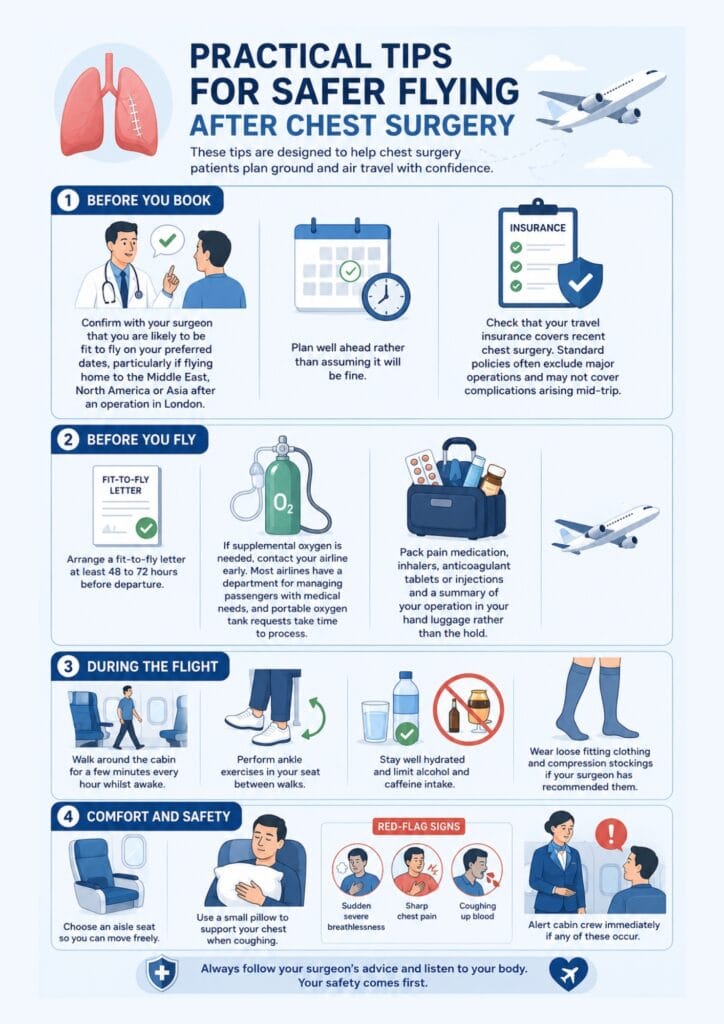
These tips are designed to help chest surgery patients plan ground and air travel with confidence.
Before you book
Confirm with your thoracic surgeon that you are likely to be fit to fly on your preferred dates, particularly if taking a long-haul flight home, such as to the Middle East, North America or Asia after an operation in London. Plan well ahead rather than assuming that everything will be fine. Check that your travel insurance covers recent chest surgery. Standard policies often exclude major operations and may not cover complications arising mid-trip.
Before you fly
Arrange a fit-to-fly letter at least 48 to 72 hours before departure. If supplemental oxygen is needed, contact your airline early to make arrangements. Most airlines have a department for managing passengers with medical needs, and requests for portable oxygen tanks take time to process. Pack pain medication, inhalers, anticoagulant tablets or injections and a summary of your operation in your hand luggage rather than in your checked-in baggage.
During the flight
Walk around the cabin for a few minutes every hour whilst awake, and perform ankle exercises in your seat between walks as both help prevent blood clots. Staying well-hydrated and limiting alcohol and caffeine intake also reduces risk. Wear loose-fitting clothing and compression stockings if your surgeon has recommended them.
Comfort and safety
Choose an aisle seat so you can move freely. Use a small pillow to support your chest when coughing. Know the red-flag signs of in-flight medical events: sudden severe breathlessness, sharp chest pain or coughing up blood. Alert cabin crew immediately if any of these occur.
Not sure about your treatment options?
Mr Scarci provides expert consultations typically within one week of contact.
Why Cabin Air Pressure Matters After Chest Surgery
Commercial aircraft cabins are pressurised to the equivalent of an altitude of roughly 6,000 to 8,000 feet above sea level. At that pressure, the amount of oxygen available in each breath is lower than at ground level. For most healthy passengers, this is barely noticeable, but for patients recovering from chest surgery it is a very important consideration.
After any lung operation, the remaining lung tissue needs to work harder to maintain adequate oxygen levels. If lung volume has been reduced, for example after a lobectomy, or if the lung has not yet fully re-expanded after a pneumothorax, the drop in cabin oxygen can push blood oxygen levels low enough to cause breathlessness, light-headedness or, in more serious cases, significant respiratory distress.
There is also a separate risk relating to gas expansion. Any air or gas trapped in the chest cavity, including a small residual pneumothorax that may not be causing symptoms at ground level, will expand by roughly 30% at typical cabin altitude. A small collapsed lung that’s manageable on the ground can therefore become a much more serious problem in the air. This is the primary reason why a chest X-ray confirming full lung re-expansion is considered essential before flying after thoracic surgery, rather than relying on symptoms alone.
Patients with pre-existing respiratory disease face an additional challenge, as their baseline oxygen levels may already be reduced before boarding. In these cases, a formal hypoxic challenge test, sometimes called a “fit to fly” test, can be carried out before travel to determine whether supplemental oxygen will be needed during the flight.
"After multiple failed consultations elsewhere, Mr Scarci identified exactly what was wrong and operated within two weeks. Recovery was smooth and I'm back to normal life."
How Long Should You Wait? A Guide by Procedure Type
There is no single waiting time that applies to all chest surgery patients. The right interval before flying depends on the specific procedure performed, how smoothly recovery has progressed and the findings on follow-up chest X-ray. The following is a general guide based on current clinical practice:
Procedure | Approximate waiting time before flying |
CT-guided lung biopsy | 5 to 7 days, subject to chest X-ray confirming no pneumothorax |
VATS wedge resection | 7 to 14 days for uncomplicated cases |
VATS lobectomy | 2 to 4 weeks for uncomplicated cases |
Pneumonectomy | At least 4 to 6 weeks; individual assessment essential |
Chest drain removal (pneumothorax) | At least 7 days after confirmed full re-expansion on chest X-ray; individual assessment essential |
Primary spontaneous pneumothorax (no surgery) | At least 1 to 2 weeks after full radiological resolution |
VATS pleurodesis or bullectomy | 2 to 6 weeks for uncomplicated cases |
These timeframes assume an uncomplicated recovery. Any of the following would warrant a longer wait and reassessment before flying:
Persistent air leak or delayed lung re-expansion
Post-operative chest infection or pneumonia
Blood clots identified during recovery
Oxygen levels that remain below normal at rest or on gentle exertion
It is also worth noting that the waiting time before flying is a minimum, not a target. If recovery is slower than expected, the interval should be extended accordingly. The decision should always be confirmed by your thoracic surgeon rather than based on a calendar date alone.
Want a specialist opinion on your condition?
Get a clear answer from a surgeon who will be with you throughout.
How a Specialist Thoracic Surgeon Supports Patients Planning Air Travel
There is a persistent hospital myth, or urban myth, that all patients must delay air travel for six to eight weeks after any chest surgery, regardless of the procedure or how well recovery is going. This old rules approach does not reflect current evidence or the nature of modern minimally invasive techniques. Research has shown that appropriately assessed patients who fly earlier carry a similar low risk profile to those who wait longer. No surgical pathway carries zero risk, but individual situations vary considerably, and it is old rules rather than evidence that continue to govern travel decisions for many patients.
A thoracic surgeon experienced in minimally invasive lung surgery will tailor advice to your specific operation, lung function and destination. Keyhole techniques like VATS and robotic approaches for lung cancer surgery, pneumothorax, emphysema, chest wall tumours, and mediastinal disease are designed to maximise post-operative lung volume and facilitate earlier mobilisation, which in turn opens the door to earlier safe air travel for the majority of patients. For most uncomplicated cases, two to four weeks is a reasonable window to aim for, though the very important question of exactly when to fly safely is always determined by clinical assessment rather than a fixed rule.
For chest surgery patients travelling from abroad or from an out-of-town hospital, a well-organised plan should cover pre-operative fitness assessment, post-operative imaging to confirm lung re-expansion, a fit-to-fly letter and, where relevant, arrangements for supplemental oxygen or ground travel to and from the airport. Virtual follow-up appointments allow surgeons to reassess fitness to fly and review imaging without requiring the patient to travel back in person.
"I had rib pain for 6 years, was bounced around NHS without diagnosis. I was recommended to Mr Scarci — at consultation within minutes he knew what the problem was. Was offered surgery date the next week. 2 weeks post surgery I am almost back to full health."
Flying After Chest Surgery: How Mr Marco Scarci Can Help
Whether you are planning surgery in London and need to fly home shortly afterwards, or you are managing ongoing respiratory care and travel decisions feel uncertain, Mr Marco Scarci offers personalised guidance at every stage. His services cover pre-operative travel planning, fit-to-fly documentation, virtual follow-up and, where needed, coordination with airline medical departments and community teams.
Contact his practice to discuss your individual situation before booking your trip. Coordinating with hospital teams at his London practice to arrange pre-flight oxygen testing, physiotherapy, and DVT prevention strategies, as well as streamlined private thoracic surgery appointments in London.
Frequently Asked Questions About Flying After Chest Surgery
The answers below are general information and do not replace specific advice from your own surgeon or respiratory physician.
Is it safe to fly home just a few days after keyhole lung surgery or lung biopsy?
Even minor procedures can leave a small collapsed lung or residual air that may expand at altitude. Best practice is to wait until a chest X-ray confirms full expansion and your surgeon is satisfied, often at least five to seven days for minor procedures and longer after more extensive surgery. International patients should plan to remain in town for a minimum of seven to ten days so that any early complications can be managed before the flight.
Can I fly if I still feel breathless but my surgeon says the lung has healed?
Some breathlessness after lung surgery is expected, particularly if lung tissue has been removed, and does not automatically make air travel unsafe. The important question is whether oxygen levels are acceptable at rest and on a short walk, and whether breathlessness is gradually improving. If there is any doubt, a walk test with oximetry or a pre-flight assessment can help determine whether in-flight oxygen is needed. A car journey to the airport may feel manageable, but cabin air pressure is a different environment.
Do I need special travel insurance after chest surgery?
Standard policies often exclude recent surgery or active respiratory disease. Seek insurers who specifically cover thoracic surgery and, if applicable, oncology care. Declare your diagnosis, operation date and any planned further treatment. A clear medical summary from your surgeon confirming stable recovery and fitness to travel makes arranging appropriate cover considerably easier.
Can I take long-haul flights if I have previous lung disease but no recent surgery?
A history of lung disease or chronic respiratory conditions does not automatically rule out long-haul travel, but it does warrant individual assessment. Conditions such as severe emphysema, pulmonary fibrosis or a history of spontaneous pneumothorax may require updated imaging and oxygen planning. Arrange a consultation with a thoracic surgeon or respiratory physician six to eight weeks ahead of travel to allow enough time for any necessary tests or documentation.
What symptoms after flying should prompt urgent medical help?
Red-flag signs requiring immediate assessment include sudden or worsening breathlessness, sharp chest pain, coughing up blood, calf swelling or pain, fever with productive cough, or confusion and severe fatigue. These may indicate a collapsed lung, pulmonary embolism or pneumonia. Keep details of your operation, surgeon and hospital accessible so that any emergency department can quickly retrieve the relevant background.
