

A collapsed lung can be frightening, but not every case ends up in the operating theatre. In many cases, a pneumothorax can be treated with careful monitoring or simpler procedures. This article explains when surgery may be recommended, when it may not be necessary, and how your doctor decides on the safest approach for you.
Surgery is usually recommended for recurrent pneumothorax on the same side, a persistent air leak lasting more than five to seven days, bilateral pneumothorax, or high-risk occupations such as pilots and scuba diving professionals.
Many first-time cases can be treated with monitoring, needle aspiration or a chest drain, without the need for surgery.
Individual patient factors significantly influence the decision to perform surgery, including cause, underlying lung disease, lifestyle, and risk factors.
Modern keyhole techniques like video-assisted thoracoscopic surgery combine bullectomy with pleurodesis to seal the air leak and prevent recurrence.
What Is a Pneumothorax (Collapsed Lung)?
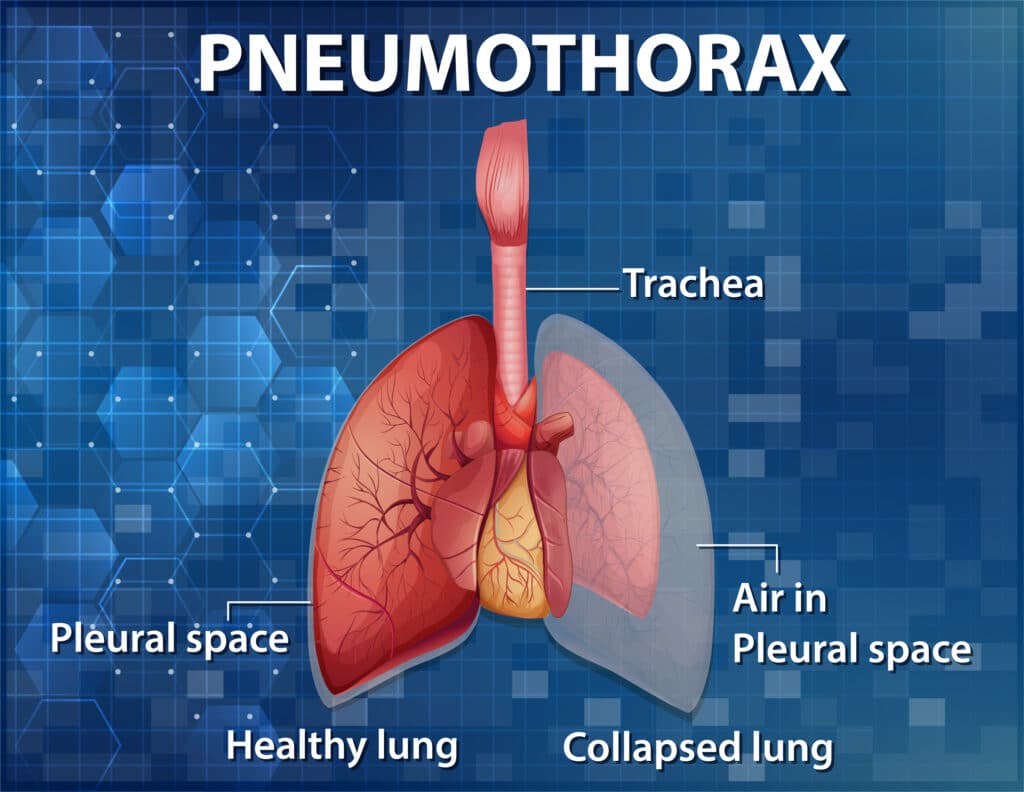
A pneumothorax occurs when excess air escapes into the pleural space, which is the gap between the lung and the chest wall. This change in air pressure stops the lung tissue from expanding fully, causing partial or complete lung collapse.
Common symptoms include sudden sharp chest pain on one side, shortness of breath, and a dry cough.
In rare cases, a pneumothorax can develop into a tension pneumothorax, which is a life-threatening emergency. This happens when trapped air builds up and puts pressure on the heart and blood vessels, causing symptoms such as severe breathlessness, low blood pressure and a fast heart rate. Urgent treatment is needed, usually with emergency decompression followed by a chest drain.
Diagnosis is usually confirmed with a chest X-ray in the emergency department. A CT scan or ultrasound may be carried out to check the size of the pneumothorax, look for blebs or help plan surgery if needed.
Main types
Primary spontaneous pneumothorax – often affects young, tall, slim individuals without known lung disease, linked to small blebs on the visceral pleura (the inner lining of the lung).
Secondary spontaneous pneumothorax – occurs alongside existing lung disease such as COPD, emphysema, cystic fibrosis, or pulmonary fibrosis. Higher risk and worse outcomes.
Traumatic pneumothorax – caused by rib fractures, blunt or penetrating chest injuries.
Iatrogenic – following medical procedures such as lung biopsy or central line placement.
Catamenial pneumothorax – related to the menstrual cycle, typically right-sided, caused by endometrial tissue reaching the diaphragm or pleura. Often linked to endometriosis.
Have a question about your diagnosis?
A consultation gives you a personalised plan — not a generic estimate.
When Does a Collapsed Lung Not Need Surgery?
Many first-time, uncomplicated pneumothoraces can be managed without an operation, especially in otherwise healthy patients.
Observation and monitoring
Observation may be suitable when the pneumothorax is small, symptoms are mild, oxygen levels are stable, and there is no underlying lung disease.
In this situation, your doctor may monitor you with repeat chest X-rays over the following days or weeks. A small amount of trapped air can often be reabsorbed by the body on its own. Some studies suggest that most conservatively managed cases resolve within eight weeks.
Needle aspiration
Needle aspiration is a simple bedside procedure used to remove air from the chest cavity. A fine needle or small tube is inserted into the chest to release the trapped air and help the lung re-expand.
It may be suitable for many stable cases of primary spontaneous pneumothorax and can sometimes avoid the need for a chest drain.
Chest drain insertion
A chest drain may be needed if the pneumothorax is larger or symptoms are getting worse. The drain is usually inserted under local anaesthetic and helps remove air from around the lung.
It may be connected to an underwater seal or fitted with a one-way valve, depending on the situation. The drain usually stays in place until the lung has fully re-expanded.
Chemical pleurodesis without surgery
For some patients, surgery may not be the safest option. This can include people who are frail or who have advanced lung disease, significant heart problems or other serious health concerns.
In these cases, chemical pleurodesis may be considered. This involves putting a substance, often sterile talc, through a chest drain to help the lung stick to the chest wall and reduce the risk of recurrence.
Recurrence rates may be higher than with surgery, but for some patients it can be a sensible and safer compromise.
"Dr. Marco Scarci is a deeply knowledgeable, open-minded, and empathetic surgeon. He listens to details and solves problems to truly deliver the most optimal results. As a medical professional myself, I can tell you that finding a specialist like Dr. Scarci is very rare, and it is a privilege to have him in my corner."
When Does a Pneumothorax Need Surgery?
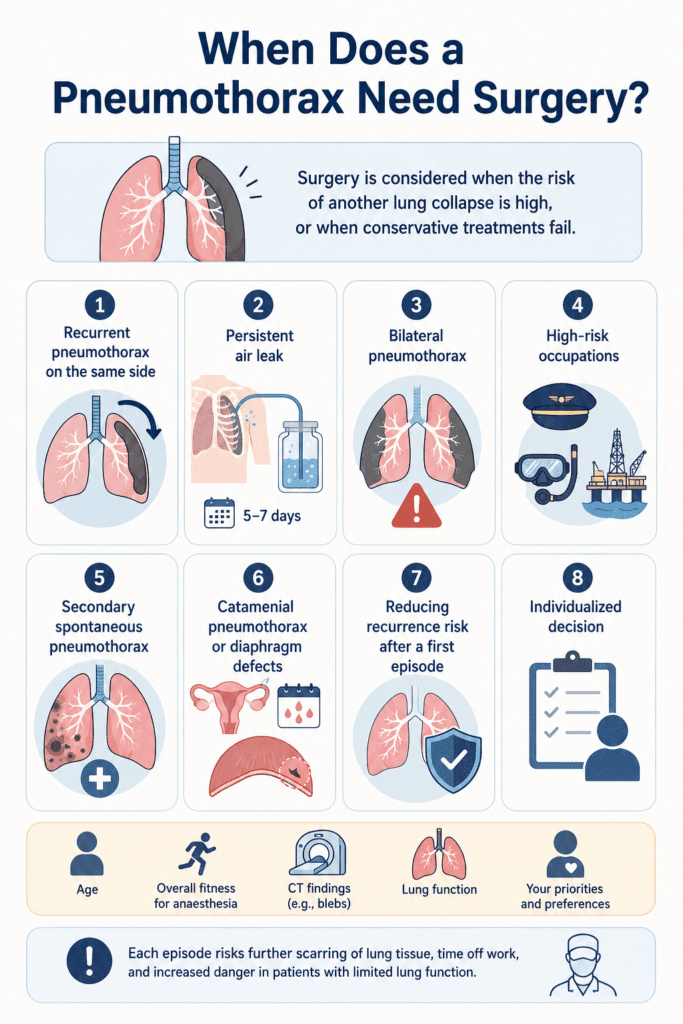
Surgery for pneumothorax is usually recommended when the risk of another lung collapse is high, or the current episode is not resolving with simpler measures. It may also be considered when conservative treatments fail.
Key indications
Recurrent pneumothorax on the same side
If a pneumothorax happens again on the same side, treatment to prevent further episodes is often recommended.
Persistent air leak
If air continues to leak after a chest drain has been in place for around five to seven days, the leak may need to be sealed to help the lung stay expanded.
Bilateral pneumothorax
If both lungs are affected at the same time, this can be life-threatening and often needs urgent specialist treatment.
High-risk occupations
Pilots, divers, offshore workers and others in high-risk roles may be advised to have definitive treatment earlier, because another pneumothorax could be especially dangerous at work.
Secondary spontaneous pneumothorax
In people with existing lung disease, the lungs may be more fragile, and another pneumothorax can carry greater risk. Treatment may be considered earlier to reduce the chance of recurrence.
Catamenial pneumothorax or diaphragm defects
When pneumothorax is linked to the menstrual cycle, or when there are defects in the diaphragm, repair may be needed to address the underlying cause.
Reducing recurrence risk after a first episode
In some cases, definitive treatment may be discussed after a first pneumothorax if the patient wants to reduce the risk of recurrence as much as possible.
Each episode risks further scarring of lung tissue, time off work, and increased danger in patients with limited lung function. Pneumothorax treatment decisions depend on your age, overall fitness for anaesthesia, CT findings such as blebs, and your personal priorities.
Not sure about your treatment options?
Mr Scarci provides expert consultations typically within one week of contact.
Surgical Options for Pneumothorax
Most operations for spontaneous pneumothorax are now carried out using keyhole surgery. The main aims are to find and treat the source of the air leak, help the lung stay expanded, and reduce the risk of another collapse.
The exact approach depends on the cause of the pneumothorax, whether it has happened before, the condition of the lungs and the patient’s overall health.
Video-assisted thoracoscopic surgery, or VATS
Video-assisted thoracoscopic surgery, often called VATS, is the most common surgical approach for spontaneous pneumothorax. It is a minimally invasive keyhole procedure, usually performed through two or three small incisions between the ribs.
A small camera allows the surgeon to inspect the lung and chest cavity in detail. This can help identify blebs, bullae or other areas of weakness that may not always be clear on imaging alone.
Compared with open surgery, VATS usually offers a shorter hospital stay, less postoperative pain and a quicker recovery.
Bullectomy: removing blebs or bullae
During VATS, the surgeon may find small air-filled weak areas on the surface of the lung, known as blebs or bullae. These can sometimes rupture and allow air to escape into the space around the lung, causing a pneumothorax.
If blebs or bullae are found, the surgeon may remove them. This is called a bullectomy. It is often carried out alongside pleurodesis to reduce the risk of the lung collapsing again.
Pleurodesis: reducing the risk of recurrence
Pleurodesis is used to help prevent another pneumothorax. It works by encouraging the lung to stick to the inside of the chest wall, reducing the space where air could collect again.
This procedure can be carried out during VATS or, in some cases, through an existing chest drain if a patient is not suitable for an operation. The most appropriate method depends on the patient’s condition, and the reason treatment is being offered.
Pleurodesis methods
Method | How It Works | Recurrence Profile |
Mechanical pleurodesis | Roughening or partial removal of pleural lining during VATS or thoracotomy to make the lung stick to the chest wall | Effective; can be done during VATS or thoracotomy |
Talc pleurodesis (chemical) | Sterile talc powder is applied during VATS to encourage the lung to stick to the chest wall | Among the lowest recurrence rates |
Chemical pleurodesis via drain | Sclerosant through chest tube; no operating theatre | Higher recurrence than surgical approaches |
When is open surgery needed?
Open surgery, known as thoracotomy, is now usually reserved for more complex cases. It may be considered when there are very large bullae, dense scar tissue, previous failed VATS or other factors that make keyhole surgery unsuitable.
Thoracotomy involves a larger incision and may require spreading the ribs to access the chest cavity. Recovery is usually longer than with VATS, and there may be more postoperative discomfort.
For most patients, however, keyhole surgery remains the preferred approach when an operation is needed.
"After two years of being told my symptoms were anxiety, Mr Scarci identified the problem immediately. The surgery was straightforward and I was discharged after three days. I only wish I had found him sooner."
What to Expect Before, During and After Surgery
If surgery is recommended, your team will explain what the procedure involves, what the recovery may look like, and what you need to do before and after treatment. The exact plan will depend on your health, the type of pneumothorax and the operation being performed.
Before surgery
Before the operation, your surgeon will review your medical history, risk factors and recent imaging. This usually includes a chest X-ray and, in many cases, a CT scan to look at the lung in more detail.
You may also have lung function tests and blood tests, depending on your overall health and the planned procedure.
Your surgeon will talk you through the available options, including VATS, open thoracotomy if needed, the type of pleurodesis being considered, and any non-surgical alternatives. If you smoke, you will be strongly advised to stop before surgery, as this can reduce complications and lower the risk of recurrence.
During surgery
The operation is carried out under general anaesthetic, so you will be asleep throughout. In many cases, single-lung ventilation is used, which allows the surgeon to operate safely on the affected side of the chest.
The length of the procedure can vary depending on the technique used and how complex the case is. Many operations take around 25 to 60 minutes, although some may take longer.
At the end of the procedure, a chest drain is usually left in place. This helps remove any remaining air or fluid and allows the lung to fully re-expand.
Immediately after surgery
After surgery, you will be monitored closely as you recover from the anaesthetic. Pain relief will be provided to keep you comfortable, which may include regular painkillers and, in some cases, nerve blocks.
Your team will encourage you to start moving as soon as it is safe. Early mobilisation helps reduce the risk of complications and supports recovery.
A chest X-ray is usually carried out to check that the lung has re-expanded. The chest drain may stay in place for a few days, depending on whether there is still an air leak and how well the lung is expanding.
Many patients go home within one to three days, although this varies depending on recovery and whether there is an ongoing air leak.
Recovering at home
Once you are home, recovery continues gradually. Many people can return to desk-based work within about two weeks, but this depends on the type of operation, your symptoms and your surgeon’s advice.
You will usually be asked to avoid heavy lifting, strenuous exercise and intense physical activity for several weeks. Breathing exercises may be recommended to help keep the lungs clear and reduce the risk of complications such as infection or partial lung collapse.
You should not fly until your surgeon confirms that the lung has fully re-expanded and it is safe to travel. Scuba diving is often permanently discouraged after a pneumothorax, unless very specific medical criteria are met.
Want a specialist opinion on your condition?
Get a clear answer from a surgeon who will be with you throughout.
Risks, Outcomes and Long-Term Outlook
Thoracic surgery for pneumothorax is generally considered safe, with low complication rates and high success rates. As with any operation, there are some risks. These can include pain, wound infection, bleeding, a prolonged air leak or a reaction to the anaesthetic.
Less common complications include pneumonia, blood clots or the need to change from VATS to open thoracotomy during the operation.
One of the main benefits of surgery is that it can significantly reduce the risk of another pneumothorax. After successful VATS with pleurodesis, the chance of recurrence is usually low, often falling to low single-digit percentages in the first year. Around 90% of patients remain free from recurrence at five years.
Without surgery, the risk of another pneumothorax is usually higher. Recurrence can happen months or even years later, and in some cases it may occur in the opposite lung.

How Mr Marco Scarci Can Help
Mr Marco Scarci is a consultant thoracic surgeon based in London with extensive experience in managing pneumothorax using minimally invasive VATS techniques. He offers rapid assessment of new or recurrent cases, second opinions on whether surgery is indicated, and personalised surgical planning, including for complex situations such as catamenial pneumothorax or pneumothorax in emphysema.
Both private and NHS pathways are available, with face-to-face consultations and virtual consultations for UK and international patients.
The private thoracic surgery route Mr Scarci provides can offer faster access to specialist assessment and greater flexibility when arranging consultations or treatment.
Frequently Asked Questions
Does every spontaneous pneumothorax eventually need surgery?
No. Many first-episode, small primary spontaneous pneumothoraces in otherwise healthy people resolve with observation, needle aspiration, or a short-term chest drain. Surgery is more likely after a second episode, a persistent air leak, or in people with particular risk factors or high-risk jobs. The decision is individual and should follow discussion with a thoracic surgeon who has reviewed imaging and lung function.
How long will I have a chest tube after pneumothorax surgery?
Most patients keep a chest drain for one to three days until there is no further air leak and the lung is fully expanded on imaging. In complex cases or fragile lungs, the drain may stay longer. Removal is usually a quick bedside procedure, and modern pain relief makes management comfortable.
Can I fly or scuba dive after a collapsed lung or pneumothorax surgery?
Commercial flying is usually allowed only after the lung has completely re-expanded and a waiting period has passed, confirmed by a clear chest X-ray and surgeon approval. Scuba diving carries a much higher risk of serious barotrauma, so diving is often discouraged permanently unless strict criteria are met. Seek personalised guidance from your surgeon and, for divers, a diving medicine specialist.
Is VATS always better than open thoracotomy for pneumothorax?
VATS is preferred in most cases because it causes less pain and allows faster recovery while achieving excellent recurrence control when combined with pleurodesis. Open thoracotomy may be recommended when previous surgery, scarring, or complex anatomy makes keyhole surgery unsafe. An experienced surgeon will discuss both options and recommend the best approach for your situation.
What can I do to reduce the chance of another collapsed lung?
Stop smoking and avoid vaping or inhaled recreational drugs. Follow treatment plans for underlying lung conditions, attend all follow-up appointments, and seek prompt medical review for new chest pain or breathlessness. Where appropriate, definitive surgical treatment with pleurodesis can substantially reduce recurrence risk, particularly after more than one episode.
