

Rib fractures are common chest injuries, but recovery can feel uncertain. This guide explains how long healing usually takes, what you can and cannot do during recovery, and when to seek specialist help.
A single broken rib often feels much better within 3–4 weeks. Multiple or displaced fractures may take 8–12 weeks or longer to heal.
Pain relief and regular deep breathing exercises help reduce the risk of chest infection and pneumonia.
Worsening breathlessness, high fever, coughing up blood or severe uncontrolled pain need urgent assessment.
Bruised ribs usually recover in 2–4 weeks. Early home care and treatment for bruised ribs are similar to those for fractures.
What Is a Rib Fracture and How Does It Differ from Bruised Ribs?
A rib fracture is a crack or break in one or more ribs. A bruised rib affects surrounding muscles, cartilage or the outer bone layer without a complete break. Both can result from falls, road traffic collisions, sport or severe coughing.
‘Broken’, ‘fractured’ and ‘cracked’ ribs describe the same injury. Bruised ribs do not involve a complete break, although the pain can feel similar. Learn more about how to tell if you broke a rib.
Common causes include:
Falls, particularly in older adults
Sports injuries and collisions
Road traffic collisions or assault
Severe coughing in people with weak bones
Repetitive strain, especially in athletes and rowers
Ribs cannot be immobilised because the chest moves with every breath, so there is no cast or splint. Bruised ribs usually heal in 2–4 weeks, while fractures often take 6–12 weeks. Advice for recovery from a thoracic surgeon like Mr Marco Scarci can help you manage symptoms and recover safely.
Knowing what to expect and how to manage pain can make recovery more comfortable.

Have a question about your diagnosis?
A consultation gives you a personalised plan — not a generic estimate.
Typical Rib Fracture Healing Time: Week-by-Week Overview
With a non-displaced fracture, many people gradually return to normal activities within 4–6 weeks. Full bone healing can take up to 12 weeks. The healing process includes inflammation, soft callus formation, hard callus formation and remodelling.
Here’s what a straightforward single fracture timeline typically looks like:
Timeframe | What to Expect |
Week 1 | Pain is usually highest during the first week after a rib fracture. Sharp pain with deep breaths, coughing, laughing, or turning in bed. Bruising and swelling at the fracture site. |
Weeks 2–3 | Pain is still present but gradually less sharp. Basic movements become easier. Walking encouraged. |
Weeks 4–6 | Bone healing from a rib fracture typically occurs within 4 to 6 weeks. Many patients return to desk work and light activity with mild discomfort. |
Weeks 6–8 | Bone consolidation generally occurs between 6 and 8 weeks. Affected ribs strengthen significantly. |
Weeks 8–12 | Ribs heal fully in most cases. Some residual ache with exertion is normal. |
For more complex injuries-displaced rib fractures where bone fragments sit out of alignment, or flail chest (which occurs when three or more ribs are broken in two places)-healing can take 8–12 weeks for multiple fractures, sometimes longer. Older adults and those with underlying lung disease face the slowest recovery. |
Pain often improves before the rib has fully healed. Feeling better at week four does not mean you are fully recovered. Smoking, osteoporosis and poorly controlled diabetes can slow healing and increase infection risk.
"Dr. Marco Scarci is a deeply knowledgeable, open-minded, and empathetic surgeon. He listens to details and solves problems to truly deliver the most optimal results. As a medical professional myself, I can tell you that finding a specialist like Dr. Scarci is very rare, and it is a privilege to have him in my corner."
Broken Rib vs Bruised Rib: Does It Change Healing Time?
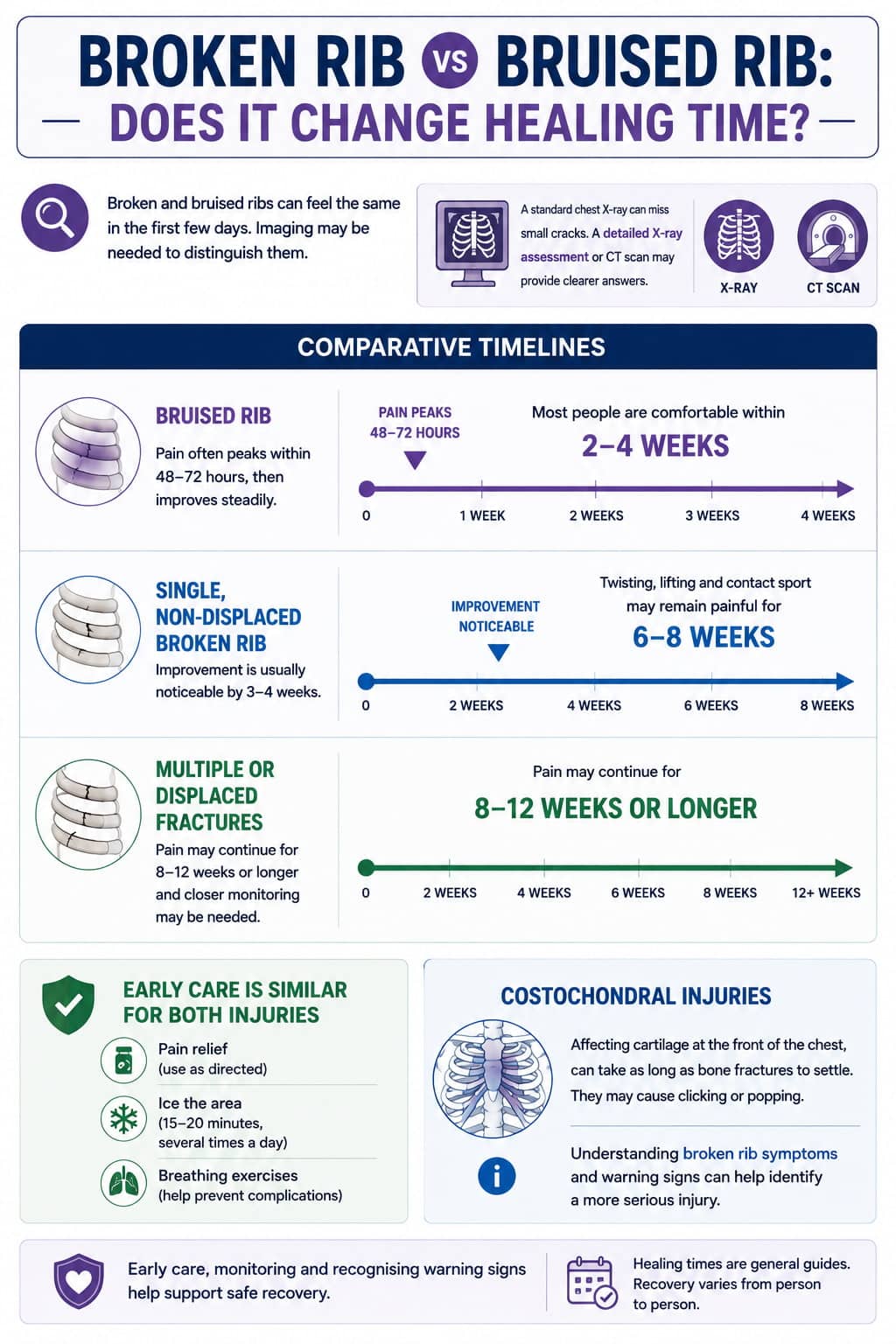
Broken and bruised ribs can feel the same in the first few days. Imaging may be needed to distinguish them. A standard chest X-ray can miss small cracks, while a detailed X-ray assessment or CT scan may provide clearer answers.
Comparative timelines:
Bruised rib: Pain often peaks within 48–72 hours, then improves steadily. Most people are comfortable within 2–4 weeks.
Single, non-displaced broken rib: Improvement is usually noticeable by 3–4 weeks. Twisting, lifting and contact sport may remain painful for 6–8 weeks.
Multiple or displaced fractures: Pain may continue for 8–12 weeks or longer and closer monitoring may be needed.
Early care is similar for both injuries: pain relief, ice and breathing exercises. However, severe night pain at 8–10 weeks or pain after a fall or slip may require review.
Costochondral injuries, affecting cartilage at the front of the chest, can take as long as bone fractures to settle. They may cause clicking or popping. Understanding broken rib symptoms and warning signs can help identify a more serious injury.
Want a specialist opinion on your condition?
Get a clear answer from a surgeon who will be with you throughout.
What You Can Do While a Rib Fracture Is Healing
Appropriate activity supports recovery. Too little movement increases the risk of complications, while doing too much can worsen pain.
From day 1: Gentle walking, washing, dressing and comfortable arm and shoulder movements.
After 1–2 weeks: Longer walks on level ground and simple household tasks without lifting or twisting.
After 3–4 weeks: A return to desk work if pain is controlled and heavy lifting is not required.
Continue deep breathing exercises throughout recovery to keep the lungs expanded and reduce infection risk. Gentle shoulder and spine movements can also prevent stiffness.
Those who have had rib plating or other chest wall injuries may need a different plan. Follow individual medical advice. A wider range of thoracic conditions may also affect recovery.
What You Should Avoid During Rib Fracture Recovery
Avoid activities that could worsen pain or displace a healing fracture, particularly in the first 6–8 weeks:
No heavy lifting, including shopping bags, suitcases or young children, for at least 4–6 weeks or until cleared by a clinician.
Avoid contact sport, running and upper-body gym work for at least six weeks, often longer for multiple fractures.
Avoid lying flat for long periods if this makes breathing shallow or painful.
Do not strap or bind the chest. This restricts breathing and raises the risk of infection.
Avoid smoking and vaping, which can delay healing and increase infection risk.
Mild discomfort with movement is expected. Stop any activity that causes sudden, sharp or worsening pain.
Breathing Exercises and Preventing Chest Infections While You Heal
Rib pain can lead to shallow breathing, allowing mucus to build up in the lungs and increasing the risk of infection. This is particularly important in older adults, who have a higher risk of pneumonia after rib fractures.
Practise these from day one until you are moving comfortably:
Every hour while awake: Take 3–5 slow, deep breaths. Hold each for 3–5 seconds, then breathe out fully.
After each set: Perform a firm huff or supported cough to clear mucus.
When coughing or sneezing: Hold a folded towel or small pillow over the injured area to reduce pain.
Take short walks several times each day to support lung function and circulation. Seek prompt medical advice if you develop worsening breathlessness, fever, yellow or green mucus or new chest tightness.
When Rib Fracture Healing Takes Longer Than Expected
Most fractures heal well, but some cause persistent pain or instability beyond 8–12 weeks. Delayed healing and nonunion are more likely after multiple or displaced fractures.
Suspect delayed healing or nonunion when:
Sharp or mechanical pain continues at the same site after 12 weeks
You feel clicking, popping or movement in the rib when breathing or turning
You cannot return to normal work or sport after several months
Risk is higher with displaced fractures, three or more broken ribs, smoking and high-energy trauma. Assessment may include examination and a CT scan to identify ribs that have not healed. Read more about the long-term effects of broken ribs.
Treatment can include surgical stabilisation with titanium plates and screws, bone grafting in selected cases or treatment for nerve pain. Surgery is uncommon, but can be effective when symptoms persist.
When Is a Broken Rib an Emergency During the Healing Period?
Most bruised and broken ribs do not require emergency care. However, some symptoms need immediate assessment, even weeks after the injury.
Seek emergency help if you develop sudden or worsening breathlessness or chest tightness, blue lips or fingertips, confusion, faintness, coughing up blood or large amounts of dark sputum, or new severe pain beneath the ribs.
These symptoms may indicate a pneumothorax, a haemothorax, internal bleeding, or a severe infection. A pneumothorax can cause a collapsed lung and needs urgent treatment. Pneumothorax treatment should not be delayed.
Following a serious accident, displaced rib fragments can damage nearby organs. Do not drive yourself if you suspect a complication. Older adults and people with significant heart or lung disease should seek help at a lower threshold.
How Mr Marco Scarci Can Help if Your Rib Fracture Is Not Healing as Expected

Mr Marco Scarci is a London-based consultant thoracic surgeon who assesses persistent pain, clicking, deformity and complex chest wall injuries after rib fractures.
He can assess persistent pain after bruised or broken ribs that does not respond to standard treatment, multiple or displaced fractures following trauma, rib nonunion causing chest wall instability or deformity, and painful chest wall scars after previous surgery.
Assessment may include review of previous imaging, further CT scans and an individual treatment plan. This may involve minimally invasive treatment, rib plating surgery, nerve blocks or physiotherapy. Patients can arrange private thoracic surgery appointments in London.
Fractured Ribs: What You Can and Can’t Do While Healing
Can Do:
Gentle walking and normal self-care from day one, as pain allows
Deep breathing exercises and supported coughing throughout recovery
A gradual return to desk work and light duties around weeks 3–4 for simple fractures
Sleeping propped up with pillows during the first few nights if more comfortable
Can’t Do:
Heavy lifting, contact sport or vigorous gym work for at least six weeks, often longer for multiple fractures
Chest binding or tight bandaging that restricts breathing
Smoking or high-risk activities, such as ladder work and high-impact sport, until the chest wall is stable and pain-free
If recovery is taking longer than expected, or you are unsure about driving, flying or returning to intensive sport, seek personalised advice. Mr Scarci can provide specialist assessment where symptoms persist.
Frequently Asked Questions About Rib Fracture Healing Time
How long before I can drive again after a broken rib?
Many people with a simple fracture can consider driving after around 3–4 weeks, once they can perform an emergency stop and check blind spots without sharp pain. Multiple fractures, rib plating or ongoing pain may mean waiting six weeks or longer. Check with your clinician and insurer before driving.
When can I fly with a healing rib fracture?
Short flights are often possible once pain is controlled at rest and while walking, usually after 2–3 weeks for an uncomplicated fracture. Long-haul travel soon after injury carries greater risks because of immobility and cabin pressure changes. Seek medical clearance within the first six weeks, especially after pneumothorax, haemothorax or pneumothorax surgery such as VATS or pleurodesis.
Is it normal to feel clicking or popping as my rib heals?
Mild, occasional clicking in the first few weeks can happen as swelling settles. Persistent painful clicking after 8–12 weeks, or visible chest wall movement while breathing, may indicate a mobile fracture or nonunion. A CT scan can help determine whether further treatment is needed.
Do all broken ribs show on an X-ray, and does that affect healing time?
No. Small cracks, cartilage injuries and some non-displaced fractures may not show on a standard chest X-ray, especially early on. Healing time is guided more by symptoms and examination findings than by X-ray visibility. Severe or prolonged pain may require a CT scan.
Will my rib be as strong as before once it has healed?
Once fully united, a healed rib is often as strong as, or occasionally stronger than, the surrounding bone. Muscles and ligaments may take longer to recover. Most people return to their previous activity level within 8–12 weeks if they build intensity gradually. Repeated injuries, osteoporosis or ongoing concerns about chest wall strength warrant specialist advice.
