

Slipping rib syndrome can be a frustrating and often misunderstood cause of chest or upper abdominal pain. Because its symptoms can mimic other conditions, many people spend months or even years searching for an explanation before receiving a clear diagnosis.
In this expert guide, London thoracic surgeon Mr Marco Scarci explains what slipping rib syndrome feels like, why it happens, and how it is assessed and treated.
Slipping rib syndrome typically feels like a sudden sharp, stabbing pain in the lower chest or upper abdomen, often followed by a lingering dull ache that can last hours to days.
Many patients notice a popping sensation, clicking, or “giving way” feeling at the costal margin, especially when bending, twisting, coughing, or taking a deep breath.
The pain originates from irritation of the intercostal nerves under ribs 8–10 (the false ribs), not from a broken bone, and can mimic heart, lung, or stomach problems.
While symptoms can develop into chronic pain that limits daily life, most patients improve with accurate diagnosis, targeted conservative treatments, and, if needed, specialist thoracic surgery.
What Is Slipping Rib Syndrome?

Slipping rib syndrome, also known as rib tip syndrome, clicking rib syndrome or Cyriax syndrome, is a mechanical chest wall condition in which the anterior cartilaginous part of a lower rib moves excessively, sliding under or over the rib above. It is not a rib fracture. The problem lies in the disruption of the fibrous junctions and interchondral joints that normally hold the lower rib tips in place.
When a rib slips, it irritates the nearby intercostal nerve, producing sharp pain in the lower chest or upper abdomen. The condition is frequently missed because standard imaging appears normal, and symptoms convincingly mimic cardiac, pulmonary or abdominal problems. Many patients undergo investigations for gallbladder disease or heart conditions before the true cause is identified.
What Does a Slipping Rib Actually Feel Like?
Most people describe the initial sensation as a sudden, sharp, stabbing pain at the lower rib margin or upper abdomen, usually on one side. The intensity can be alarming enough to suggest a heart attack or gallbladder attack.
After the sharp episode, a dull ache or deep bruising sensation often lingers for hours to days. Patients frequently report a popping, clicking or slipping sensation at the costal arch during certain movements. Pain can radiate along the rib into the side, upper back or flank. When intercostal nerve irritation is prominent, the sensation may feel like burning, tingling or electric shocks.
Common triggers include:
Twisting or bending movements
Coughing, sneezing or deep breathing
Rolling over in bed or lying on the affected side
Reaching overhead or lifting
Symptoms can be intermittent at first but may progress to chronic pain that limits exercise, work and sleep. A typical pattern involves a sharp jab and audible click when reaching during sport, followed by hours of tenderness, something that tends to affect younger patients in particular.
"I had rib pain for 6 years, was bounced around NHS without diagnosis. I was recommended to Mr Scarci — at consultation within minutes he knew what the problem was. Was offered surgery date the next week. 2 weeks post surgery I am almost back to full health."
Which Ribs Are Involved? (False Ribs vs Floating Ribs)
Understanding basic rib anatomy explains why only certain ribs are vulnerable. The rib cage has twelve pairs:
Rib type | Ribs | Attachment |
True ribs | 1 to 7 | Attach directly to the breastbone via individual costal cartilage |
False ribs | 8 to 10 | Connect to the ribs above through shared cartilage at the costal margin |
Floating ribs | 11 to 12 | No anterior attachment; anchored only to the spine |
Slipping rib syndrome affects ribs 8, 9 and 10 (the false ribs) almost exclusively. The tenth rib is particularly vulnerable because its connection to the costal arch is most susceptible to laxity. When the interchondral joints weaken, the lower rib tips can slide under or over the rib above during movement.
Floating ribs (11 and 12) do not typically cause classic slipping rib syndrome because they lack anterior cartilage attachments. Pain involving these ribs is a separate condition (floating rib syndrome or twelfth rib syndrome) and tends to present in the flank or lower back.
Typical Symptoms and How They Present Day to Day
Symptoms vary from occasional mild twinges to severe pain that disrupts daily life, and often fluctuate over weeks or months. Common features include:
Localised sharp pain at the lower costal margin
A dull ache radiating around to the side or upper back
A sensation of instability or “something moving” in the rib cage
Popping or clicking accompanying pain episodes, sometimes audible
Everyday triggers frequently involve twisting, like reaching for a seatbelt, lifting a child or participating in sports such as cricket, rowing, tennis and gymnastics. Pain can worsen with prolonged coughing, causing many patients to unconsciously take shallow breaths.
Sleep becomes disrupted when turning in bed produces sharp chest wall pain. Many patients develop muscle guarding, altered posture and, over time, fatigue and anxiety about serious underlying disease. Activities that aggravate pain are progressively avoided, reducing quality of life further. The condition can also cause rib flare on the affected side as protective muscle patterns change.
"I was diagnosed in March with a rare condition. My local hospital said it was inoperable due to the size of the mass. Mr Scarci reassured me the thymoma was resectable. I was booked for surgery the following week where he successfully removed the entire tumour."
Why Does Slipping Rib Syndrome Happen? Causes and Risk Factors
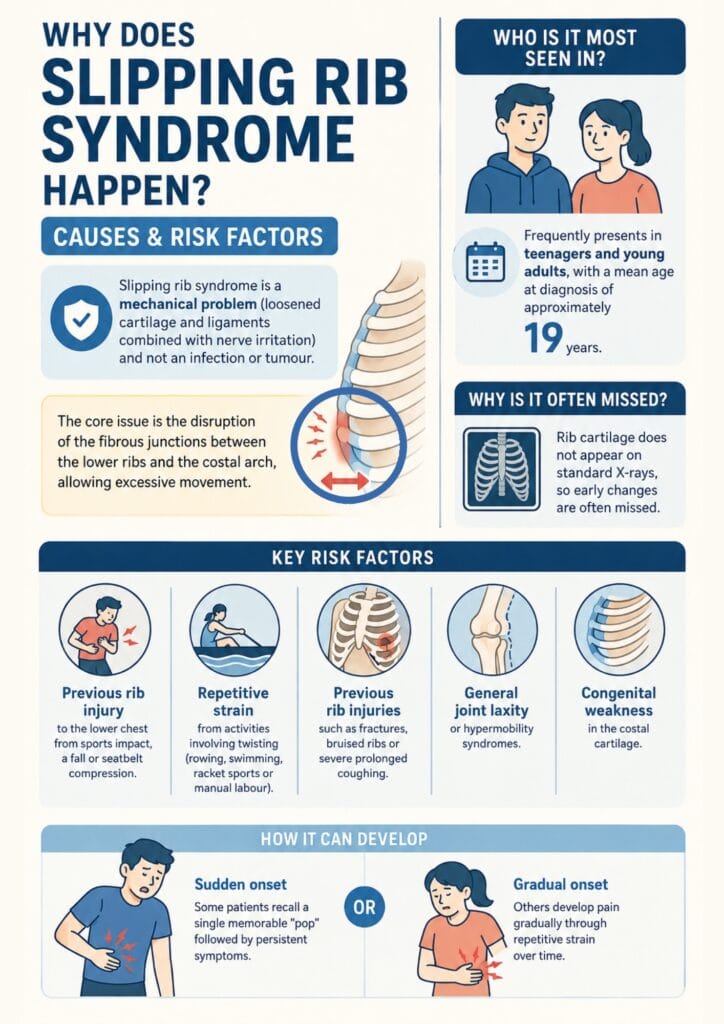
Slipping rib syndrome is a mechanical problem (loosened cartilage and ligaments combined with nerve irritation) and not an infection or tumour. The core issue is the disruption of the fibrous junctions between the lower ribs and the costal arch, allowing excessive movement.
Key risk factors include:
Previous rib injury to the lower chest from sports impact, a fall or seatbelt compression
Repetitive strain from activities involving twisting (rowing, swimming, racket sports or manual labour)
Previous rib fractures, bruised ribs or severe prolonged coughing
General joint laxity or hypermobility syndromes
Congenital weakness in the costal cartilage
The condition frequently presents in teenagers and young adults, with a mean age at diagnosis of approximately 19 years. Because rib cartilage does not appear on standard X-rays, early changes are often missed. Some patients recall a single memorable “pop” followed by persistent symptoms; others develop pain gradually through repetitive strain.
How Slipping Ribs Cause Pain: Intercostal Nerve Irritation
The pain in slipping rib syndrome is largely nerve-driven. An intercostal nerve runs beneath each rib, and when the rib tip affected moves excessively, it can pinch, rub, or stretch this nerve, particularly during motion.
This nerve irritation produces:
Localised stabbing pain at the costal margin
Referred pain along the nerve’s path into the side, abdomen, or back
Burning or searing sensations
Tingling, pins-and-needles, or electric-shock feelings
Sensitivity to touch over the affected rib
Occasional muscle thinning in the nearby abdominal wall
Because nerve pain can be intense and unpredictable, many patients worry about heart or internal organ problems despite normal investigations. Intercostal nerve blocks, such as injections of local anaesthetic around the affected nerve, can temporarily switch off this pain and serve as both pain relief and a valuable diagnostic tool.
Diagnosis: How Do We Know It’s Slipping Rib Syndrome?
Diagnosis is primarily clinical and relies on an experienced chest wall or thoracic specialist. Many doctors refer to a thoracic surgeon when chest wall symptoms are persistent or unexplained.
The typical assessment includes taking a detailed history, focusing on where the pain is located, what it feels like, and which movements trigger it. A physical examination is then carried out, during which the clinician palpates the chest wall and abdomen to identify the affected rib tip and reproduce the symptoms.
The hooking manoeuvre is often used as the key diagnostic test. During this, the clinician hooks their fingers under the costal margin and gently lifts to reproduce the click and pain, helping to confirm rib hypermobility.
Dynamic ultrasound may also be performed while the patient moves or breathes deeply. This can show the rib slipping in real time and is considered the most valuable imaging tool for this condition.
Diagnostic nerve blocks can be used to confirm the source of pain. A local anaesthetic is injected at the suspected rib level, and temporary pain relief supports the diagnosis.
Chest CT or MRI scans rarely diagnose slipping rib syndrome directly, but they may be used to rule out other chest wall problems or abdominal conditions.
Many patients have already undergone normal gastroenterology, cardiology and respiratory investigations before being referred for physical examination and targeted assessment. A thorough differential diagnosis is essential to exclude conditions such as Tietze syndrome or costochondritis.
Slipping Rib Syndrome vs Other Chest and Rib Conditions
Slipping rib syndrome is frequently confused with other causes of chest and rib pain.
Condition | Key differences from SRS |
Rib fractures | Follow significant trauma, visible on X-ray or CT, constant pain without clicking |
Costochondritis | Tenderness near the sternum, no rib movement or popping |
Muscle strain | Improves steadily with rest, no mechanical clicking |
Tietze syndrome | Visible swelling at a single costochondral junction |
Serious conditions such as heart disease, pulmonary embolism or lung collapse must be excluded when red-flag symptoms are present, such as breathlessness, chest pressure, fever or systemic illness. Once these are ruled out, persisting mechanically triggered pain at the costal margin should prompt consideration of slipping rib syndrome.
Have a question about your diagnosis?
A consultation gives you a personalised plan — not a generic estimate.
Treatment Options: From Conservative Care to Surgery
Slipping rib syndrome treatment typically starts with conservative measures, then escalates based on symptom severity and duration.
Conservative treatment
Conservative treatment usually includes activity modification, such as avoiding known triggers and twisting movements.
Short courses of anti-inflammatory medicines and simple analgesics may be recommended, along with ice or heat during acute flares.
Physiotherapy can also be helpful, particularly when it focuses on posture, core strength and chest wall stability. This may include breathing exercises to reduce guarding, as well as education on safe movement patterns.
Interventional pain management
Interventional pain management may be considered if symptoms persist. This can include intercostal nerve blocks with local anaesthetic and steroid, which may provide temporary relief and help confirm the diagnosis.
In selected chronic cases, radiofrequency ablation or other advanced nerve techniques may also be considered.
Surgery

When conservative treatment fails, surgical options may be considered. These can include costal cartilage excision or partial rib resection, which involves removing the hypermobile anterior portion of the rib.
Another option is costal margin reconstruction, a newer approach that uses sutures or bioabsorbable plates to stabilise the costal margin.
Surgery is performed using minimally invasive, muscle-sparing approaches and has been shown to yield excellent outcomes for pain relief and return to normal activity when patients are appropriately selected.
When to See a Specialist Thoracic Surgeon
Seek specialist assessment if you have:
Persistent lower chest or upper abdominal pain for more than 6 to 12 weeks
Recurrent sharp pain and clicking at the rib margin with certain movements
Normal heart, lung and abdominal investigations but ongoing symptoms
Pain limiting sport, work or sleep despite rest and simple analgesia
A thoracic surgeon with chest wall expertise can confirm the diagnosis, coordinate dynamic ultrasound and targeted nerve blocks, and discuss all treatment options with realistic expectations about recovery.
Mr Marco Scarci offers both NHS and private consultations in London, including virtual appointments for both UK and international patients. Early referral shortens the diagnostic journey, reduces unnecessary investigations and prevents months of unmanaged chronic pain.
FAQ: Common Questions About Slipping Rib Syndrome
Is slipping rib syndrome dangerous?
No. It is not life-threatening or harmful to the heart or lungs, but it can cause persistent pain and affect quality of life. Seek urgent medical attention for new chest pain with breathlessness, sweating, or collapse.
Can it heal on its own?
Mild cases may improve with rest, activity changes, and physiotherapy. More severe cases often persist, and pain lasting longer than three months should be assessed by a specialist.
Does it show up on X-ray, CT or MRI?
Usually not. Standard X-rays are often normal, while CT and MRI mainly help rule out other conditions. Dynamic ultrasound is the most useful test for confirming slipping rib syndrome.
What does recovery after surgery involve?
Most patients stay in hospital for 1–3 days. Pain improves over several weeks, with a gradual return to activity. Heavy lifting should be avoided initially, and follow-up includes your surgeon and physiotherapy.
Can children and teenagers develop slipping rib syndrome?
Yes. It is relatively common in active adolescents and those with hypermobility. Treatment usually starts with conservative measures, with surgery considered only if symptoms persist.
