

Segmentectomy has become one of the most significant advances in the surgical treatment of early-stage lung cancer. It involves the anatomical removal of one or more segments of the lung, including the associated bronchus and blood vessels, while preserving the rest of the affected lobe and as much healthy pulmonary parenchyma as possible.
Segmentectomy is a type of pulmonary resection where a surgeon removes one anatomical segment of a lung lobe, including its bronchus, artery, and veins, while preserving the rest of the lobe. It is a lung-sparing technique used primarily for early-stage lung cancer.
Tumors smaller than 2 centimeters in diameter, especially those located peripherally, are most suitable for this surgical procedure.
Segmentectomy preserves more lung function than lobectomy, making it particularly beneficial for patients with poor lung function, COPD, or higher surgical risk.
During lung cancer surgery, nearby lymph nodes are sampled or removed to ensure adequate lymph node staging and guide further treatment.
Mr Marco Scarci, a consultant thoracic surgeon in London, regularly performs anatomical segmentectomy using minimally invasive techniques, including video-assisted thoracoscopic surgery and robotic-assisted thoracic surgery, when appropriate for selected patients.
Segmentectomy in Modern Lung Cancer Surgery
This lung-sparing approach is particularly beneficial for patients with small, peripheral tumours. Segmentectomy occupies a middle ground between wedge resection, which removes a small portion of lung tissue without following anatomical boundaries, and lobectomy, which removes an entire lobe. More extensive procedures include bilobectomy and pneumonectomy, the latter involving removal of an entire lung.
Although primarily indicated for early-stage non-small cell lung cancer, segmentectomy may also be performed for benign nodules, suppurative lesions, and indeterminate pulmonary nodules.
Since around 2020, the procedure has become increasingly common in the UK and internationally, driven by advances in CT imaging, the expansion of lung cancer screening programmes and wider access to minimally invasive thoracic surgery.
Lung Anatomy and Types of Pulmonary Resection
Understanding basic lung anatomy helps explain why segmentectomy works. The right lung has three lobes: the upper, middle, and lower lobes, while the left lung has two. The right upper lobe is one of the most common sites for early lung cancer detection.
Each lobe is divided into anatomical segments. A segment is a self-contained unit of lung with its own bronchus, artery, and veins, surrounded by connective tissue planes. This is what makes anatomic segmentectomy possible. The surgeon removes the entire segment along natural boundaries.
The main types of lung resection include:
Operation | What Is Removed |
|---|---|
Wedge resection | A small, wedge-shaped piece of lung (non-anatomical) |
Segmentectomy | One or more anatomical lung segments |
Lobectomy | One complete lobe of the lung |
Sleeve resection | Part of the airway and surrounding cancer |
Bilobectomy | Two contiguous lobes (right side) |
Pneumonectomy | The entire lung |
Both segmentectomy and lobectomy are considered “anatomical resections” because they follow natural planes and include lymph node dissection. Wedge resection is non-anatomical and generally offers less reliable margins. |
"Dr. Marco Scarci is a deeply knowledgeable, open-minded, and empathetic surgeon. He listens to details and solves problems to truly deliver the most optimal results. As a medical professional myself, I can tell you that finding a specialist like Dr. Scarci is very rare, and it is a privilege to have him in my corner."
What Is a Segmentectomy?
Segmentectomy is a surgical procedure that removes a section of the lung with its bronchus and vessels. Anatomic segmentectomy removes the entire segment with its bronchus and vessels.
An anatomical segmentectomy is a surgical procedure in which the surgeon removes the entire lung segment containing the tumor, including its segmental bronchus, pulmonary artery branches, and veins. The intersegmental plane is carefully identified and divided so that adjacent segments remain intact.
A wedge resection removes a small area of the lung around the tumour without respecting segment boundaries. It is sometimes used as a complementary technique within segmentectomy procedures or for very small peripheral nodules in frail patients.
Segmentectomy offers better cancer margins and allows proper identification and removal of lymph nodes compared with wedge resection, while preserving more lung tissue than lobectomy.
However, segmentectomy is more technically challenging than lobectomy due to the complexity of identifying and dissecting individual segmental structures.
In experienced thoracic surgery units, segmentectomy is now often performed via keyhole surgery, using 1 to 3 small incisions, rather than open thoracotomy.
Not sure about your treatment options?
Mr Scarci provides expert consultations typically within one week of contact.
When Is Segmentectomy Used for Lung Cancer?
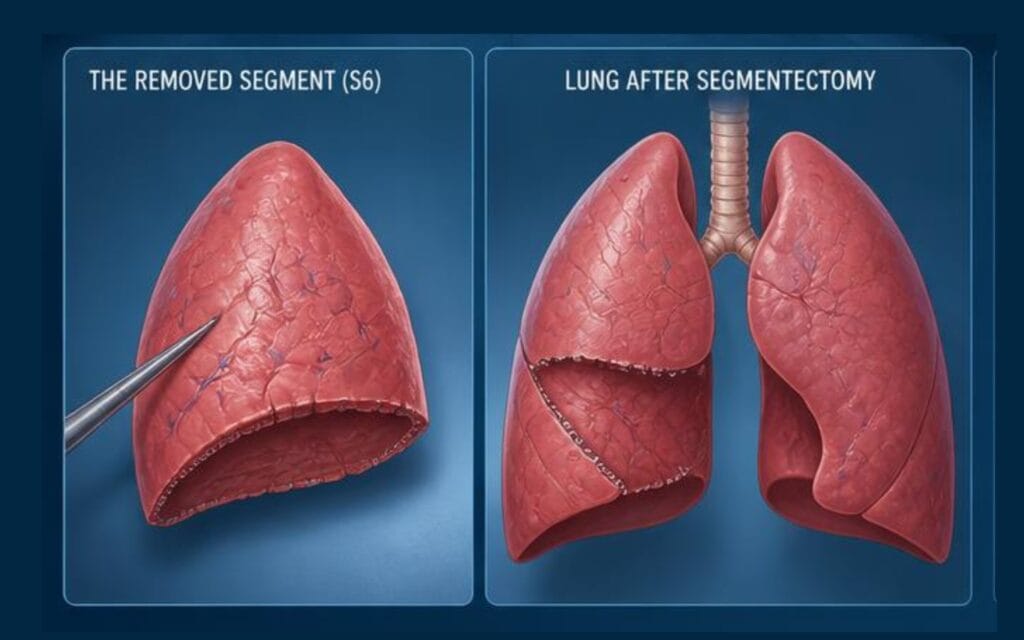
Segmentectomy is most commonly recommended for clinical stage IA non-small cell lung cancer with a tumour up to around 2 cm in diameter, particularly when the lesion sits in the outer (peripheral) part of the lung.
The cancer should appear confined to a single segment – for example, a small tumour in the posterior segment of the right upper lobe is a classic scenario for apical segmentectomy or posterior segmentectomy.
Segmentectomy is also suitable for lung nodules, small carcinoid tumours, suppurative lesions, and ground-glass opacities discovered on CT screening before they cause symptoms.
It is often the preferred option for patients with reduced lung function, previous lung resection, COPD or other thoracic conditions, where a full lobectomy would remove too much healthy lung.
It is not typically used for small cell lung cancer, where treatment usually centres on chemotherapy and radiotherapy rather than anatomical resection.
Who Is (and Is Not) a Good Candidate? Indications and Contraindications
Choosing the right patients for segmentectomy is critical. Not every early lung cancer is best treated this way, and the decision depends on tumour characteristics, lung health and overall fitness.
Suitable candidates include:
Segmentectomy is particularly suited to patients with a single small tumour of 2 cm or less confined to one segment, with no evidence of distant spread or confirmed lymph node involvement. It is also appropriate for those with adequate cardiopulmonary reserve for thoracic surgery but who would benefit from maximal lung preservation, as well as patients with significant cardiopulmonary disease, such as severe COPD, recurrent pneumothorax, or a previous myocardial infarction, for whom a lung-sparing approach is especially important.
Finally, it may be offered to patients who simply prefer to preserve as much lung function as possible, provided that outcomes remain comparable to more extensive resection.
Segmentectomy may not be appropriate when:
Lobectomy is generally preferred when the tumour is larger than approximately 2-3 cm, where it tends to provide better oncological control, or when the tumour is centrally located, close to major bronchi, or crosses segmental boundaries. It is also the more appropriate choice when there is confirmed extensive lymph node involvement, such as N1 or N2 disease. Conversely, neither segmentectomy nor lobectomy may be suitable when the patient has diffuse lung disease with no pulmonary reserve, extensive metastases, or is unable to tolerate general anaesthesia.
Want a specialist opinion on your condition?
Get a clear answer from a surgeon who will be with you throughout.
How Is a Lung Segmentectomy Performed?
The operation is performed under general anaesthetic with one-lung ventilation, allowing the surgeon to work on a deflated lung.
The surgeon identifies and divides the segmental artery, vein, and bronchus, then carefully dissects along the intersegmental plane to remove the segment. The area is checked for air leaks before chest drains are placed.
In a right upper lobe segmentectomy, one of the most commonly performed procedures, pre-operative CT scans and sometimes 3D reconstruction help the surgeon map the upper lobe pulmonary artery branches and segmental bronchus before they are divided.
Video-assisted thoracoscopic surgery (VATS) uses several small incisions between the ribs, while robotic-assisted thoracic surgery (RATS) enhances precision with 3D vision and fine instrument control. Both mean less pain and quicker recovery compared with open thoracotomy.
Most segmentectomies for early lung cancer are planned as minimally invasive keyhole procedures, including robotic-assisted lung cancer surgery, whenever safely possible. Thoracoscopic segmentectomy is now a well-established approach in high-volume centres.
"After two years of being told my symptoms were anxiety, Mr Scarci identified the problem immediately. The surgery was straightforward and I was discharged after three days. I only wish I had found him sooner."
Lymph Node Assessment During Segmentectomy
Accurate staging of lung cancer depends on thorough lymph node evaluation. It is crucial to evaluate nearby lymph nodes during a segmentectomy for accurate staging because undetected spread changes prognosis and treatment.
During the procedure, a lymphadenectomy is performed. This involves removing nearby lymph nodes from inside the lung (hilar nodes) and the centre of the chest. Full mediastinal lymph node dissection or systematic sampling ensures adequate lymph node staging.
Segmentectomy allows for proper identification and removal of lymph nodes, which is a key advantage over wedge resection. Research has repeatedly shown that adequate nodal assessment improves staging accuracy.
If cancer is found in a lymph node during surgery, the surgeon may extend the resection to a lobectomy or recommend adjuvant treatment such as chemotherapy after surgery. Thorough lymph node assessment is one reason segmentectomy is generally preferred to wedge resection for most patients with operable early lung cancer.
Benefits of Segmentectomy Compared With Lobectomy
For the right patient, segmentectomy offers several meaningful advantages:
Preservation of lung tissue
Segmentectomy preserves more lung function than lobectomy. Studies show FEV₁ decline at one year is roughly 8-9% after segmentectomy versus approximately 12% after lobectomy (JCOG0802 data). This matters most for patients who already have COPD or limited reserve.
Comparable survival
For small, peripheral stage IA tumours (around 2 cm or less), segmentectomy has comparable survival rates to lobectomy for small tumors. The JCOG0802 trial reported 10-year overall survival of approximately 83.5% for segmentectomy versus 79.8% for lobectomy, demonstrating improved survival with the lung-sparing approach.
Lower complication risk
Segmentectomy has a lower risk of post-operative complications, less pain, and shorter hospital stay, especially when combined with video-assisted thoracic surgery or robotic techniques.
Future surgical options
Keeping healthy lungs intact means that if a new cancer develops, further surgery remains possible. This is an increasingly important factor as screening detects more early-stage cancers.
Risks, Complications, and Recurrence
As with any surgery, segmentectomy carries risks that patients should understand.
General risks of thoracic surgery include bleeding, infection, pneumonia, blood clots and, rarely, the need to convert from keyhole to open surgery. Mortality is usually below 1% in healthy patients after segmentectomy.
The incidence of persistent air leaks is higher with segmentectomy than lobectomy because dissecting along intersegmental planes can leave raw lung surfaces. These are usually managed with chest drains and observation.
Segmentectomy has a slightly higher risk of local cancer recurrence compared to lobectomy, particularly for tumours over 2 cm or those with invasive pathological features. Analysis by Yang CF and colleagues confirms careful patient selection is essential. The JCOG0802 supplementary analysis found a locoregional relapse hazard ratio of approximately 2.2 compared to lobectomy.
Regular follow-up imaging, typically CT scans at defined intervals, is vital to detect any recurrence or new tumours early. Factors such as margin size and solid tumour dominance influence recurrence risk and should be discussed with your doctor.
Have a question about your diagnosis?
A consultation gives you a personalised plan — not a generic estimate.
Recovery After Segmentectomy: Hospital Stay and Rehabilitation

Most patients recover well after segmentectomy, especially when a minimally invasive approach is used.
Patients typically stay in the hospital for around 3-5 days after minimally invasive segmentectomy. A UK centre study found a median stay of 4 days for both segmentectomy and lobectomy performed via keyhole approaches, which aligns with the positive experiences described in some patient testimonials.
Early recovery includes pain control (often with regional nerve blocks to protect against excessive narcotic use), breathing exercises with a physiotherapist, chest drain management, and getting out of bed and walking on day 1 where possible.
Most patients return to normal activities within a few weeks: light daily activities by 2-3 weeks, work by 4-6 weeks depending on occupation, and more strenuous exercise once cleared by the surgeon.
Segmentectomy vs Other Lung Cancer Operations: How Decisions Are Made
Choosing between wedge resection, segmentectomy, and lobectomy is rarely straightforward. The decision is usually made collaboratively.
A multidisciplinary team (MDT) meeting involving thoracic surgeons, oncologists, radiologists, respiratory physicians, and the wider thoracic surgery team reviews each case.
The main factors considered include tumour size and position (central vs peripheral, upper lobe vs lower lobe), stage of the disease, lymph node involvement, and the patient’s overall health and lung function tests. If a patient is fit and has a larger or more central tumour, lobectomy remains the standard operation for best oncological control. For borderline cases, a lobectomy is favoured for tumours in the 2-3 cm range.
Patients are encouraged to discuss the pros and cons of each option with their thoracic surgeon, including personalised risk, expected outcomes and recovery times.
Why Choose Mr Marco Scarci for Segmentectomy in London?
Mr Marco Scarci is a consultant thoracic surgeon based in London with extensive experience in minimally invasive lung cancer surgery, including VATS and robotic segmentectomy. He has performed over 5,000 minimally invasive procedures and authored more than 170 peer-reviewed publications.
He offers both private and NHS pathways, with access to advanced imaging, rapid diagnostics and modern operating theatres. The practice’s security service ensures all patient data is handled with strict confidentiality and security.
Every patient receives personalised care: detailed pre-operative assessment, clear explanation of whether segmentectomy is appropriate, and tailored post-operative follow-up. Patients with suspected or confirmed lung cancer, including small nodules in the right upper lobe or other segments, can self-refer or be referred for a rapid opinion on surgical options, using the clinic’s contact and appointment service.
Frequently Asked Questions About Segmentectomy for Lung Cancer
Is segmentectomy always done with keyhole (VATS or robotic) surgery?
Many segmentectomies for early-stage lung cancer are now performed via VATS or robotic-assisted thoracic surgery, which involve several small incisions rather than one large cut. However, open thoracotomy may still be recommended if the tumour position is complex, there is significant scarring, or if it is safer to convert during the operation.
Will I need chemotherapy or radiotherapy after a segmentectomy?
Many patients with very early-stage lung cancer and clear lymph nodes do not need chemotherapy or radiotherapy after surgery. Adjuvant therapy may be recommended after segmentectomy for some patients, depending on the pathology report, including tumour size, margins and lymph node findings.
How much lung function will I lose after a segmentectomy?
Segmentectomy removes less lung tissue than lobectomy, so the reduction in lung function is usually modest for most patients. Pre-operative lung function tests and imaging allow the team to estimate how much capacity will remain.
Can a segmentectomy be repeated if another cancer appears later?
Preserving more lung tissue with a first segmentectomy may allow further surgery if a new nodule develops in a different area. Whether repeat surgery is possible depends on location, remaining lung function, and overall health at that time.
How quickly can I get assessed for a possible segmentectomy with Mr Marco Scarci?
Patients can usually be seen for an initial consultation within a short timeframe, especially via the private route or at locations such as the Elstree Outpatients Centre. Referrals can include CT scans, PET scans, and lung function tests, which help decide whether segmentectomy, another form of pulmonary resection, or non-surgical treatment is most suitable.
