

If you have been dealing with sharp, unexplained rib pain that keeps coming back despite normal scans and repeated trips to A&E, you are not alone. Slipping rib syndrome is an often-missed cause of persistent chest wall discomfort, and many patients spend months or even years seeking the correct diagnosis. Intercostal nerve blocks offer a targeted way to relieve pain and can also provide useful diagnostic information when slipping rib syndrome is suspected.
- Slipping rib syndrome causes severe rib pain when hypermobile lower ribs, typically the 8th, 9th or 10th, sublux or irritate the intercostal nerves running beneath them.
- An intercostal nerve block is a minimally invasive procedure in which local anaesthetic, sometimes combined with a small dose of corticosteroid, is injected around the affected intercostal nerve.
- A positive response can have both diagnostic and therapeutic value, supporting identification of the symptomatic rib while temporarily reducing pain.
- Nerve blocks can form part of a wider plan alongside physiotherapy, activity modification and surgery when appropriate.
- Persistent or worsening rib pain should be assessed to exclude heart, lung and other important causes of chest or upper abdominal pain before proceeding with treatment.
Understanding Slipping Rib Syndrome and Rib Pain
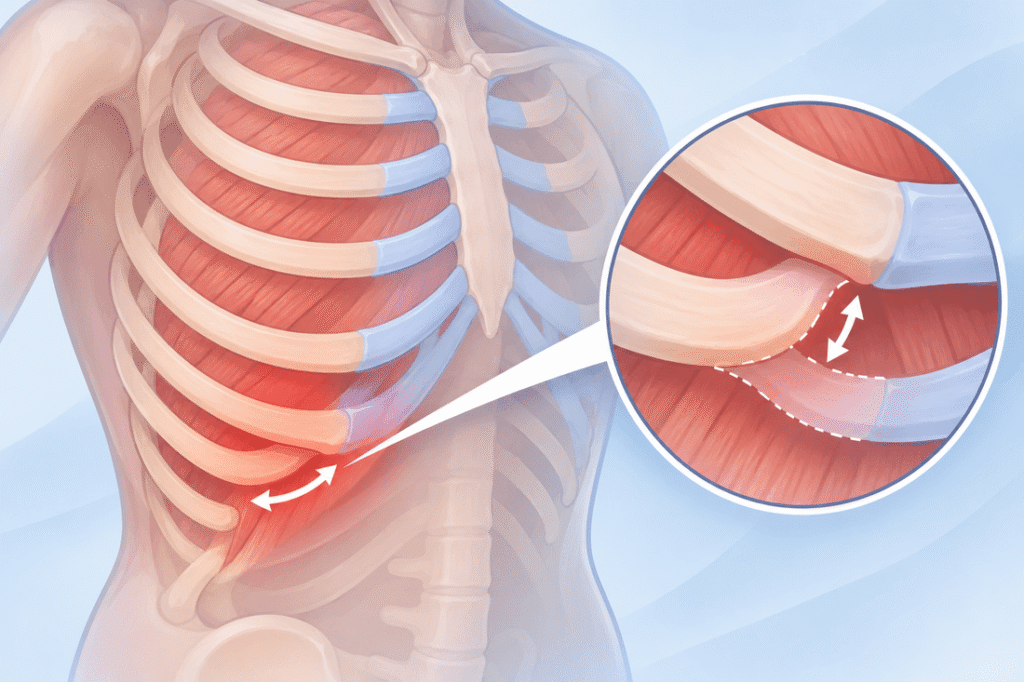
Slipping rib syndrome is a condition in which the 8th, 9th or 10th ribs, known as the false ribs, become hypermobile because of lax or damaged costal cartilage and supporting attachments. Unlike the upper ribs, which connect more directly to the sternum, these lower ribs form part of the costal margin. When the supporting attachments become unstable, the rib tip can move abnormally and produce sharp, sometimes debilitating pain.
Patients commonly describe sudden, stabbing pain below the breastbone or along the lower rib cage, sometimes accompanied by a clicking or popping sensation. The discomfort is often worsened by bending, twisting, coughing or lifting, and some patients describe a distinct feeling that a rib is “stuck” or “moving out of place”. Symptoms can be intense enough to resemble cardiac, gallbladder or other upper abdominal problems.
The pain develops when mobile rib cartilage compresses or repeatedly irritates the adjacent intercostal nerves. Because these nerves supply sensation across the chest wall and upper abdomen, pain can radiate around the rib cage, towards the back or into the upper abdomen. Slipping rib syndrome can therefore mimic cardiac disease, pleurisy, gastrointestinal problems and other causes of chest discomfort.
Common triggers and risk factors include minor trauma such as a sports impact, recurrent coughing following a chest infection, repetitive trunk rotation in sports such as rowing, tennis or golf, previous thoracic surgery and hypermobility conditions such as Ehlers-Danlos syndrome. In one study of 54 athletes, the mean time from symptom onset to diagnosis was 15.4 months, and the 10th rib was the most commonly symptomatic rib, affecting around 44% of patients.
Diagnosis usually starts with careful history-taking and targeted physical examination. The hooking manoeuvre involves palpating beneath the lower costal margin to reproduce characteristic movement and pain, although less forceful palpation techniques may also be used because the manoeuvre can be uncomfortable.
Dynamic ultrasound can help visualise rib movement in real time. One study found that the rib push manoeuvre during dynamic ultrasound had 87% sensitivity for detecting slipping rib syndrome.
As a renowned consultant thoracic surgeon in London, Mr Marco Scarci assesses patients with persistent rib and chest wall pain to determine whether symptoms are caused by rib instability, intercostal nerve irritation or another thoracic condition. Early specialist assessment can be particularly useful when symptoms have persisted despite normal or inconclusive investigations.
Patients with less clearly localised symptoms may also require assessment for other causes of persistent chest wall pain.
Have a question about your diagnosis?
A consultation gives you a personalised plan — not a generic estimate.
What Is an Intercostal Nerve Block and How Does It Help?
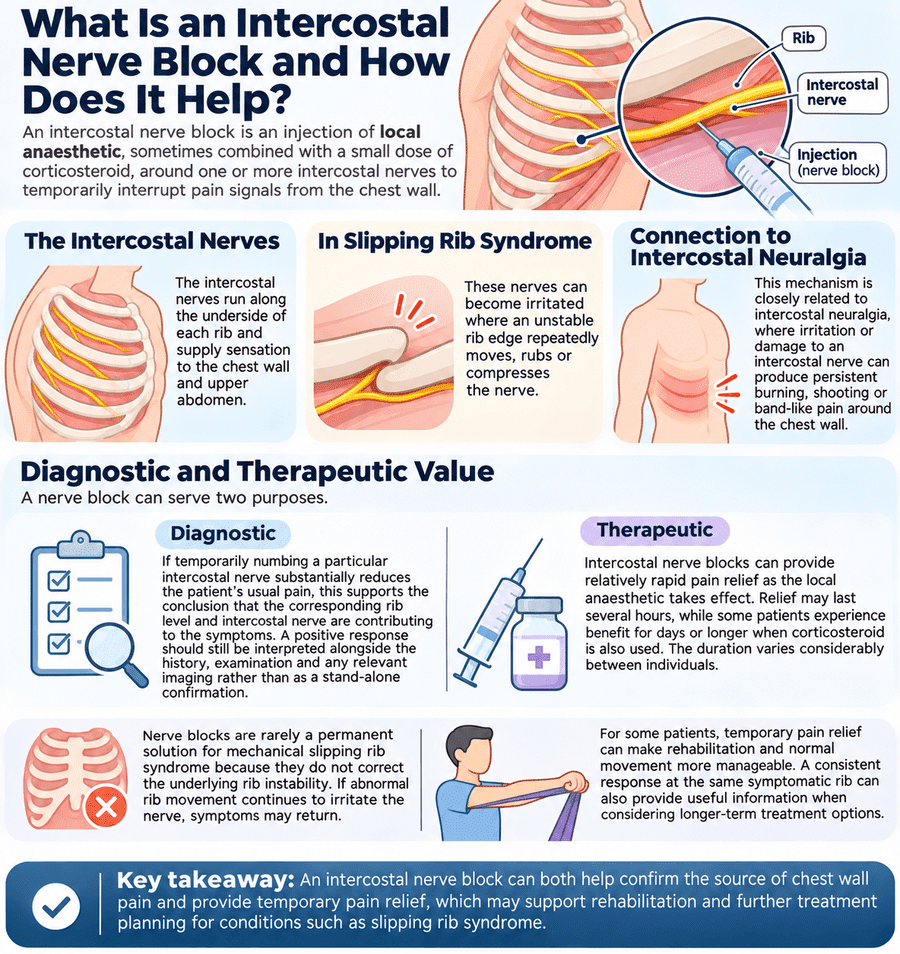
An intercostal nerve block is an injection of local anaesthetic, sometimes combined with a small dose of corticosteroid, around one or more intercostal nerves to temporarily interrupt pain signals from the chest wall. Corticosteroid may also be included in selected cases to reduce local inflammation and potentially extend the duration of relief.
The intercostal nerves run along the underside of each rib and supply sensation to the chest wall and upper abdomen. In slipping rib syndrome, these nerves can become irritated where an unstable rib edge repeatedly moves, rubs or compresses the nerve.
This mechanism is closely related to intercostal neuralgia, where irritation or damage to an intercostal nerve can produce persistent burning, shooting or band-like pain around the chest wall.
Diagnostic and Therapeutic Value
A nerve block can serve two purposes.
- Diagnostic: If temporarily numbing a particular intercostal nerve substantially reduces the patient’s usual pain, this supports the conclusion that the corresponding rib level and intercostal nerve are contributing to the symptoms. A positive response should still be interpreted alongside the history, examination and any relevant imaging rather than being treated as a stand-alone confirmation.
- Therapeutic: Intercostal nerve blocks can provide relatively rapid pain relief as the local anaesthetic takes effect. Relief may last several hours, while some patients experience benefit for days or longer when corticosteroid is also used. The duration varies considerably between individuals.
Nerve blocks are rarely a permanent solution for mechanical slipping rib syndrome because they do not correct the underlying rib instability. If abnormal rib movement continues to irritate the nerve, symptoms may return.
For some patients, temporary pain relief can make rehabilitation and normal movement more manageable. A consistent response at the same symptomatic rib can also provide useful information when further treatment is being considered.
"I had rib pain for 6 years, was bounced around NHS without diagnosis. I was recommended to Mr Scarci — at consultation within minutes he knew what the problem was. Was offered surgery date the next week. 2 weeks post surgery I am almost back to full health."
Intercostal Nerve Block Procedure: From Consultation to Recovery
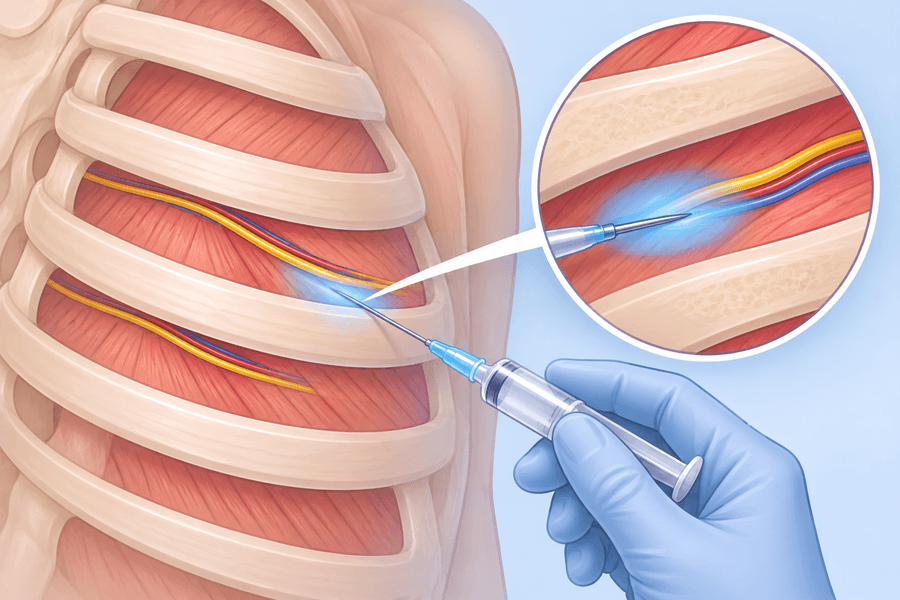
The procedure is minimally invasive and is performed using a fine needle. The exact technique, medication used and whether imaging guidance is required depend on the individual patient and the rib level being treated.
Pre-Procedure Assessment
Before an injection, the clinician reviews the patient’s symptoms, previous investigations and available imaging, such as chest X-rays, CT scans or ultrasound. The painful rib levels are mapped carefully, and current medicines are reviewed, paying particular attention to anticoagulants and antiplatelet medicines because of their effect on bleeding risk.
The purpose of the nerve block should also be clear. Depending on the individual case, the aim may be short-term pain relief, diagnostic clarification or creating a period of reduced pain in which physiotherapy and movement are easier.
Step-by-Step Process
The patient is positioned comfortably, often lying on their side or sitting in a position that allows access to the affected rib spaces.
The skin over the target area is cleaned with antiseptic solution, and a small amount of local anaesthetic may first be used to numb the skin. A fine needle is then advanced towards the target intercostal nerve.
Ultrasound guidance can be used to visualise the needle in relation to the rib and pleura. Once the position has been checked, local anaesthetic, with or without corticosteroid, is injected around the intercostal nerve.
Sedation is not routinely required for every intercostal nerve block. Most patients experience brief stinging or pressure during the injection, and the procedure can often be performed without sedation.
Immediate Post-Procedure Monitoring
Patients are usually observed briefly after the injection while the clinical team assesses pain relief and checks for any early side effects, such as temporary numbness, heaviness around the chest wall or dizziness.
Patients are generally advised to avoid strenuous activity and heavy lifting immediately afterwards. Anyone who has received sedation should not drive themselves home.
Side Effects and Rare Risks
Potential complications include localised soreness, bruising, bleeding, infection, allergic reactions and pneumothorax, because the intercostal nerve lies close to the pleura. These complications are uncommon, particularly when appropriate procedural precautions and imaging guidance are used, but the risks should be discussed before treatment.
New shortness of breath, worsening chest pain, fever or increasing redness or swelling around the injection site should prompt urgent medical advice.
Not sure about your treatment options?
Mr Scarci provides expert consultations typically within one week of contact.
Integrating Intercostal Nerve Blocks with Physiotherapy and Definitive Treatment
Intercostal nerve blocks work most effectively as part of a wider management plan that may include physiotherapy, activity modification and surgery in selected patients. For persistent mechanical slipping rib syndrome, a single intervention does not always provide a complete long-term solution.
Unlocking Rehabilitation
Nerve blocks may help patients participate more comfortably in physiotherapy by temporarily reducing pain that would otherwise restrict movement. Once severe rib pain is reduced, patients may find it easier to breathe deeply, reduce protective postures and gradually restore normal movement without repeatedly provoking intense symptoms.
The Role of Physiotherapy
A structured physiotherapy programme may include thoracic spine and shoulder mobility work, breathing exercises, controlled core strengthening and education about movements that provoke symptoms.
Rehabilitation should be individualised because exercises that repeatedly reproduce rib subluxation or severe pain may aggravate symptoms rather than help. The aim is to improve comfortable movement and function without placing unnecessary stress on an unstable costal margin.
Planned Series of Blocks
Some patients may benefit from repeat injections if an initial block produces worthwhile but temporary relief. Repeat nerve blocks are considered according to the duration of benefit, medicines used, underlying cause of the pain and whether another treatment may provide a more appropriate long-term option.
They are not automatically scheduled indefinitely. The clinical response should be reviewed before deciding whether further injections are appropriate.
When to Consider Surgery
Surgical treatment may be considered when pain remains significant despite appropriate conservative management and the clinical assessment demonstrates persistent mechanical rib instability.
Factors that may support surgical consideration include well-localised pain, reproducible rib movement, persistent limitation of work, sport or normal activities, and a consistent response to targeted treatment.
Evidence for nerve blocks specifically in slipping rib syndrome is largely based on clinical series and treatment algorithms rather than large randomised trials. A positive block can therefore contribute useful information, but the decision to proceed with surgery should be based on the complete clinical picture.
Minimally Invasive Surgical Options
When surgery is appropriate, treatment can involve excision of unstable costal cartilage or procedures designed to stabilise the affected costal margin. The goal is to remove or stabilise the mechanical source of intercostal nerve irritation.
Published data have reported recurrent symptoms in 17.1% after cartilage resection without plating in one surgical series. This has contributed to the development of stabilisation techniques for selected patients, although the most appropriate operation depends on the individual’s anatomy and pattern of instability.
Patients with associated trauma or suspected fracture may also need assessment of rib fracture healing before treatment decisions are made.
An Individualised Plan
Every patient’s situation is different. Mr Scarci considers the pattern of symptoms, examination findings, previous investigations and treatments already tried before discussing further options.
For some patients, a nerve block and rehabilitation may provide sufficient symptom control. Others with persistent structural instability may require further assessment for surgery. The aim is to choose treatment according to the underlying cause of the pain rather than relying on a nerve block alone.
"I was diagnosed in March with a rare condition. My local hospital said it was inoperable due to the size of the mass. Mr Scarci reassured me the thymoma was resectable. I was booked for surgery the following week where he successfully removed the entire tumour."
Frequently Asked Questions
How do I know if my rib pain is suitable for an intercostal nerve block?
A nerve block suits one-sided rib pain that can be reproduced by pressing a rib or by twisting or deep breathing, once heart attack, pulmonary embolism and pneumonia are ruled out. Widespread or two-sided pain, or red-flag symptoms like weight loss, breathlessness at rest or fever, need investigation first.
How long will the pain relief from an intercostal nerve block last?
Immediate relief from the local anaesthetic may last several hours, while the addition of corticosteroid may extend the benefit for some patients. Relief can last for days, weeks or occasionally longer, although responses vary considerably. The response to the first injection can provide useful information when deciding whether repeat blocks, physiotherapy or further specialist assessment may be appropriate.
Can intercostal nerve blocks be repeated safely?
Repeat blocks may be considered for chronic rib pain when the first injection has provided worthwhile relief. The appropriate interval and number of injections depend on the medication used, the patient’s response, other medical conditions and the overall treatment plan. If corticosteroid is being used repeatedly, the potential cumulative effects should also be considered by the treating clinician.
Will an intercostal nerve block cure my slipping rib syndrome?
Nerve blocks primarily treat pain by temporarily reducing signalling from the irritated intercostal nerve. They do not correct underlying hypermobile rib cartilage, so in mechanical slipping rib syndrome they are best viewed as a diagnostic and symptom-control option rather than a cure. Long-term management may involve rehabilitation and, in selected patients, surgery to address persistent structural instability.
Do I need a GP or specialist referral to see Mr Marco Scarci for rib pain?
Many patients are referred by their GP, respiratory physician or sports doctor, but private consultation arrangements can vary. Bringing previous imaging reports, a list of current medicines and a brief summary of symptoms and treatments already tried can help make the first assessment more useful.
