

Tietze syndrome is an uncommon cause of musculoskeletal chest pain. It causes localised pain and swelling where the ribs join the breastbone, and can be mistaken for heart or lung disease.
Although the condition is benign, chest pain should always be assessed carefully, particularly if it is new, severe or accompanied by symptoms such as breathlessness, dizziness or sweating. Understanding the typical features of Tietze syndrome can help distinguish it from other causes and support appropriate treatment.
Tietze syndrome is a rare, benign inflammatory condition causing localised chest pain and swelling at a costochondral joint, usually in people aged 20 to 50.
Unlike costochondritis, it usually causes visible or palpable swelling at one site on the front of the chest.
Heart disease, pulmonary embolism, infection and chest wall tumours must be excluded, particularly if symptoms are persistent or unusual.
Most cases improve within weeks or months with rest, pain relief and physiotherapy.
What Is Tietze Syndrome?
Tietze syndrome is a rare, benign inflammatory condition causing painful swelling at one or more costochondral or costosternal joints. It was described by German surgeon Alexander Tietze in 1921.
It usually affects one upper rib, most often the second or third, on one side of the chest. Around 70% of cases are unilateral. It affects men and women equally and is most common between ages 20 and 50, although adolescents can also be affected.
Tietze syndrome is often confused with costochondritis, which causes inflammation and pain where the ribs meet the breastbone but does not usually cause swelling. Pain from Tietze syndrome is often reproduced by pressing the affected area. A firm, tender lump near the breastbone may suggest the condition.
It’s highly recommended that you consult a thoracic specialist, such as Mr Marco Scarci, to determine which condition you have.
Typical Symptoms and How They Differ from Other Chest Pain
New chest pain should always be taken seriously, but Tietze syndrome has a recognisable pattern.
Nature of the pain
Pain may be sharp, aching or pressure-like. It can worsen with deep breathing, coughing, sneezing or movement, and may spread to the shoulder or arm on the affected side. Symptoms may begin gradually or suddenly.
Swelling and tenderness
The main feature is firm, localised swelling over the affected cartilage. It is tender to touch and may remain after pain improves. The skin usually looks normal. Redness or warmth may suggest infection instead.
Costochondritis comparison
Costochondritis often affects several ribs, may occur on both sides of the chest and does not cause visible swelling. Tietze syndrome more often affects one swollen joint in a younger person.
Other causes of non-cardiac chest pain
Anxiety, reflux and muscle strain can cause atypical chest pain, but do not usually cause focal swelling on the chest wall. Tietze syndrome is typically localised and one-sided.
Feature | Tietze syndrome | Costochondritis | Other non-cardiac chest pain |
Pain location | Usually localised to one upper rib joint, most often the second or third | Often affects several rib joints, commonly ribs two to five | Varies depending on the cause |
Swelling | Firm, visible or palpable swelling is common | No visible swelling | Usually absent, although injury or infection may cause swelling |
Tenderness | Marked tenderness over the affected cartilage | Tenderness across one or more costochondral joints | Depends on the cause |
Pain pattern | Sharp, aching or pressure-like pain that may worsen with movement, deep breathing, coughing or sneezing | Similar pain, often worsened by movement or pressure | Reflux may cause burning, while muscle strain usually follows activity or injury |
Distribution | Usually affects one side of the chest | May affect both sides of the chest | May be localised, widespread or felt behind the breastbone |
Skin changes | Skin is usually normal, without redness or warmth | Skin is usually normal | Redness or warmth may indicate infection or inflammation |
Common triggers | Repetitive strain, heavy lifting, vigorous exercise or persistent coughing | Strain, poor posture, repetitive movement or chest infection | Anxiety, reflux, muscle strain or respiratory illness |
Key distinction | Localised swelling at a painful chest wall joint | Chest wall pain without swelling | Usually no focal swelling at the front of the chest |
Any new, severe, or unexplained chest pain needs prompt medical assessment, particularly if it occurs with breathlessness, sweating, fainting, or pain spreading to the arm, jaw, or back.
"I was diagnosed in March with a rare condition. My local hospital said it was inoperable due to the size of the mass. Mr Scarci reassured me the thymoma was resectable. I was booked for surgery the following week where he successfully removed the entire tumour."
Causes, Risk Factors and When to Worry
The exact cause is unknown. Possible triggers include repeated strain from heavy lifting, contact sports or vigorous upper-body exercise. Persistent coughing, often after a respiratory infection, may also trigger symptoms. Infection may contribute to local inflammation in some cases.
Tietze syndrome is more common in younger adults, although it can occur at any age. There is no clear difference between sexes. Repeated stress on the chest wall appears to be the main risk factor.
When to worry
Seek medical advice for unexplained weight loss, night sweats, fever, breathlessness or pain unrelated to movement or touch. These symptoms may indicate another cause, such as heart disease, pulmonary embolism, infection, a chest wall tumour, lymphoma or lung cancer.
Urgent assessment is needed for new or severe chest pain. Seek emergency care immediately for crushing chest pain, sudden breathlessness, fainting or symptoms that may suggest a heart attack.
How Tietze Syndrome Is Diagnosed: The Role of Differential Diagnosis
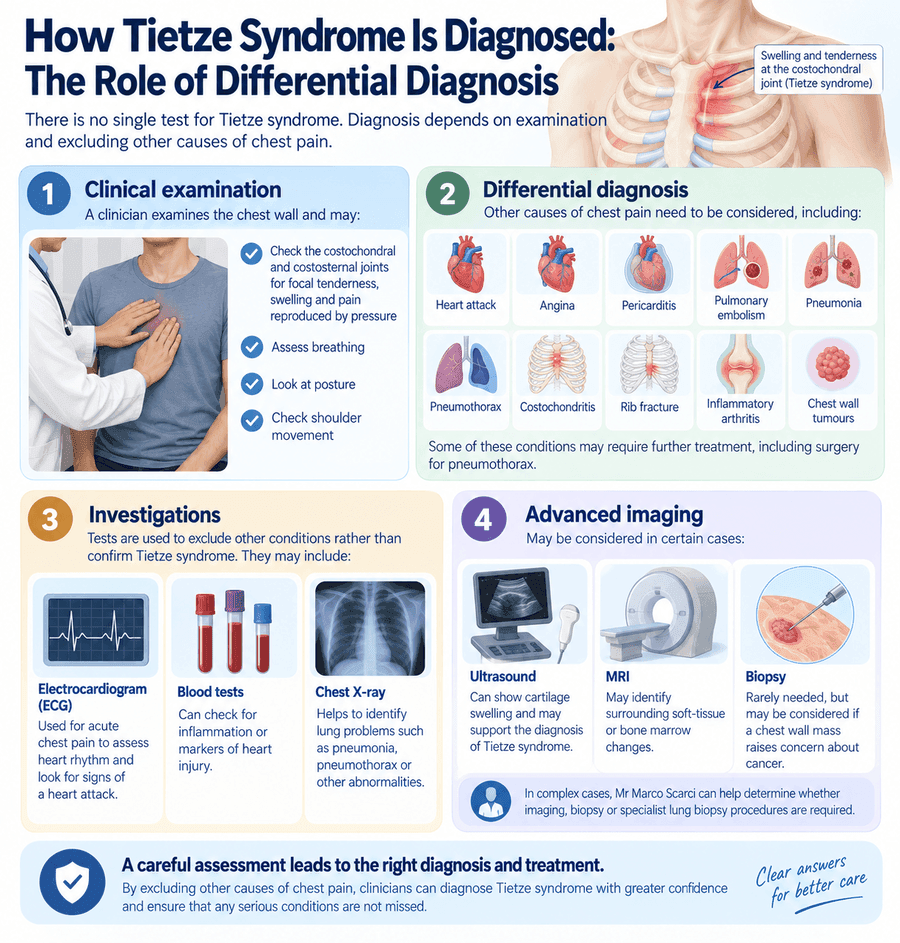
There is no single test for Tietze syndrome. Diagnosis depends on examination and excluding other causes of chest pain.
Clinical examination
A clinician examines the costochondral and costosternal joints for focal tenderness, swelling and pain reproduced by pressure. They may also assess breathing, posture and shoulder movement.
Differential diagnosis
Other causes include heart attack, angina, pericarditis, pulmonary embolism, pneumonia, pneumothorax, costochondritis, rib fracture, inflammatory arthritis and chest wall tumours. Some may require further treatment, including surgery for pneumothorax .
Investigations
Tests are used to exclude other conditions rather than confirm Tietze syndrome. They may include an electrocardiogram for acute chest pain, blood tests for inflammation or heart injury and a chest X-ray.
Advanced imaging
Ultrasound can show cartilage swelling and may support the diagnosis. MRI may identify surrounding soft-tissue or bone marrow changes. Biopsy is rarely needed but may be considered if a chest wall mass raises concern about cancer. In complex cases, Mr Marco Scarci can help determine whether imaging, biopsy or specialist lung biopsy procedures are required.
"I had rib pain for 6 years, was bounced around NHS without diagnosis. I was recommended to Mr Scarci — at consultation within minutes he knew what the problem was. Was offered surgery date the next week. 2 weeks post surgery I am almost back to full health."
Treatment Options and When to See a Thoracic Surgeon
Most cases improve within weeks to months and do not cause life-threatening complications.
First-line treatment
Rest from activities that worsen pain is important. Oral or topical NSAIDs may help if safe for you, while paracetamol is an alternative. Heat or ice packs can provide short-term relief.
Supportive therapies
Physiotherapy may help improve posture, chest wall mobility and shoulder movement. Gentle stretching and breathing exercises can support recovery.
Second-line interventions
Persistent symptoms may be treated with a local corticosteroid and anaesthetic injection, often guided by ultrasound. Nerve blocks may be considered in selected cases. A small body of evidence, including intercostal nerve radiofrequency ablation, suggests that specialist pain procedures may help refractory pain.
Surgery
Surgery is rarely required. Limited cartilage resection may be considered only in exceptional cases after conservative treatment has failed. A recent case report described a pain-free outcome in a young adult following extensive chest wall surgery for long-standing refractory disease. Complex procedures should be performed in specialist centres, including those treating chest wall deformities.
For persistent, unexplained or complex chest wall pain, Mr Marco Scarci’s London practice can arrange assessment, imaging and an individualised plan. Patients seeking prompt review can book a private thoracic consultation in London.
Want a specialist opinion on your condition?
Get a clear answer from a surgeon who will be with you throughout.
FAQ
How long does Tietze syndrome usually last?
Pain often improves within a few weeks with rest and pain relief, although swelling can last for several months. Mild symptoms may occasionally recur for up to a year. Seek review if symptoms do not improve or change.
Can I exercise if I have Tietze syndrome?
Gentle, low-impact exercise such as walking is usually suitable. Avoid activities that clearly worsen pain, including heavy lifting, intense upper-body exercise and contact sports, until symptoms settle.
Is Tietze syndrome dangerous or linked to heart disease?
Tietze syndrome does not damage the heart and is not life-threatening. However, new or severe chest pain must be assessed promptly because it can also indicate a heart attack, pulmonary embolism, lung cancer requiring specialist surgery or another serious condition. Once confirmed, the outlook is excellent.
Can Tietze syndrome come back after it has healed?
It can recur, although not everyone experiences further episodes. Flare-ups may follow strenuous activity, coughing illnesses, trauma or poor posture. Gentle stretching and avoiding known triggers may reduce the risk.
Should I see a thoracic surgeon or a rheumatologist first?
Start with your GP, who can assess your symptoms and refer you to the appropriate specialist. A rheumatologist may be helpful if inflammatory arthritis or systemic inflammation is suspected. A thoracic surgeon may be appropriate if there is concern about the chest wall, ribs, or lungs, or if imaging or intervention is needed.
