

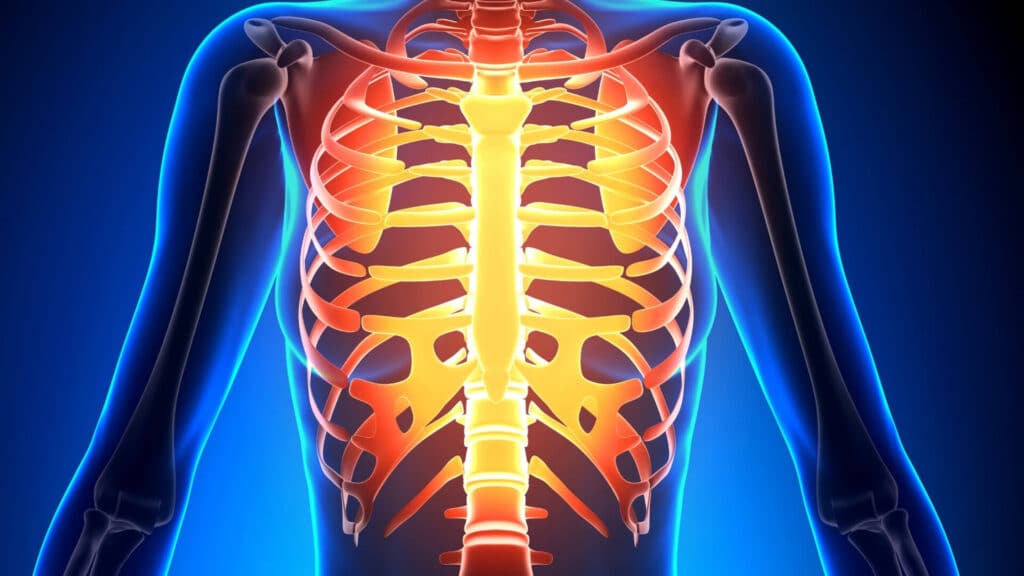
Chest or rib pain can make it hard to tell whether you have costochondritis or a rib fracture. This distinction matters because the two conditions carry different risks, are diagnosed differently and follow different treatment and recovery courses.
If you are unsure which condition you have, a thoracic specialist can provide a targeted examination and definitive diagnosis.
Costochondritis is inflammation of the rib cartilage; a rib fracture is a break in the bone itself.
A rib fracture almost always follows an identifiable trauma such as a fall or blow, whereas costochondritis usually develops gradually with no clear injury.
Pain from costochondritis is reproducible by pressing on the cartilage near the sternum; fracture pain is localised over the bone and may be accompanied by bruising or a grinding sensation.
Imaging is used mainly to rule out other causes with costochondritis, which is diagnosed clinically, whereas a rib fracture typically needs an X-ray, CT or ultrasound to confirm.
Rib fractures usually take about six weeks to heal and carry a higher risk of complications such as pneumonia or lung collapse, while costochondritis usually resolves within a few weeks with rest and anti-inflammatories.
Seek urgent care for breathing difficulties, coughing up blood, dizziness or crushing chest pain.
What Is Costochondritis?
Causes
Costochondritis is inflammation of rib cartilage, specifically the costochondral joints where the ribs connect to the costal cartilage attaching to the sternum. This cartilage gives the rib cage flexibility during breathing, and when these joints become inflamed, the result is sharp, aching chest pain that can mimic cardiac conditions. It commonly follows physical strain, viral infections, repetitive upper body movement, heavy lifting, strenuous exercise, prolonged coughing from a chest infection or minor chest trauma, though in many cases no clear cause is identified.
Symptoms
The pain is typically sharp or aching, worsens with deep breaths or movement, and is located at the front of the chest near the sternum. It is reproducible on palpation of the affected costochondral joints, and discomfort may radiate toward the thoracic spine or abdomen but rarely into the arms.
Risk Factors
Costochondritis is most often seen in adults around ages 40 to 50 and more frequently in women. Risk rises with activities involving repetitive strain to the chest muscles, a history of respiratory infections, connective tissue disorders and possibly vitamin D deficiency.
Not sure about your treatment options?
Mr Scarci provides expert consultations typically within one week of contact.
What Is a Rib Fracture?
Causes
A rib fracture is a break or crack in one or more of the bony ribs. It commonly results from direct impact or excessive strain, falls, car collisions, contact sports injuries or assault, and severe coughing episodes can also cause it, especially in elderly patients or those with osteoporosis.
Types
Fractures range from hairline cracks in a single rib to displaced breaks across multiple ribs, and include simple non-displaced fractures, displaced fractures and stress fractures. Flail chest occurs when several adjacent ribs break in two or more places, causing a segment of the chest wall to lose structural integrity. First rib fractures, involving the upper ribs, are typically markers of high-energy trauma and are often accompanied by other serious rib injuries.
Complications
Morbidity and mortality increase substantially with the number of ribs fractured. Each additional fractured rib is associated with roughly 19% higher mortality and 27% higher pneumonia risk, alongside general risks of pneumonia and lung collapse. UK data from 2019 recorded rib and sternal fracture incidence of approximately 46 per 100,000 in males and 30 per 100,000 in females. Blunt chest trauma, including rib fractures, accounts for roughly 15% of all trauma presentations in UK hospitals.
"Dr. Marco Scarci is a deeply knowledgeable, open-minded, and empathetic surgeon. He listens to details and solves problems to truly deliver the most optimal results. As a medical professional myself, I can tell you that finding a specialist like Dr. Scarci is very rare, and it is a privilege to have him in my corner."
Costochondritis vs Rib Fracture: How They Compare at a Glance
Factor | Costochondritis | Rib Fracture |
Best for describing | Gradual-onset chest pain with no trauma history | Sudden severe pain following an injury or fall |
Underlying cause | Inflammation of the cartilage at costochondral joints | Break or crack in the bony rib |
Pain type | Sharp or aching pain, reproducible on palpation | Deep, severe pain with possible crepitus or bruising |
Onset | Gradual or linked to overuse/infection | Usually sudden, following identifiable trauma |
Duration | Typically resolves in a few weeks to 1–2 months | Usually heals in about six weeks; complications may extend this |
Diagnosis | Clinical examination; imaging to exclude other causes | X-ray, CT or ultrasound to confirm |
Treatment | Rest, NSAIDs, activity modification | Pain management, breathing exercises, possible surgery |
Severity | Low, rarely causes complications | Moderate to high, risk of pneumonia or lung collapse |
Both are common causes of chest wall pain, but the key difference is that costochondritis involves inflamed cartilage diagnosed clinically, while a rib fracture involves broken bone confirmed by imaging. |
Have a question about your diagnosis?
A consultation gives you a personalised plan — not a generic estimate.
Chest Pain Characteristics and Location
The key distinction is where the tenderness sits, cartilage for costochondritis versus bone for a fracture, and whether swelling, bruising or deformity is present. Pain from costochondritis is easier to identify clinically, since it’s reproducible by palpating the costosternal joints without imaging, whereas fracture pain, though severe, requires imaging to confirm.
Diagnostic Methods and Imaging
Costochondritis is diagnosed mainly through clinical examination, including palpation of the costochondral joints and manoeuvres like the “crowing rooster” test. Imaging is used only to rule out other causes, such as heart attack or infection, since no test can definitively confirm costochondritis, though MRI can help in persistent cases.
Rib fractures often need imaging for confirmation. X-rays detect around 50% of isolated non-displaced fractures, while CT is the gold standard for multiple injuries or suspected pneumothorax, and ultrasound is a useful bedside alternative.
Imaging gives rib fractures a more definitive diagnosis, while costochondritis remains a clinical judgement that, though usually reliable, carries a small risk of missing another condition.
Pain Relief, Treatment Approaches and Recovery
Costochondritis is managed with rest, NSAIDs, activity modification, cold packs and gentle stretching or strengthening exercises. Corticosteroid injections are occasionally used for refractory cases, though evidence is limited. Most cases resolve within 1 to 2 months, recurrence is low, and surgery is rarely needed.
Rib fracture treatment centres on pain control, including stronger analgesia, deep breathing exercises and chest physiotherapy, with rib taping generally avoided as it restricts breathing. Severe cases such as displaced fractures or flail chest may need surgical stabilisation with plating. Healing usually takes about six weeks, longer in elderly patients or those with multiple fractures.
The stakes are higher with rib fractures, since patients must actively guard against life-threatening complications, while costochondritis is managed more simply with rest and NSAIDs and carries little risk of serious complications.
Which Do You Have?
Costochondritis may be more likely if:
Your chest pain developed gradually, without a clear injury.
Pressing on the cartilage near your breastbone reproduces the pain.
You have recently overused your upper body or had a chest infection.
There is no bruising, swelling, or visible deformity.
The condition often improves within a few weeks with rest and anti-inflammatory medication. A physical examination by a specialist experienced in chest wall pain can usually confirm the diagnosis.
Rib fracture may be more likely if:
Your pain began suddenly after chest trauma, such as a fall, direct blow, or car accident.
Severe pain is concentrated over the bony part of a rib rather than the cartilage.
You notice bruising, swelling, or a grinding sensation when moving or breathing.
A broken rib may require imaging to confirm the injury and check for complications, such as a collapsed lung or damage to organs near the lower or floating ribs. Seek prompt assessment, especially if you are over 65 or have a pre-existing lung condition.
Seek emergency care immediately if you:
Have difficulty breathing.
Cough up blood.
Feel dizzy, faint, or unusually weak.
Have crushing chest pain or pain that feels similar to a heart attack.
These symptoms can indicate a serious complication that needs urgent assessment.
If you are uncertain which condition explains your rib pain, you can book a consultation with Mr Marco Scarci, a London-based thoracic specialist, who can perform a targeted physical exam, order appropriate imaging and provide a definitive diagnosis. Accurate identification matters, since chronic pain and preventable complications can result from misdiagnosis in either direction. Both conditions, when properly identified and managed, have good long-term outcomes, but recovery depends on an accurate diagnosis from the start.
Want a specialist opinion on your condition?
Get a clear answer from a surgeon who will be with you throughout.
Frequently Asked Questions
Can costochondritis and a rib fracture occur at the same time?
Yes, though uncommon. A direct chest injury can fracture a rib while also irritating the adjacent cartilage, so imaging confirms the fracture while examination reveals cartilage tenderness too. Specialist-led bruised rib and chest wall injury treatment can help when symptoms are severe or persistent.
How long should I wait before seeking medical evaluation for chest pain?
Any new or unexplained chest pain warrants prompt assessment to rule out cardiac causes. Mild, gradual pain with no trauma can reasonably wait a few days with rest and anti-inflammatories, but severe pain, pain after trauma or breathlessness needs immediate evaluation, especially if you suspect broken rib symptoms and treatment needs.
When is thoracic surgery consultation necessary?
Most cases never need surgery. A thoracic surgery consultation becomes important for displaced fractures, flail chest, non-union or complications such as persistent fluid or respiratory compromise, including long-term effects of broken ribs; for costochondritis, referral is only relevant if slipping rib syndrome is suspected.
What happens if these conditions are misdiagnosed or left untreated?
An untreated rib fracture carries the greater risk, since shallow breathing can lead to pneumonia or respiratory failure; understanding the treatment and recovery pathway for fractured ribs helps reduce this. Untreated costochondritis is less dangerous but can cause chronic pain and anxiety, so accurate physical examination and history matter in both cases.
When can I return to normal activities?
Costochondritis patients can usually resume activity gradually within a few weeks, using pain as a guide. Rib fracture patients should follow the healing timeline, typically at least six weeks, avoiding contact sports until imaging confirms adequate healing.
