

A lung cancer diagnosis raises urgent questions about what the stage means, which tests are needed and which treatment options may be suitable. Understanding the stage can help clarify how far the cancer has spread and what this means for treatment decisions.
This guide explains cancer staging, why results can change after surgery and how stage informs a personalised treatment plan. It also explores how factors such as tumour characteristics and overall health influence the next steps in care.
Lung cancer staging describes the main tumour, lymph nodes and whether cancer has spread. It guides treatment options and prognosis.
Early lung cancer, usually stages 0 and I, may be treated with curative surgery or radiotherapy. Advanced lung cancer, including stage IV or extensive stage disease, is treated to control cancer and maintain quality of life.
Clinical stage is assigned before treatment. Pathological stage, also called surgical stage or pathologic stage, is confirmed after surgery and may differ from the original assessment.
Non-small cell lung cancer usually uses the TNM staging system, while small cell lung cancer is commonly described as limited stage or extensive stage.
What Are Lung Cancer Stages?
Lung cancer stages show how far the cancer has grown or spread. Lung cancer describes a disease that begins in the lung, while cancer staging answers three questions:
How large is the main tumour?
Has cancer spread to nearby lymph nodes?
Has it reached distant organs or distant parts of the body?
These principles are used by the National Institute for Health and Care Excellence, the American Cancer Society, and international specialist groups.
Non-small cell lung cancer accounts for most cases and is grouped from stage 0 to stage IV. Small cell lung cancer is less common, usually faster growing, and often classified as limited or extensive stage.
Stage is not the same as cancer type or grade. Cancer type identifies the cells involved, while grade describes how abnormal cells look under a microscope. This article focuses on staging lung cancer and what each stage of lung cancer means in practice.
Have a question about your diagnosis?
A consultation gives you a personalised plan — not a generic estimate.
How Is Lung Cancer Stage Determined Before Treatment? (Clinical Stage)
Clinical stage is the first estimate of how far cancer has spread. It is based on tests completed before surgery or other major treatment.
Lung cancer diagnosis and clinical staging may include:
Medical history, examination and lung function tests
CT of the chest and upper abdomen
FDG PET CT
Brain MRI, where appropriate
Biopsy by bronchoscopy, CT-guided needle biopsy or EBUS to sample nearby lymph nodes
Biopsy confirms the type of cancer, while molecular and biomarker tests may identify targeted treatment choices. Clinical stage is the best estimate available, but scans cannot always detect small deposits of cancer cells.
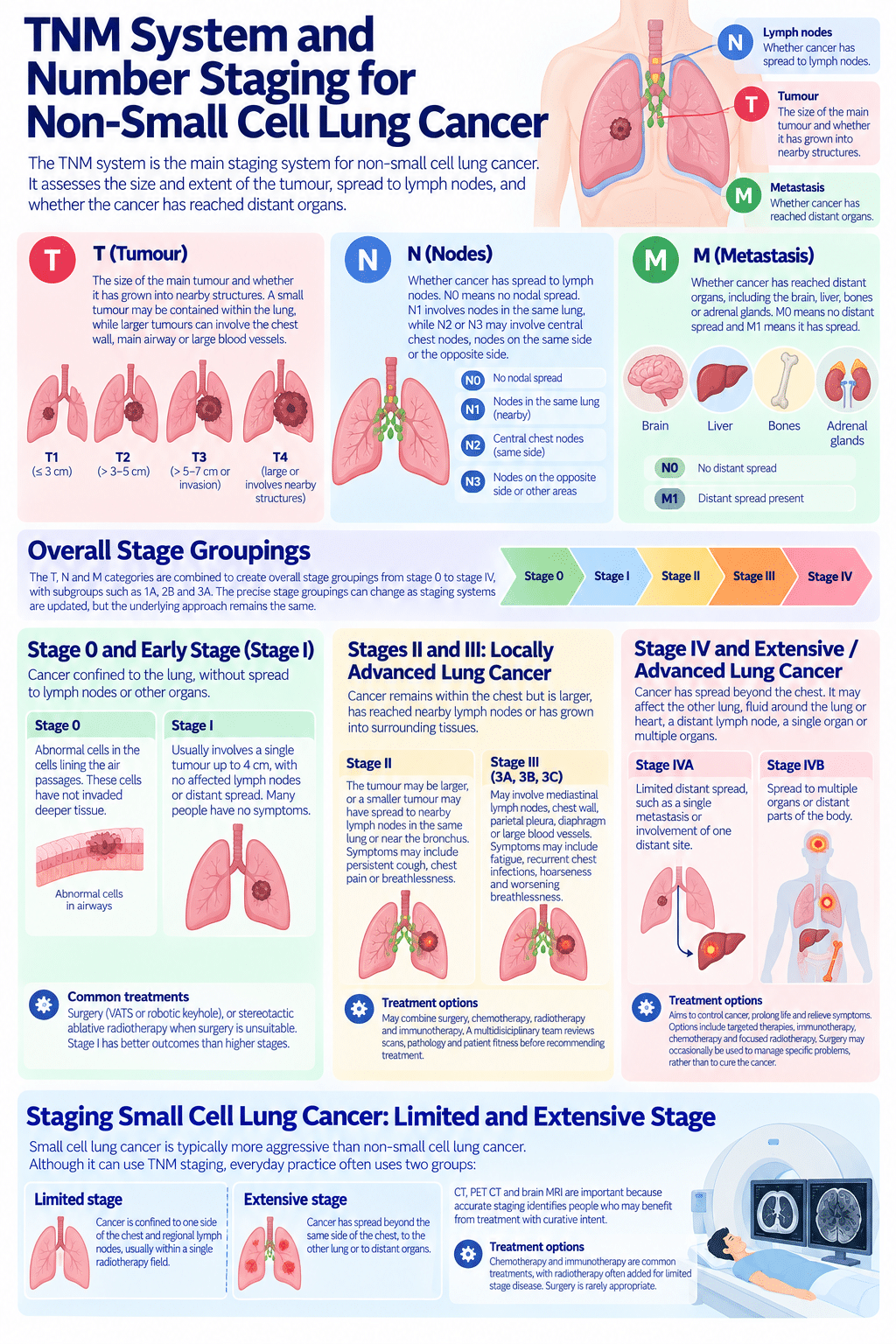
TNM System and Number Staging for Non‑Small Cell Lung Cancer
The TNM system is the main staging system for non-small cell lung cancer. The TNM staging system assesses:
T (Tumour): The size of the main tumour and whether it has grown into nearby structures. A small tumour may be contained within the lung, while larger tumours can involve the chest wall, main airway or large blood vessels.
N (Nodes): Whether cancer has spread to lymph nodes. N0 means no nodal spread. N1 involves nodes in the same lung, while N2 or N3 may involve central chest nodes, nodes on the same side or the opposite side.
M (Metastasis): Whether cancer has reached distant organs, including the brain, liver, bones or adrenal glands. M0 means no distant spread and M1 means it has spread.
These categories create overall stage groupings from stage 0 to stage IV, with subgroups such as 1A, 2B and 3A. The precise stage groupings can change as staging systems are updated, but the underlying approach remains the same.
Want a specialist opinion on your condition?
Get a clear answer from a surgeon who will be with you throughout.
Stage 0 and Early Stage (Stage I) Lung Cancer
Early lung cancer is confined to the lung, without spread to lymph nodes or other organs. It may cause no symptoms and is sometimes detected through lung cancer screening or scans performed for another reason.
Stage 0 describes abnormal cells in the cells lining the air passages. These cells have not invaded deeper tissue.
Stage I lung cancer usually involves a single tumour up to 4 cm, with no affected lymph nodes, or distant spread. Persistent cough or breathlessness can occur, but many people have no symptoms.
Treatment commonly involves surgery, such as VATS or robotic keyhole removal of a lobe or segment. Stereotactic ablative radiotherapy may be used when surgery is unsuitable. Stage I has better outcomes than higher stages, although survival statistics vary by tumour biology, general health and treatment.
Keyhole lung cancer surgery can reduce incision size and support a quicker recovery for suitable patients.
Stages II and III: Locally Advanced Lung Cancer
These stages are locally advanced, meaning the cancer remains within the chest but is larger, has reached nearby lymph nodes or has grown into surrounding tissues.
In Stage II lung cancer, the tumour may be larger, or a smaller tumour may have spread to nearby lymph nodes in the same lung or near the bronchus. There is no distant spread. Symptoms may include persistent cough, chest pain or breathlessness.
Stage III (3A, 3B, 3C): The cancer may involve mediastinal lymph nodes, the chest wall, parietal pleura, diaphragm or large blood vessels. It has usually spread to lymph nodes but has not reached distant organs. Symptoms may include fatigue, recurrent chest infections, hoarseness and worsening breathlessness.
Treatment choices for stage II and III disease may combine surgery, chemotherapy, radiotherapy and immunotherapy. Many factors determine the best treatment, including whether the tumour is resectable, fitness for treatment and molecular test results.
A multidisciplinary team reviews scans, pathology and patient fitness before recommending treatment. In the middle of the pathway, Mr Marco Scarci may review imaging and invasive staging tests when surgery is being considered.
Not sure about your treatment options?
Mr Scarci provides expert consultations typically within one week of contact.
Stage IV and Extensive / Advanced Lung Cancer
Stage IV non-small cell lung cancer means cancer has spread beyond the chest. It may affect the other lung, fluid around the lung or heart, a distant lymph node, a single organ or multiple organs.
Stage IVA: Limited distant spread, such as a single metastasis or involvement of one distant site.
Stage IVB: Spread to multiple organs or distant parts of the body.
Advanced stages may cause weight loss, fatigue, pain from bone involvement, headaches or weakness if the brain is affected. Symptoms vary, so lung cancer symptoms should always be assessed individually.
Stage IV treatment aims to control cancer, prolong life and relieve symptoms. Options include targeted therapies, immunotherapy, chemotherapy and focused radiotherapy. Surgery may occasionally be used to manage specific problems, rather than to cure the cancer.
Staging Small Cell Lung Cancer: Limited and Extensive Stage
Small cell lung cancer is typically more aggressive than non-small cell lung cancer. Although it can use TNM staging, everyday practice often uses two groups:
Limited stage: Cancer is confined to one side of the chest and regional lymph nodes, usually within a single radiotherapy field.
Extensive stage: Cancer has spread beyond the same side of the chest, to the other lung or to distant organs.
CT, PET CT and brain MRI are important because accurate staging identifies people who may benefit from treatment with curative intent. Chemotherapy and immunotherapy are common treatments, with radiotherapy often added for limited stage disease. Surgery is rarely appropriate.
Clinical vs Pathological Stage: Why Your Post‑Surgery Stage Might Change
People having surgery may receive both a clinical stage and a pathological stage.
Clinical stage is based on scans, biopsies, bronchoscopy, EBUS and examination before treatment.
Pathological stage is based on detailed examination of the removed tumour and lymph nodes. It may also be called surgical stage or pathologic stage.
The stage can change after surgery because pathology can identify details that imaging cannot show:
Hidden lymph node deposits: Tiny cancer cells may be present in lymph nodes that looked normal on scans.
Tumour size or invasion: The main tumour may be slightly larger than first measured, or may involve nearby structures.
Additional nodules: Small nodules may be found in the same lobe.
A meta-analysis of 698 NSCLC patients found agreement between clinical and pathological TNM stages in fewer than 55% of cases. This does not mean that staging was wrong. It reflects the more detailed information available after tissue is examined.
For example, presumed early stages may be upgraded if hidden lymph node disease is found. Conversely, suspicious nodes can prove benign. A changed stage may affect whether adjuvant chemotherapy or immunotherapy is recommended.
"Dr. Marco Scarci is a deeply knowledgeable, open-minded, and empathetic surgeon. He listens to details and solves problems to truly deliver the most optimal results. As a medical professional myself, I can tell you that finding a specialist like Dr. Scarci is very rare, and it is a privilege to have him in my corner."
How Stage Influences Treatment Options and Surgery Decisions
The stage of lung cancer, cancer type, lung function and overall fitness shape the treatment plan. In broad terms:
Very early lung cancer: Surgery or precise radiotherapy with curative intent.
Stage II and III: Combined treatment, sometimes including surgery.
Stage IV / extensive stage: Systemic treatment and supportive care to control cancer and relieve symptoms.
A cancer can be resectable, meaning it can technically be removed, without being operable, meaning surgery may not be safe for the individual. Lung function, heart health, and other factors are important. The decision depends on both the tumour and the patient’s overall fitness for surgery.
Minimally invasive lung surgery, which includes VATS and robotic surgery, may be suitable for early stages and selected locally advanced cases. It can mean smaller incisions, a shorter hospital stay and quicker recovery.
How Long Does Lung Cancer Staging Take and Can It Be Wrong?
In the UK, staging may take several days to two weeks, depending on scan availability, biopsy results and molecular testing. A thorough assessment is more important than speed alone.
Clinical assessments can differ while results are still pending. Once imaging, pathology and specialist review are complete, the final recommendation should be clearer. Restaging after treatment is also normal, as it helps measure response.
If the diagnosis or treatment plan remains unclear, a second opinion can help confirm the stage and available options.
Discussing Your Treatment Options with Mr Marco Scarci

If you have been diagnosed with lung cancer, are awaiting staging results or are unsure whether surgery is appropriate, a consultation with Mr Marco Scarci, a consultant thoracic surgeon in London, can help clarify your options. He can review your scans, biopsy findings, lung function and multidisciplinary team recommendations to explain whether surgery, systemic treatment, radiotherapy or further tests may be suitable.
A specialist review can be particularly useful where staging results are uncertain, surgery has been recommended or declined, or you would like a second opinion before making a treatment decision.
Living With Your Lung Cancer Stage: Prognosis, Emotions and Support
A lung cancer diagnosis can feel overwhelming, particularly when discussions include advanced lung cancer, survival statistics or metastatic disease. Anxiety and uncertainty are understandable.
Stage matters, but it is not the whole picture. Prognosis can also be influenced by tumour biology, molecular markers, the immune system, smoking status, response to treatment and overall health. This is why generic survival statistics cannot predict an individual outcome.
Support may include lung cancer nurse specialists, counselling, support groups, pulmonary rehabilitation and smoking cessation services. Patients should ask their consultant what their own stage means and what support is available.
Frequently Asked Questions About Lung Cancer Stages
Can my lung cancer stage improve after treatment?
The original stage remains in the medical record, even when treatment shrinks or clears the cancer. After treatment, doctors describe response as complete, partial, stable or progressive disease rather than assigning a new stage number.
Is cancer grade the same as lung cancer stage?
No. Stage describes the size and spread of cancer, while grade describes how abnormal the cancer cells look. The same distinction applies in other cancers, including breast cancer. Both can influence treatment.
Why do some people talk about four stages and others about five stages of lung cancer?
Some clinicians refer to four stages, I to IV. Others include stage 0, which makes five stages in total. The difference is numbering only. Focus on what your overall stage means for your treatment options.
Does everyone with early-stage lung cancer need surgery?
No. Surgery is often preferred for fit people with early-stage non-small cell lung cancer, but it is not suitable for everyone. Those with poor lung function or serious health conditions may be offered non-surgical options like stereotactic radiotherapy or other local treatments.
Should I get a second opinion about my lung cancer stage or treatment plan?
Yes, if you would find reassurance helpful, particularly where staging reports conflict or major surgery is proposed. Seeking a second opinion is common and entirely acceptable. It can be particularly helpful when you have a borderline resectable tumour, conflicting staging reports, or when major surgery has been recommended or declined.
